About Butorides virescens (Linnaeus, 1758)
Taxonomy and Common Name
This species, Butorides virescens (Linnaeus, 1758), commonly called the green heron, is a relatively small heron.
Size Measurements
Adult body length is approximately 44 cm (17 in), with formal measurements recording a total length of 41–46 cm (16.1–18.1 in), a weight of around 240 g (8.5 oz), and a wingspan of 64–68 cm (25.2–26.8 in).
Neck Posture
The neck is often held pulled tightly against the body.
Adult Plumage and Body Features
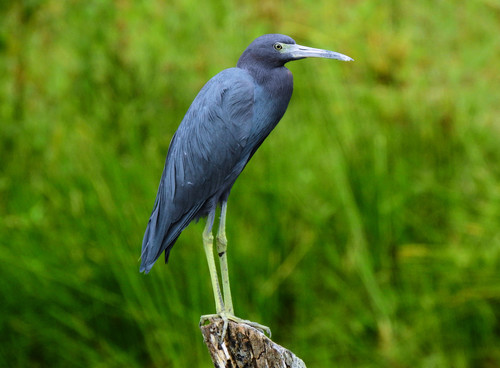
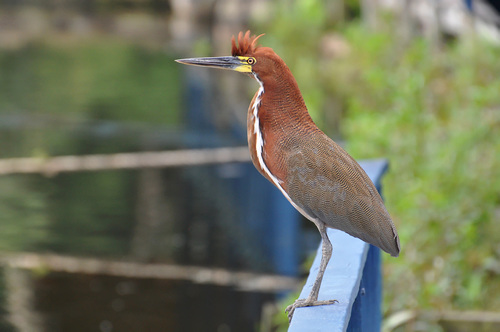
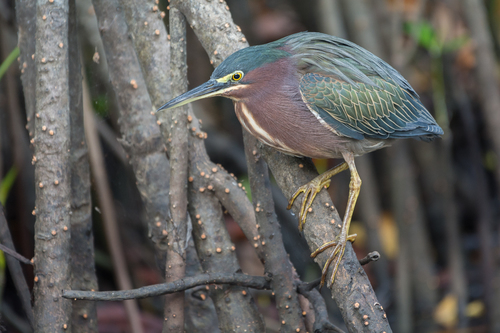
Adult green herons have a glossy greenish-black cap, and greenish back and wings that fade from grey-black into green or blue. They have a chestnut neck with a white stripe running down the front, grey underparts, and short yellow legs.
Bill Characteristics
Their bill is dark with a long, sharp point.
Sexual Dimorphism
Adult females are usually smaller than males, and have duller, lighter plumage, especially during the breeding season.
Juvenile Appearance
Juvenile green herons are duller overall, with brown and white streaks on the sides of the head, neck, and underparts, tan splotches on the back and wing coverts, and greenish-yellow legs and bill.
Hatchling Appearance
Hatchlings are covered in down feathers, which are light grey on the upper body and white on the belly.
Typical Calls
The green heron's typical call is a loud, sudden kyow, and it also produces a series of more subdued kuk calls.
Courtship Flight Calls
During courtship, the male utters a raah-rahh call with its bill held wide open, makes noisy wingbeats and whoom-whoom-whoom calls in flight, and sometimes calls roo-roo to the female before landing.
Perched Courtship Calls
When perched, the male also gives an aaroo-aaroo courtship call.
Habitat and Foraging Range
Green herons live and forage across riparian zones, wetlands, ponds, lakes, and human-made canals and ditches.
Foraging Activity Patterns
They have no strong preference for diurnal or nocturnal foraging, and regularly forage during both day and night. Shore-dwelling individuals adjust their activity to match tidal rhythms.
General Diet Composition
Their diet mainly consists of small fish, frogs, and aquatic arthropods, but they will catch and consume any accessible invertebrate or vertebrate prey, including leeches, earthworms, dragonflies, damselflies, waterbugs, grasshoppers, spiders, crayfish, prawns, mice, other rodents, lizards, tadpoles, and snakes.
Common Fish Prey
Common fish prey include minnows, sunfish, catfish, perch, eels, and goldfish in urban areas.
Foraging Social Behavior
When feeding, green herons are intolerant of other birds, including other green herons, and are never observed foraging in groups.
Typical Foraging Behavior
They typically stand motionless on shore, in shallow water, or on perches on branches to wait for prey, and can hover briefly to catch prey when needed.
Bait-Fishing Behavior
Green herons have been observed using lures to attract fish in a behavior called bait-fishing, dropping captured prey such as mayflies or other objects including bread and feathers onto the water's surface to draw in fish. This bait-fishing behavior is common among herons.
Tool Use
Green herons are one of the few bird species known to use tools, regularly using bread crusts, insects, or other items as bait for this purpose.
Spring Migration Timing
Northern green heron populations migrate to their breeding ranges in March and April; near the northernmost edge of the species' range, breeding is well underway by the end of May.
Fall Migration Timing
Migration to wintering grounds begins in September, and by late October, green herons are no longer present in regions where they do not reside year-round.
Migration and Climate Change
At minimum, the northward spring migration does not appear to be affected by global warming, as green herons arrive in their breeding ranges at the same time they did 100 years ago.
Non-Migratory Post-Breeding Movement
Individuals from non-migratory populations leave their territories after the breeding season to roam the local region. They may or may not return to the previous year's breeding location, depending on whether they found higher quality habitat during their travels.
Non-Migratory Breeding Timing
In these non-migratory populations, the timing of the breeding season is determined by rainfall and resulting prey availability.
Mating System
Green herons are seasonally monogamous. Pairs form within the breeding range, after an elaborate courtship display performed by the male.
Male Courtship Display
Males select nesting sites, then fly in front of females noisily with puffed-up head and neck plumage.
Nesting Habitat
They nest in patches of forest and swamp, over water or in vegetation near water.
Nest Structure and Placement
Nests are stick platforms, most often built in shrubs or trees, and occasionally placed on the ground. They prefer nesting locations in trees; some nests are constructed as high as 20 m (66 ft) above ground, though heights of a few meters are more common.
Colonial Nesting
Rarely, large numbers of green herons gather in heronries to nest.
Clutch Characteristics
Clutches usually contain 2 to 6 pale green eggs, which are laid at two-day intervals, though the second egg may be laid up to six days after the first.
Incubation and Chick Rearing
After the final egg is laid, both parents incubate the clutch for approximately 19 to 21 days until hatching, then feed the young chicks. Feeding frequency decreases as the chicks get closer to fledging.
Fledging Timeline
Young green herons may begin leaving the nest at 16 days old, but do not fully fledge and become able to survive independently until they are 30 to 35 days old.
Tropical Breeding Frequency
In the tropical parts of the green heron's range, green herons sometimes breed twice per year.