About Phoenicopterus ruber Linnaeus, 1758
Taxonomy and Common Identification
The American flamingo (scientific name Phoenicopterus ruber Linnaeus, 1758) is a large wading bird with reddish-pink plumage.
Breeding and Egg Laying
Like all flamingos, it lays a single chalky-white egg on a mud mound between May and August.
Incubation lasts 28 to 32 days until hatching, and both parents brood their young.
Sexual Maturity and Reproduction
American flamingos may reach sexual maturity between 3 and 6 years of age, though they usually do not reproduce until they reach 6 years old.
Lifespan
With a life expectancy of 40 years, this species has one of the longest lifespans among birds.
Size Comparison to Other Flamingos
On average, adult American flamingos are smaller than greater flamingos, but they are the largest flamingo species native to the Americas.
Height
They measure 120 to 145 cm (47 to 57 in) tall.
Weight
Males have an average weight of 2.8 kg (6.2 lb), while females average 2.2 kg (4.9 lb).
Plumage Coloration
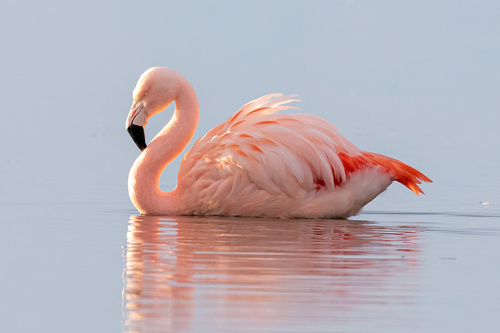
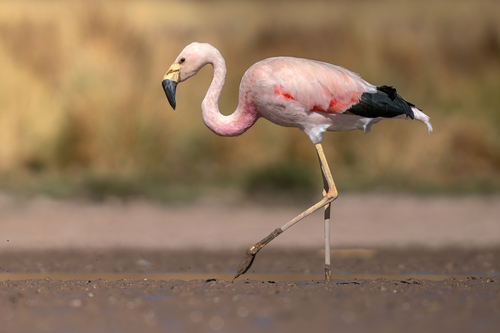
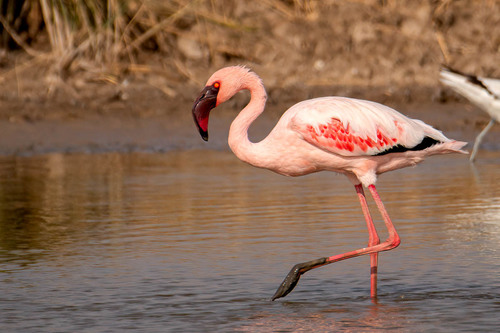
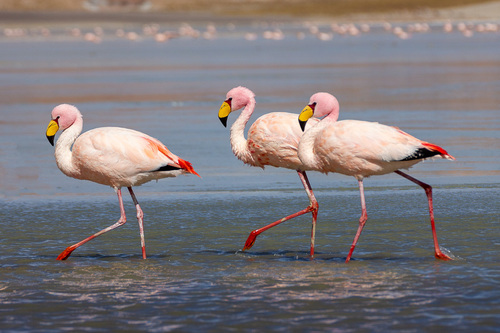
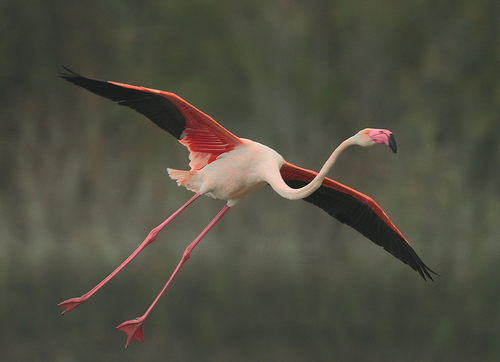
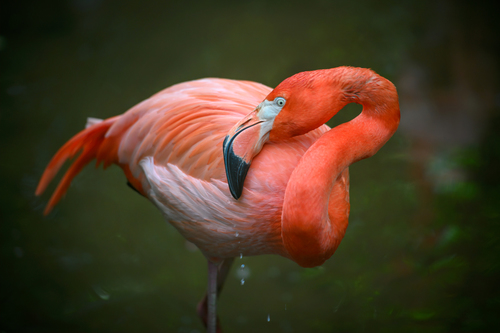
Most of this species' plumage is pink, which led to its earlier common name of rosy flamingo and distinguishes adult American flamingos from the much paler greater flamingo.
Wing Coloration
The wing coverts are red, and the primary and secondary flight feathers are black.
Bill and Leg Coloration
The bill is pink and white with an extensive black tip, and the legs are entirely pink.
Vocalization
The call of the American flamingo is a goose-like honking.
Conservation Agreement
This species is one of the species covered by the Agreement on the Conservation of African-Eurasian Migratory Waterbirds.
Breeding Range
American flamingos breed in South America (the Galápagos Islands of Ecuador, coastal Colombia and Venezuela, and northern Brazil), the West Indies (Trinidad and Tobago, Cuba, Jamaica, Hispaniola (the Dominican Republic and Haiti), The Bahamas, the Virgin Islands, and the Turks and Caicos Islands), and tropical and subtropical areas of continental North America (along the northern coast of the Yucatán Peninsula in Mexico, and formerly southern Florida in the United States).
Vagrant Occurrences
It occurs as a vagrant in Puerto Rico, Anguilla, Barbados, Honduras, and (after its extirpation) Florida, though some Florida populations are now considered to be year-round residents.
Galápagos Population Distinctiveness
The Galápagos Islands population of American flamingo is genetically distinct from the Caribbean population; Galápagos flamingos are significantly smaller, show sexual dimorphism in body shape, and lay smaller eggs.
Galápagos Subspecies Classification
They are sometimes classified as a separate subspecies, Phoenicopterus ruber glyphorhynchus.
Hurricane Dispersal
Marine biologists note that while flamingos are native to the tropical southern United States, hurricanes can drive flocks of flamingos north, leading to rare sightings in Kentucky, New York, Ohio, Pennsylvania and Virginia.
Displaced Bird Behavior
Most of these displaced birds return to their original ranges, but occasionally an individual separates from a flock, with records of single flamingos remaining alone in these northern areas for years.
Preferred Habitat Types
American flamingos prefer the same types of habitats as their relatives: saline lagoons, mudflats, and shallow, brackish coastal or inland lakes.
Habitat Example
The Petenes mangroves ecoregion of the Yucatán is one example of this species' habitat.