About Phoenicopterus roseus Pallas, 1811
The greater flamingo (Phoenicopterus roseus Pallas, 1811) is the largest living species of flamingo.
Size
On average, it stands 110–150 cm (43–59 in) tall and weighs 2–4 kg (4.4–8.8 lb; the largest recorded male greater flamingos reach up to 187 cm (74 in) in height and 4.5 kg (9.9 lb) in weight.
Adult Plumage
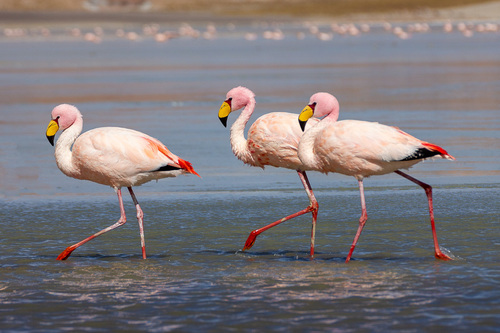
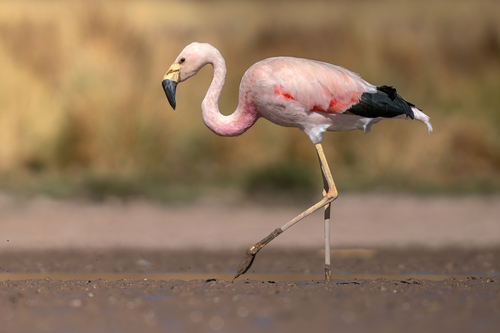
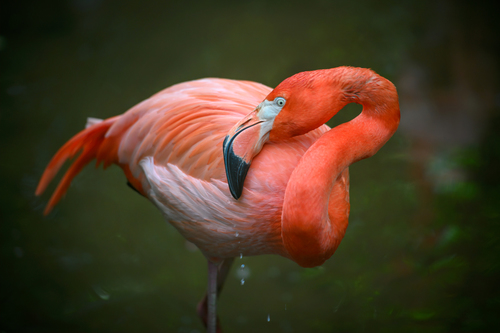
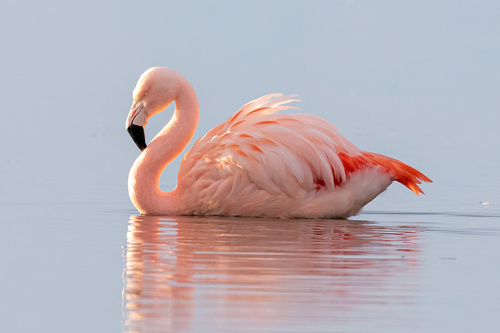
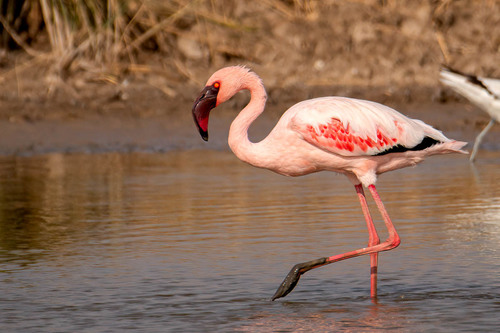
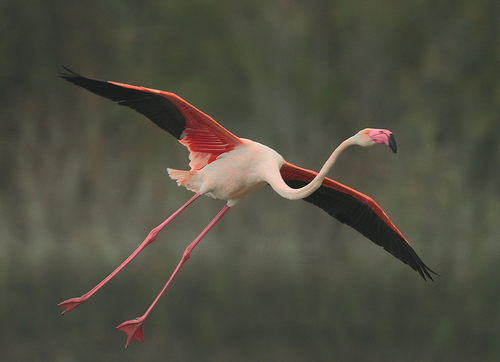
Most of its plumage is pinkish-white, with red wing coverts and black primary and secondary flight feathers. Its bill is pink with a limited black tip, and its legs are entirely pink. Its call is a goose-like honking.
Immature Plumage
Newly hatched chicks are covered in fluffy gray down, and subadult greater flamingos have paler plumage and dark legs. Adult greater flamingos that are feeding chicks also become paler, but keep their bright pink legs.
Color Origin
The species' pink color comes from carotenoid pigments found in the organisms that live in their feeding grounds. Secretions from the uropygial gland also contain carotenoids.
Feather Cosmetic Use
During the breeding season, greater flamingos spread these uropygial secretions over their feathers more often, which makes their color brighter. This cosmetic use of the secretions has been described as applying "make-up".
Global Distribution
This species is distributed across parts of Northern Africa, including coastal northern Algeria, inland areas along the Nile River in Egypt, Libya, Morocco, and Tunisia; portions of Sub-Saharan Africa, including Kenya, Madagascar, Rwanda, Tanzania, and Uganda; Southern Asia, including coastal Bangladesh, India, Pakistan, and Sri Lanka; Western Asia, including Bahrain, Cyprus, Iraq, Iran, Oman, Israel, Palestine, Kuwait, Lebanon, Qatar, and the United Arab Emirates; and Southern Europe, including Albania, Bulgaria, Croatia, France's Camargue and Corsica, Greece, Italy, Slovenia, Malta, Monaco, Montenegro, North Macedonia, Portugal, Spain and the Balearic Islands, and Turkey.
Northern Breeding Site
The northernmost known breeding site is Zwillbrocker Venn in western Germany, near the border with the Netherlands.
West Asian Breeding Sites
Greater flamingos have been recorded breeding at three different sites in Abu Dhabi Emirate, United Arab Emirates.
Indian Wintering Sites
In Gujarat, a coastal state in western India, greater flamingos can be seen at Nal Sarovar Bird Sanctuary, Khijadiya Bird Sanctuary, Flamingo City, and Thol Bird Sanctuary, where they stay for the entire winter season.
Egg Laying
Like all flamingo species, the greater flamingo lays a single chalky-white egg on a mud mound.
Predators
Adult greater flamingos have very few natural predators. Eggs and chicks may be preyed on by raptors, crows, gulls, and marabou storks (Leptoptilos crumenifer); roughly half of all predation on greater flamingo eggs and chicks is caused by yellow-legged gulls (Larus michahellis).
Pair Bonding
Unlike many other species of long-lived birds, greater flamingos do not form permanent pair bonds that last across consecutive breeding seasons. When choosing prospective breeding partners, both sexes appear to prefer older, more experienced individuals, so pairs usually consist of birds of similar age.
Courtship Displays
The species is well known for performing courtship displays in large mixed-sex groups. The complexity of an individual's courtship display may signal the individual's age and fitness: display complexity increases until an individual reaches around 20 years of age, after which it starts to decline.
Parental Care
While both sexes take part in parental care, observations of captive greater flamingos show that males are more involved than females in tasks such as incubation and nest protection. It has been hypothesized that females spend more time away from the nest to feed and recover from egg laying.
Egg Development
Greater flamingos only lay one egg per breeding attempt, but if the egg is lost, an additional egg can be laid. Eggs hatch after 26 to 32 days of incubation.
Maturation Timeline
Most individuals do not gain full adult plumage until they are 4 years old, though this can happen as early as 30 months of age in rare cases. While greater flamingos reach sexual maturity at 3 years old, most females do not breed until they are 5 to 6 years old.