About Phoenicoparrus andinus (Philippi, 1854)
Scientific Name and Distinguishing Bill Traits
The Andean flamingo, scientific name Phoenicoparrus andinus (Philippi, 1854), can be distinguished from other flamingos by its deeper lower mandible and very long filtering filaments on the maxilla.
Size and Mass Rank
It is the largest flamingo found in the Andes, and is one of the two heaviest living flamingo species alongside the taller greater flamingo.
Body Measurement Ranges
Reported body measurements for the Andean flamingo range from 1.5 to 4.9 kg (3.3 to 10.8 lb) in body mass, 1 to 1.4 m (3 ft 3 in to 4 ft 7 in) in height, and 1.4 to 1.6 m (4 ft 7 in to 5 ft 3 in) in wingspan.
Plumage Coloration
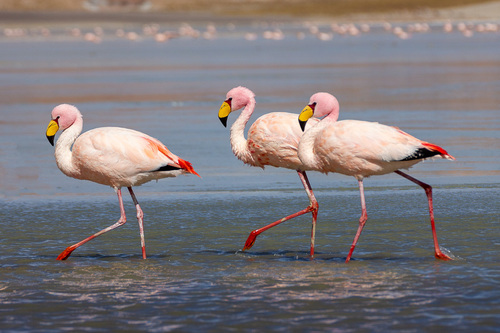
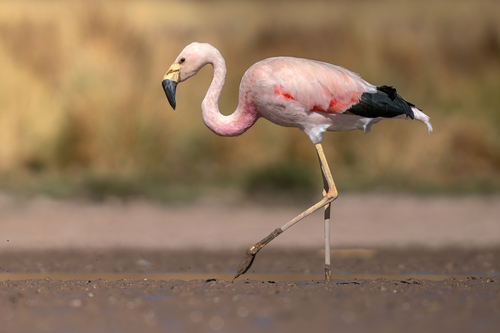
This flamingo has a pale pink body with brighter upperparts, and deep vinaceous-pink coloring on its lower neck, breast, and wing coverts.
Leg and Foot Characteristics
It is the only flamingo species that has yellow legs and three-toed feet.
Bill Morphology
Its bill is pale yellow near the skull, black along most of its length, and curves downward.
Lower Mandible Comparison
Its lower mandible is less prominent than those of flamingos in the genus Phoenicopterus.
Native Distribution Range
This species is native to high Andes mountain range wetlands, ranging from southern Peru to northwestern Argentina and northern Chile.
Migratory Capacity
Andean flamingos are migratory, and can travel up to 700 miles in a single day.
Seasonal Habitat Shifts
In summer, they inhabit salt lakes, and migrate to lower elevation wetlands for the winter.
Potential Migration Driver
This seasonal migration is thought to possibly be caused by the extreme aridity of salt flats during winter.
Hypothesized Migration Path
The full migration path is unknown, but it is believed to run between Chilean breeding grounds and the wetlands of central and western Argentina.
Breeding Range Concentration
Breeding activity is concentrated in northern Chile, extreme southwestern Bolivia, and northwestern Argentina.
Nonbreeding Movement Patterns
During the nonbreeding season, some individuals stay around the same wetlands where they bred, while others move to lower elevation wetlands and lakes.
Documented Movement Routes
These movements include traveling east to the central plains of Argentina, and north through the Andes to southern Peru.
Vagrant Records
Vagrants have been recorded as far north as Conococha in central Peru, along the coast of Peru and northern Chile, in Amazonian Brazil, in southern Argentina, and in coastal southern Brazil.