About Phelsuma ornata Gray, 1825
Scientific Name and Common Name
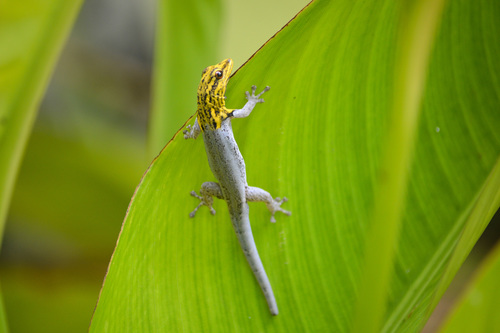
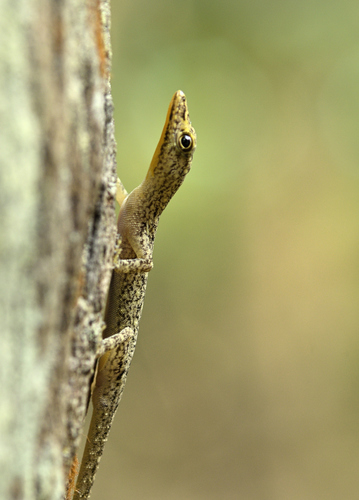
Phelsuma ornata Gray, 1825, commonly called the Mauritius ornate day gecko, typically reaches a total length of 10–13 cm (3.9–5.1 in).
Head and Neck Coloration
The back of its head and neck are greyish brown, and are bordered by distinct white neck stripes.
Body Color Variation
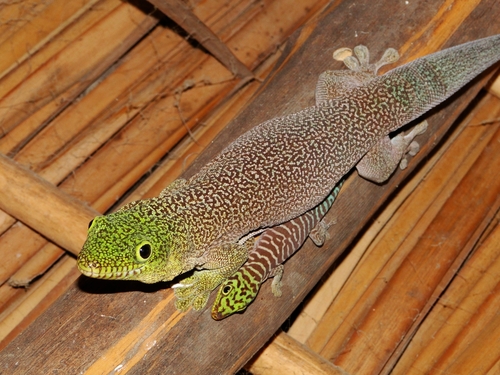
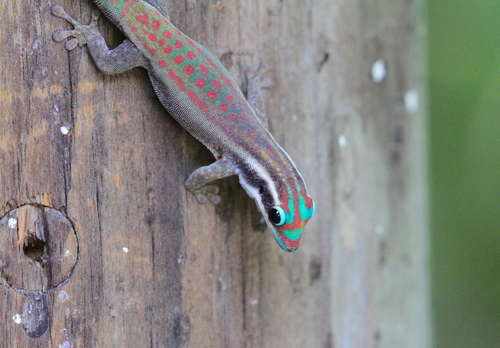
Its body color is quite variable: it can be solid bluish green, green with a blue patch on the upper front of its back, or entirely blue.
Flank Color
Its flanks are brown.
Snout Markings
Its snout features an intricate pattern made up of cyan, white, red, and dark blue markings.
Back and Head Markings
Its back is covered with red dots, and its head displays a clear T-shaped pattern.
Tail and Ventral Coloration
Its tail is turquoise, marked with red transverse bars, and its ventral (underside) surface is off-white.
Geographical Range
This species is found in coastal areas of Mauritius, Round Island, Île aux Aigrettes, and Coin de Mire.
Natural Habitat
It typically inhabits drier low- to mid-elevation areas across Mauritius, and can be found on trees, other pantropic vegetation, or on rocks in areas where the original native vegetation has been cleared.
Garden Colonization Observation
A resident of Flic en Flac, on Mauritius' west coast, reports that these geckos have colonized their garden.
Human Proximity Behavior
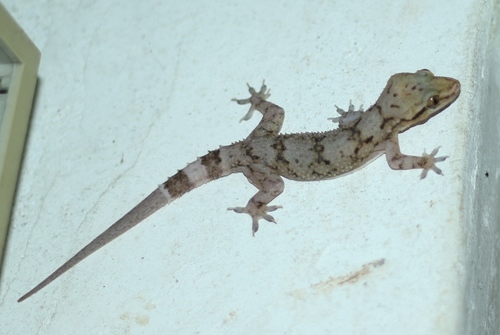
The geckos can be seen moving across garden walls and the house's exterior walls, and some individuals even enter buildings, occasionally spending the night behind wardrobes before exiting to the outside through open windows each morning.
Incubation Period
For this species, when incubated at a temperature of 28 °C (82 °F), young geckos hatch after approximately 40 days.
Hatchling Size
Newly hatched juveniles measure around 35 mm (1.4 in) in length.
Microgravity Experiment
In 2014, an experiment testing the effects of microgravity on gecko reproduction was launched into space, carrying five Mauritius ornate day geckos.
Experiment Outcome
All geckos died from a combination of factors caused by lost communication with the satellite, which included a life support malfunction that deactivated the heating system.