About Phalacrocorax pelagicus Pallas, 1811
General Size Characteristics
This species is a smallish cormorant. When fully grown, it measures 25 to 35 inches (64 to 89 cm) in length, has a wingspan of approximately 3.3 feet (1.0 meter), and weighs 52 to 86 ounces (1,500 to 2,400 g).
Nonbreeding Adult Plumage
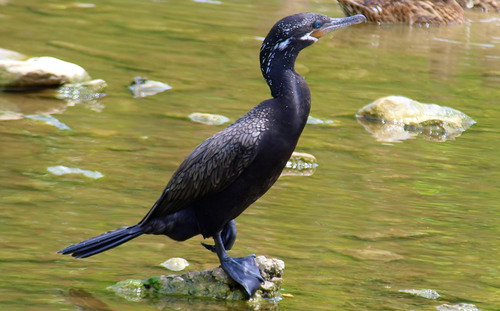
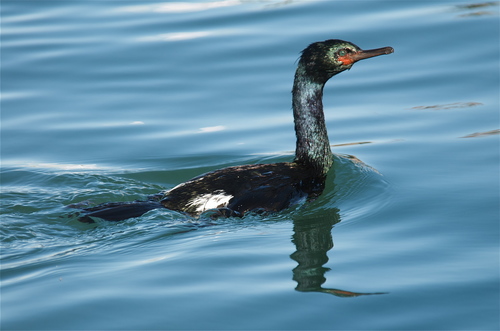
Nonbreeding adult pelagic cormorants are all-black with a metallic iridescence.
Breeding Adult Plumage
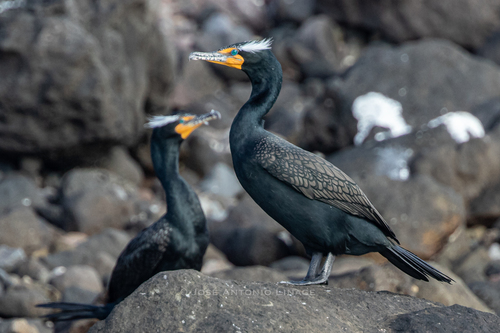
In breeding plumage, they develop two short crests (one on the top of the head and one at the nape), white thighs, and scattered thin white filoplumes on the head and neck. Its long thin bill and large fully webbed feet stay black year-round, while the patch of dark bare skin below the eye turns bright magenta during the breeding season.
Sexual Dimorphism
Males and females have identical appearance, though females are slightly smaller.
Immature Plumage
Immature birds lack iridescence, are dark brown overall, and fade to slightly lighter brown on their underside.
Sympatric Related Species
The pelagic cormorant is widely sympatric with the very similar-looking red-faced cormorant (U. urile).
Breeding Adult Species Distinction
Breeding adults of the two species can be easily distinguished by the extent of naked facial skin: in the pelagic cormorant, naked skin does not extend noticeably past the eye, while in the red-faced cormorant it extends above the bill, above the eye, and behind the eye. Red-faced cormorants also have larger crests.
Nonbreeding/Juvenile Species Distinction Difficulty
Juveniles and nonbreeding adults of the two species are often impossible to tell apart even for trained observers, when they occur in mixed flocks or cannot be observed at close range.
Close-Range Species Distinction Traits
When close observation is possible, red-faced cormorants can be easily recognized by their large naked facial "mask" and lighter bill; this species is also larger overall, though male pelagic cormorants can reach the same size as female red-faced cormorants.
Pre-Takeoff Call Distinction
Unlike red-faced cormorants, pelagic cormorants usually call before taking off, especially during the breeding season.
Courtship Display Distinctions
During courtship displays, pelagic cormorants typically tear and move nest material (a behavior red-faced cormorants may not perform), and male pelagic cormorants apparently do not bow their heads to females as male red-faced cormorants do.
Distinction From Other Cormorants
Other cormorants and shags native to the North Pacific are larger, have thicker bills, and/or lack the white thighs seen in breeding plumage pelagic cormorants.
General Habitat
The pelagic cormorant lives on the shores and in the neritic zone of the North Pacific.
North American Range
On the North American side, its range stretches from Alaska to the Baja California Peninsula in Mexico.
Asian Range
It is also found on the Aleutian Islands and other Bering Strait islands; on the Asian side, it occurs from the Russian Far East's Chukchi Peninsula through Sakhalin, south to Kamchatka, and finally to Kyūshū, but not to other parts of Japan.
Movement Patterns
Subarctic populations of pelagic cormorant are migratory, while populations from temperate and subtropical regions only disperse locally after breeding. Even so, Asian pelagic cormorants may reach China or Korea.
Vagrant Records
Vagrants of this species have been recorded in the Hawaiian Islands.