About Phalacrocorax auritus (Lesson, 1831)
Species Classification and Body Structure
The double-crested cormorant (Phalacrocorax auritus) is a large waterbird with a stocky body, long neck, medium-sized tail, webbed feet, and a medium-sized hooked bill.
Size Measurements
Its body length ranges from 70 to 90 cm (28 to 35 in), with a wingspan of 114 to 123 cm (45 to 48 in), and a body weight between 1.2 and 2.5 kg (2.6 and 5.5 lb).
Sexual Dimorphism
This species shows no sexual dimorphism between males and females.
Non-breeding Adult Plumage
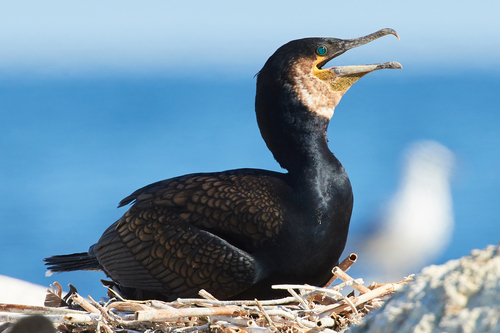
It has dark-colored plumage, with bare supra-loreal and gular skin that is yellow or orange.
Breeding Adult Plumage
Adult breeding plumage is mostly black, with the back and coverts fading to a dark grayish tone toward the center.
Nuptial Crests
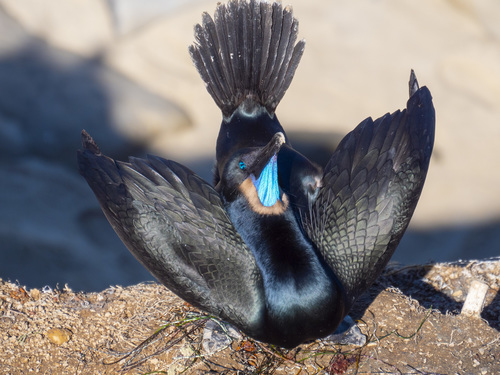
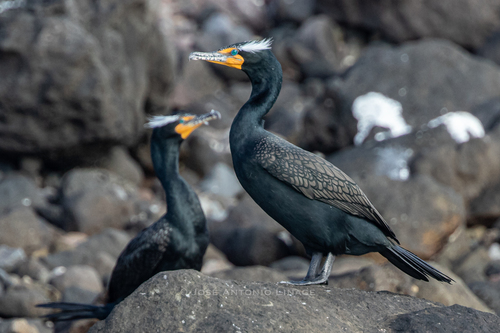
The species gets its name from its nuptial crests, which sit just above the eyes and can be white, black, or a mix of the two; the bare facial skin of breeding adults is orange.
Non-breeding Adult Features
Non-breeding adults lack these crests, and have more yellowish skin around the face; adult bills are dark-colored.
Similar Species: Great Cormorant
It closely resembles the larger great cormorant, which has a more restricted North American distribution mainly centered on Canada's maritime provinces.
Distinction from Great Cormorant
The two can be distinguished by the double-crested cormorant having more yellow on its throat and bill.
Similar Species: Neotropic Cormorant
It also looks very similar to the neotropic cormorant, and the two species sometimes occur together where their ranges overlap.
Juvenile Plumage
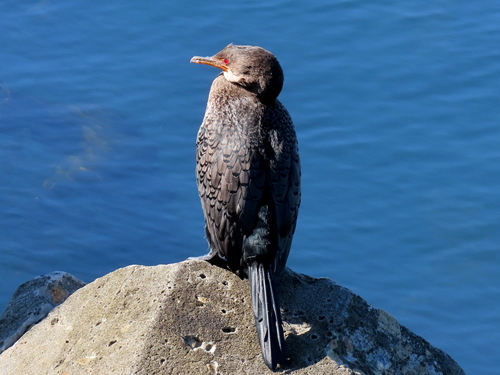
Juvenile double-crested cormorants have darker gray or brownish plumage.
Juvenile Underpart Features
Juvenile underparts are lighter than the back, with a pale throat and breast that darkens toward the belly.
Juvenile Maturation Traits
Plumage darkens as the bird ages, and juvenile bills are mostly orange or yellowish.
Species Abundance
This is a very common, widespread species.
Winter Range
It winters in any ice-free area along both North American coasts, ranging as far north as southern Alaska on the west coast and southern New England on the east coast, and as far south as Mexico and the Bahamas.
Migration and Vagrant Occurrence
Birds migrate away from the coldest parts of their breeding range, such as eastern Canada, and the species occurs as a very rare vagrant in Europe, including Great Britain, Ireland, and the Azores.
Pacific Coast Permanent Resident Range
It is a permanent resident along the Pacific Coast from the Aleutian Islands south to Nayarit, Mexico (excluding parts of British Columbia and the Southern California Bight) and inland as far as the Colorado River.
Atlantic Coast Permanent Resident Range
On the Atlantic Coast, it is resident in Long Island and surrounding areas, southern New England, Florida, Cuba, and the Yucatán Peninsula.
Breeding Range
Its breeding range extends north through most of north-central North America, from Utah north to Alberta, east through the Great Lakes states to Nova Scotia, and south to northern Massachusetts; it also breeds in parts of Alaska adjacent to Bristol Bay and Kuskokwim Bay.
Nonbreeding Coastal and Island Range
Its nonbreeding range covers all coastal plains in the United States, including the Atlantic and Gulf Coastal Plains south to Campeche, as well as the Bahamas, Turks and Caicos, Hispaniola, the Cayman Islands, and all areas it occupies as a resident.
Pacific Coast Nonbreeding Range
On the Pacific Coast, the nonbreeding range includes all resident areas plus British Columbia and the Southern California Bight.