About Microcarbo melanoleucos (Vieillot, 1817)
Taxonomy and Size
The little pied cormorant, scientifically named Microcarbo melanoleucos (Vieillot, 1817), is a small cormorant that measures 56–58 cm (22–23 in).
Distinguishing Physical Features
Compared to the little black cormorant, it has a shorter 3 cm (1.2 in) bill and a longer tail, and it also has a small black crest.
Plumage Morph Distribution
In New Zealand, the species occurs in two different plumage morphs.
Pied Morph Subspecies Distribution
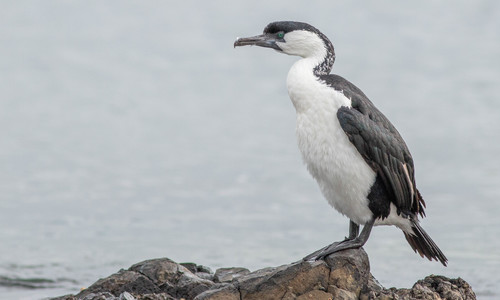
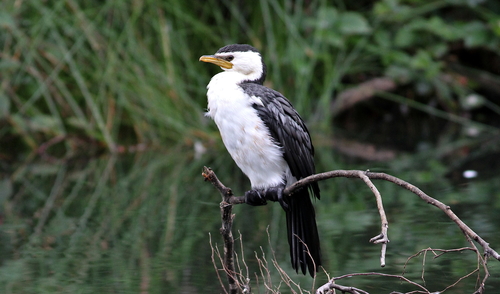
Subspecies melanoleucos and brevicauda only occur in the pied morph, which is black (with a faint green tinge) on the upper body and white on the underbody.
Subspecies brevirostris Morph Prevalence
The pied morph is also present in subspecies brevirostris, but for this subspecies, the melanistic morph is much more common.
Melanistic Morph Description
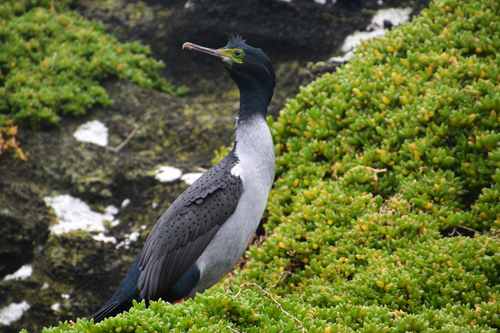
In the melanistic morph, the entire plumage is black with a greenish tinge, except for the sides of the head, chin, throat, and upper neck; the bill is yellow with black on the upper portion.
Intermediate Plumage
Intermediate plumage forms also occur.
Pied Morph Adult Description
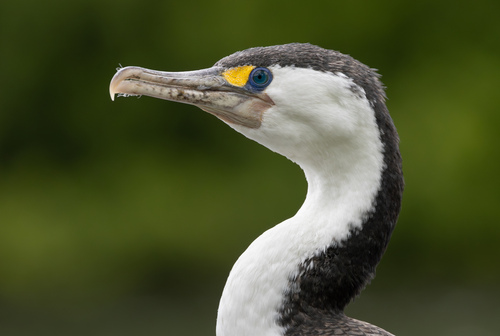
The pied morph has glossy black upperparts, with a white face, white underparts, and white thighs; the bill and bare skin around the face are yellow.
Limb Coloration
In both morphs, the legs and feet are black.
Pied Morph New Zealand Distribution
The pied morph is rare in New Zealand, and it is most common in the Northland region of the country, where it accounts for roughly one out of every four little pied cormorants.
Chick Plumage
Chicks have dark brown down; pied morph chicks have patches of paler down.
Immature Plumage
Immature birds are a dull blackish brown, and pied morph immature birds have paler underparts.
Courtship Vocalization
During courtship, the little pied cormorant produces a low cooing sound.
Similar Species
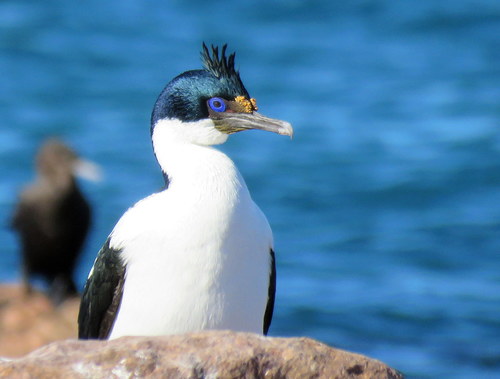
Similar species include the slightly larger black-faced cormorant and the substantially larger Australian pied cormorant.
Core Geographic Range
The little pied cormorant's range covers all of New Zealand, from Stewart Island to Northland, as well as all of mainland Australia (excluding the arid interior of western Australia) and Tasmania.
Pacific Island Range
It is also found in Papua New Guinea, Palau, Timor-Leste, the Solomon Islands, New Caledonia, and Vanuatu.
Indonesian Range
In eastern Indonesia, its range includes Sulawesi, the Lesser Sunda Islands, the Maluku Islands, and Western New Guinea; non-breeding individuals have been recorded in Java, Bali, and once off the coast of East Kalimantan.
Habitat
The species is widespread and common, and it lives near bodies of water including swamps, lakes, lagoons, estuaries, and coastlines.