About Phalacrocorax magellanicus (Gmelin, 1789)
Common Name and Distant Appearance
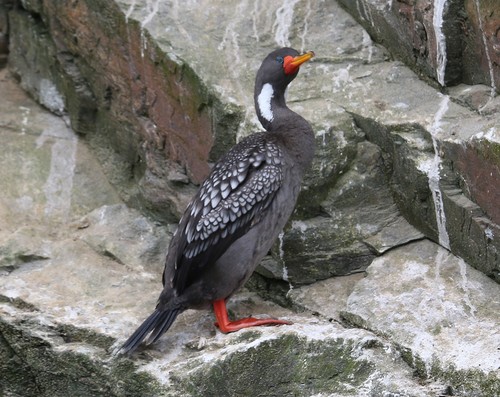
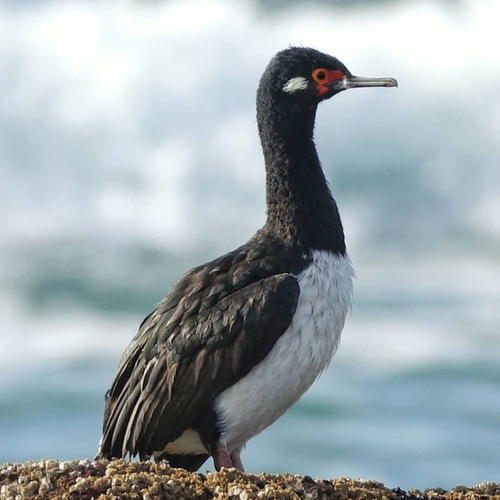
Phalacrocorax magellanicus, commonly called the rock shag, appears black and white from a distance. Its head, neck, and upperparts are black, while its chest and underparts are white.
Close-Up Plumage Details
When viewed up close, the black areas show color variation ranging from metallic blue to oily green, and are marked with scattered white flecks. The rock shag has pink, fleshy-colored legs and feet, and bare brick-red flesh surrounding its beak and eyes.
Breeding Season Plumage
During the breeding season, adults develop a not very prominent blackish crest on the forehead and a distinctive white ear patch.
Sexual Dimorphism
This species shows even less sexual dimorphism than most cormorant species, though males are typically 5% to 10% larger than females across most size measurements.
Foraging Habitat
Like all cormorants, the rock shag feeds by diving to catch underwater prey. It forages close to shore, often diving at the edges of kelp beds, where it preys on small fish that shelter among the kelp.
Primary Prey
Predominantly, these fish are cod icefishes of the genus Patagonotothen.
Diving Depth
Depth gauge studies show that the rock shag is a fairly shallow diver: it typically dives to around 5 meters below the surface, with very few individuals diving deeper than 10 meters.
Prey Capture and Dive Duration
Most of its prey is captured from the sea floor, and dives usually last around 30 seconds.
Breeding Range Overlap
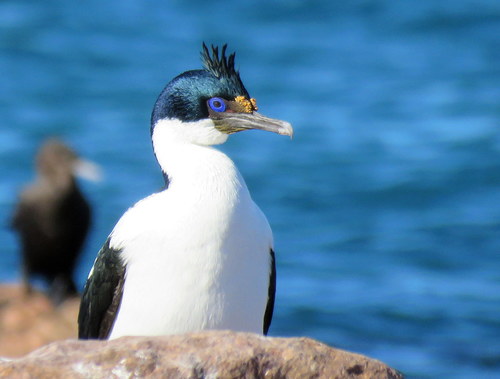
The rock shag's breeding range overlaps substantially with that of the imperial shag, Leucocarbo atriceps, but the two species have different foraging ranges. The imperial shag tends to dive in deeper water further from shore.