About Phalacrocorax gaimardi (Lesson & Garnot, 1828)
Scientific Classification and General Morphology
The red-legged cormorant (scientific name Phalacrocorax gaimardi (Lesson & Garnot, 1828)) is a medium-sized seabird with a long neck, streamlined body, webbed feet, and a long, thin hooked bill.
Size Measurements
It measures 71 to 76 centimetres (28 to 30 inches) in body length, has an average wingspan of 91 centimetres (36 inches), and weighs between 1.3 and 1.5 kilograms (2.9 to 3.3 pounds).
Sexual Dimorphism
There is no sexual dimorphism between males and females of this species.
General Appearance Distinctiveness
The species has a distinct, easily recognizable appearance.
Breeding Adult Body Plumage
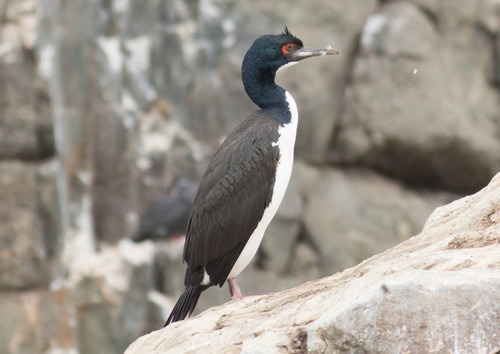
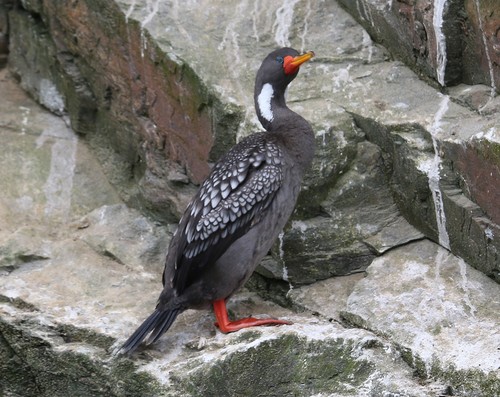
Breeding adults have smoky grey bodies with a slightly paler underside. They have scattered patches of white filoplumes behind the eyes and extending down the neck.
Breeding Adult Wing and Tail Features
Their wing coverts have a speckled, silvery grey look, with broad black wing tips, and their tail is also black.
Breeding Adult Head and Facial Features
Their eyes are green, surrounded by sixteen tiny blue marks.
Breeding Adult Soft Part Coloration
The bill is yellow, shading to orange toward the base, while the gular skin is a bright orange or red, and the legs and feet are a striking coral red.
Non-breeding Adult Appearance
Non-breeding adults are similar in appearance to breeding adults, but lack the white filoplumes, have less silvery (more dark grey) wing coverts, and have duller coloured bills and gular skin.
Juvenile General Plumage
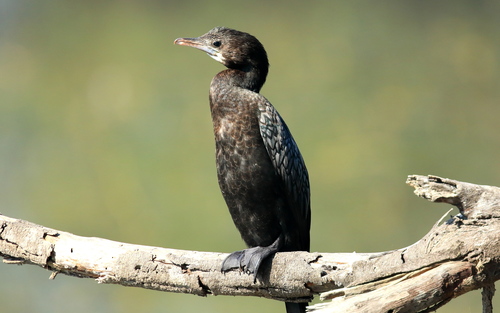
Juvenile red-legged cormorants typically have paler, brown plumage with white speckling around the throat.
Juvenile Plumage Geographic Variation
Juvenile plumage colour varies widely between populations on Atlantic and Pacific coasts.
Juvenile Soft Part Coloration
Juveniles have grey eyes, bills and gular skin ranging from black to orange, and legs and feet that range from dull orange to reddish black.
Native Distribution Region
The red-legged cormorant is native to the coasts of South America.
Pacific Coast Range
On the Pacific coast, its range extends from Macabi Island, Peru to Chiloe Island, Chile.
Atlantic Coast Populations
Small isolated populations are found on the Atlantic coast scattered across Santa Cruz, Argentina.
Southern Range Limit
The species rarely occurs further south than the Strait of Magellan.
Nesting Habitat
Red-legged cormorants nest in sparse groups on steep rock faces, including coastal cliffs, rocky islets, and sea caverns.
Nesting Habitat Camouflage
Their speckled grey plumage makes them nearly impossible to spot against these rocky outcrops, with only their colourful bills and feet giving them away.
Foraging Habitat
They forage in inshore waters and shallow offshore waters.