About Paralaudakia himalayana (Steindachner, 1867)
Taxon Identity
Paralaudakia himalayana (Steindachner, 1867) has the following morphological characteristics.
Head Shape
The head is very depressed; the snout is slightly longer than the diameter of the orbit.
Nostril Position
The nostril is positioned laterally, below the canthus rostralis, and is slightly tubular.
Upper Head Scales
Upper head scales are smooth, and the occipital scale is not enlarged.
Spinose Head and Neck Scales
Small, closely set spinose scales are present on the head near the ear and on the neck.
Ear Structure
The ear is entirely exposed, and is larger than the eye opening.
Throat Morphology
The throat is strongly folded, and no gular pouch is present.
Body Shape
The body is depressed, with a more or less distinct fold on each side of the back.
Neck and Side Scales
Scales on the neck and sides are small, uniform, and either smooth or very weakly keeled.
Vertebral Region Scales
Scales in the vertebral region are enlarged, equal, roundish-hexagonal, imbricate, and also either smooth or very weakly keeled.
Ventral Scales
Ventral scales are smooth, and slightly smaller than the enlarged dorsal scales.
Limb and Digit Structure
The limbs are strong, with compressed digits.
Limb Surface Scales
Scales on the upper surface of the limbs are large and strongly keeled.
Finger Length Ratio
The fourth finger is slightly longer than the third finger.
Toe Length Ratio
The fourth toe is considerably longer than the third toe: the claw tip of the third toe does not reach the base of the claw of the fourth toe.
Fifth Toe Length
The fifth toe extends beyond the first toe.
Tail Structure and Scales
The tail is rounded, strongly depressed at the base, and covered with moderately sized, strongly keeled scales arranged in rings.
Tail Length
The tail length is 2.5 to 3 times the distance from the gular fold to the vent.
Male Pre-anal Scales
Males have a double or triple row of thickened pre-anal scales.
Dorsal Coloration
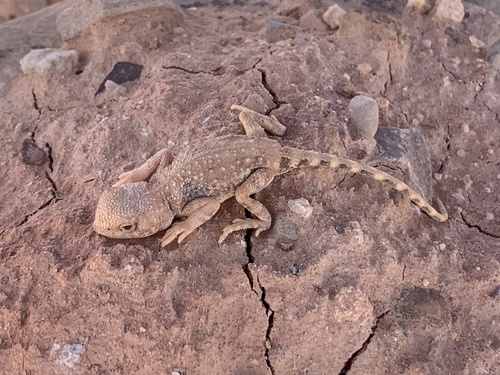
The species is olive-colored on the dorsal side, marbled with black, and typically marked with round light spots that form a network pattern.
Vertebral Band Pattern
Sometimes black spots form a festooned band along each side of the vertebral line.
Male Throat Coloration
Males have blackish marbling on the throat.
Geographical Distribution
This species is distributed in NE Afghanistan, N Pakistan, Kashmir, Nepal, China (Xinjiang), SE Turkmenistan, and extends eastward through W Tajikistan to W Kyrgyzstan and E Uzbekistan.
Type Locality
Its type locality is Leh and Kargil, Ladakh Region.