About Monilesaurus ellioti (Günther, 1864)
Head Scale Morphology
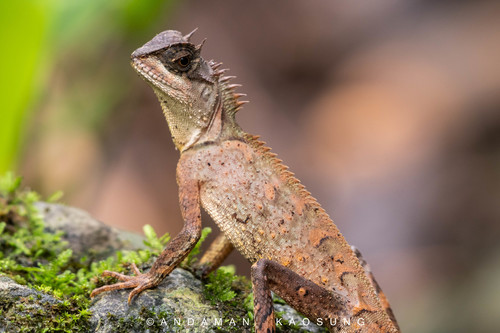
Monilesaurus ellioti (Günther, 1864) has upper head scales that are feebly keeled, imbricate, and much enlarged across the supraorbital region. A small spine sits behind the supraciliary edge, with two additional spines on each side: the anterior is midway between the nuchal crest and the tympanum, and the posterior is just above the tympanum.
Tympanum Size
The tympanum measures nearly half the diameter of the orbit.
Gular Region Structure
The gular sac is not developed. Gular scales are strongly keeled and smaller than the ventral scales.
Shoulder and Gular Fold
This species has a strong oblique fold or pit in front of the shoulder, plus a transverse gular fold.
Nuchal Crest Morphology
The nuchal crest is made of a few widely separated slender spines; the longest of these spines measures about two thirds the diameter of the orbit.
Dorsal Crest Morphology
The dorsal crest is only a slight denticulation.
Midbody Scale Count
There are 53 to 61 scales around the midsection of the body.
Loreal Scale Characteristics
Loreal scales are roughly the same size as ventral scales and keeled: the uppermost loreal scales have points directed straight backward, while the remaining loreal scales have points directed downward and backward.
Ventral Scale Characteristics
Ventral scales are strongly keeled.
Hind Limb Length
When adpressed, the hind limb reaches either the anterior border of the orbit or the tip of the snout.
Finger Length Ratio
The fourth finger is longer than the third finger.
Tail Morphology
The tail is barely compressed.
Dorsal Body Coloration
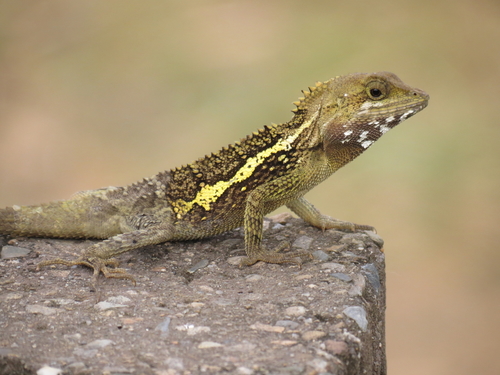
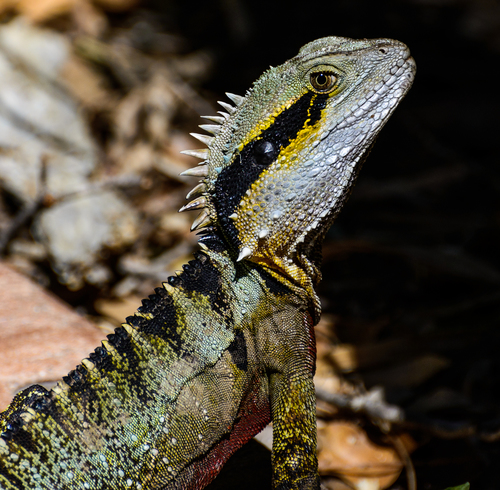
The species is olive-colored on its upper side, with more or less distinct angular dark-brown cross bands across the body.
Neck and Orbital Markings
An angular black mark appears on each side of the neck, and a white spot sits below the orbit. Dark lines radiate out from the eye.
Size Measurements
Adult M. ellioti can reach a snout-to-vent length of 3 inches (7.6 cm), with a total tail length of 8.5 inches (22 cm).
Geographical Distribution
This species is endemic to the Western Ghats of India, and has been recorded in Anaimalai, Agasthyamalai, Cardamom Hills, Palni Hills, Nilgiris, Waynad, Coorg, and Kudremukh.
Habitat and Elevation Range
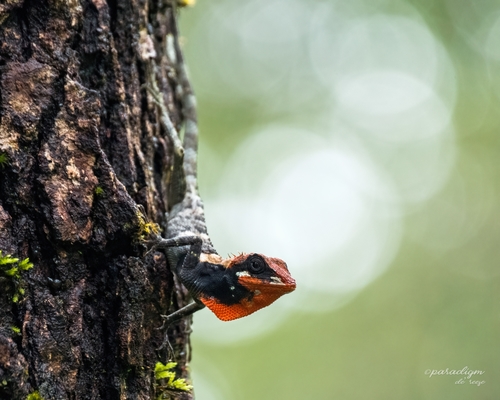
It inhabits rainforest and adjacent plantations including coffee, cardamom, tea, areca, and vanilla estates, ranging from sea level up to 1,100 m (3,600 ft) in elevation.
Reproduction
M. ellioti is oviparous.