About Pogona barbata (Cuvier, 1829)
Genus Classification
Pogona barbata is one of eight recognized species in the genus Pogona.
Adult Size
Adult males reach approximately 60 cm (24 inches) in total length from snout to tail tip, while adult females grow to around 50 cm (20 inches) long.
Head Shape
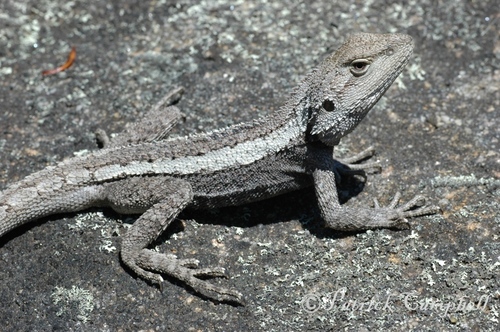
This species has a large, triangular head.
Throat Scale Characteristics
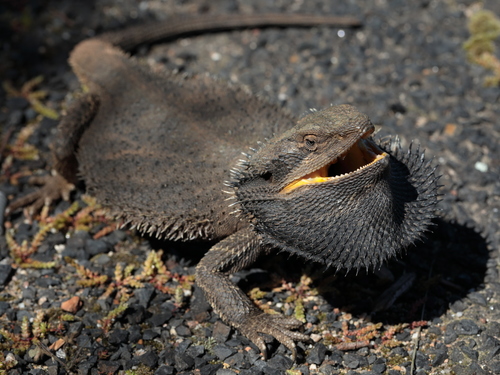
Its throat is covered in spiny, dark grey scales that can be lifted to create a prominent "beard".
Spiny Scale Distribution
Additional groups of longer spiny scales are found at the back of the head, the corners of the mouth, around the external ear openings, and run backward along both sides of the abdomen.
Body Shape
The thorax and abdomen are relatively slender and flattened dorsoventrally.
Base Body Coloration
Base body color is most often grey-black or red, and can sometimes be reddish-brown, yellowish-brown, or dark brown.
Juvenile Coloration
Juveniles are paler than adults and have patterned markings that fade as they mature.
Adult Head Tint
As they reach adulthood, a subtle pale yellow, blue, or green tint develops on the front portion of the head.
Temperature-Excited Color Change
When the lizard is excited or exposed to higher temperatures, the head, flanks, and legs turn a yellowish to orange color; otherwise, individuals are typically quite dark, ranging from yellowish through grey to black.
Mouth Interior Color
The inside of the mouth is usually bright yellow.
Species Distinction From Central Bearded Dragon
P. barbata is closely related to the central bearded dragon, but can be told apart by its less robust body and the continuous row of spines along the body's lateral edge that extends over the forearm.
Geographic Distribution
This species is most common in eastern Australia south of Cape York Peninsula, though individual specimens have been collected from Cape York, across central Australia, and as far as the west coast of Australia.
Activity Pattern
Eastern bearded dragons are diurnal.
Perching and Thermoregulation Behavior
They are arboreal, and perch in open locations such as tree branches or logs, retreating to lower, cooler areas when they become too hot.
Aggression Level
They are more aggressive than central bearded dragons.
Male Territoriality
Males are territorial, and only allow females and juveniles to enter their territories.
Dominant Male Traits
Dominant males are typically the largest individuals and occupy the highest perches.
Female Reproductive Nesting
Females dig tunnels into dry soil to lay clutches of eggs.
Initial Threat Response
When threatened, P. barbata inflates its throat and displays its beard.
Provoked Threat Display
If provoked further, it opens its mouth to show the bright yellow lining of its mouth; in comparison, the closely related central bearded dragon has a reddish-pink mouth lining.
Beard Display Frequency
Eastern bearded dragons perform this beard display more frequently than their close relative.