About Papio cynocephalus (Linnaeus, 1766)
Taxonomy and Etymology
The yellow baboon, with the scientific name Papio cynocephalus, is a baboon belonging to the Old World monkey family. Its species epithet means "dog-head" in Greek, a reference to the dog-like shape of its muzzle and head.
Body Build and Hair
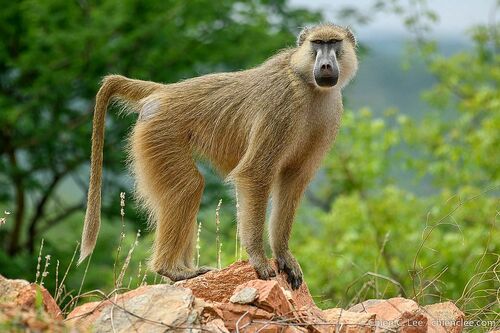
Yellow baboons have slim bodies with long arms and legs, and yellowish-brown hair. They look similar to chacma baboons, but are slightly smaller and have a less elongated muzzle.
Facial Features
Their hairless faces are black, and framed by white sideburns.
Size
Males can grow to around 84 cm (33 in), while females reach about 60 cm (24 in). They have long tails that grow to be nearly the same length as their bodies.
Lifespan
The average lifespan of a wild yellow baboon is roughly 15 to 20 years, and some individuals can live up to 30 years.
Distribution and Habitat
Yellow baboons live in savannas and light forests in eastern Africa, ranging from Kenya and Tanzania down to Zimbabwe and Botswana.
Activity Pattern and Social Structure
They are diurnal and terrestrial, and inhabit complex, mixed-gender social troops that can number anywhere from 8 to 200 individuals.
Diet Preferences
Like all other baboon species, yellow baboons are omnivorous, and they prefer fruits. They also eat a wide variety of other foods including plants, leaves, seeds, grasses, bulbs, bark, blossoms, fungi, worms, grubs, insects, spiders, scorpions, birds, rodents, and small mammals.
Feeding Behavior
All baboon species are highly opportunistic feeders, and will eat almost any food they can find.
Ecological Roles
Baboons serve several roles in their ecosystems: they act as a food source for larger predators, disperse seeds through their waste and via their messy foraging behavior, and are efficient predators of smaller animals and their young.
Habitat Adaptability
Baboons are able to occupy a wide range of ecological niches, even in areas that are inhospitable to other animals, such as regions that have been taken over by human settlement. For this reason, they are one of the most successful primate species in Africa, and are not listed as threatened or endangered.
Human Conflict
However, the same behavioral adaptations that make yellow baboons so successful also lead them to be considered pests by humans in many areas. Their raids on farmers' crops and livestock, as well as other intrusions into human settlements, have put most baboon species the target of many organized extermination projects.
Habitat Loss Impact
At the same time, ongoing habitat loss pushes increasing numbers of baboons to migrate toward areas occupied by human settlement.
Subspecies
There are two recognized subspecies of the yellow baboon: Papio cynocephalus cynocephalus, the typical yellow baboon, and Papio cynocephalus ibeanus, the Ibean baboon.