About Orcinus orca (Linnaeus, 1758)
Taxonomic Classification
Orcas are the largest living members of the dolphin family.
Adult Size
Adult males typically measure 6 to 8 m (20 to 26 ft) long and weigh more than 6 tonnes (5.9 long tons; 6.6 short tons), while adult females are smaller at 5 to 7 m (16 to 23 ft) long and around 3 to 4 tonnes (3.0 to 3.9 long tons; 3.3 to 4.4 short tons).
Record Size Individuals
Larger individuals have been recorded: the largest confirmed male reached 9.8 m (32 ft), and the largest confirmed female reached 8.5 m (28 ft). Large males can weigh over 10 tonnes (9.8 long tons; 11 short tons), and large females can weigh over 7.5 tonnes (7.4 long tons; 8.3 short tons).
Newborn Calf Size
Newborn calves measure around 2.4 m (7 ft 10 in) long and weigh about 180 kg (400 lb).
Skeletal Structure
The orca skeleton matches the typical structure of an oceanic dolphin, but is more robust.
Swimming Speed
Orcas can reach swimming speeds of up to 56 km/h (35 mph).
Pigmentation Distinctiveness
Adult orcas have highly distinctive pigmentation that almost never leads to confusion with other species, though juvenile orcas may be mistaken for false killer whales or Risso's dolphins when viewed from a distance.
Body Base Coloration
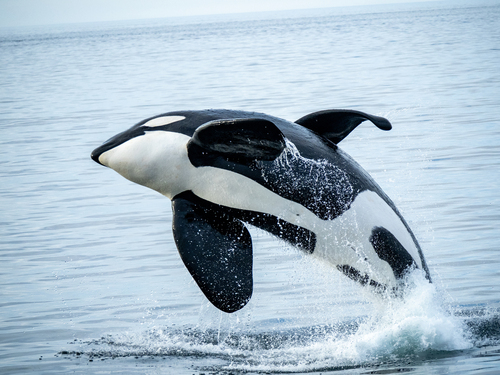
Their body is mostly black with sharply defined white areas: the entire lower jaw is white, and this white colouration extends across the underside to the genital area, narrowing and expanding along the body before ending in lateral flank patches near the tail.
White Marking Locations
The underside of the tail fluke is also white, and each eye has an oval-shaped white patch behind and above it. Orcas also have a grey or white "saddle patch" behind the dorsal fin across their back.
Sexual Dimorphism in Patterning
Males and females have different black and white patterning in their genital regions.
Juvenile Pigmentation
The white areas of newborn orcas are yellow or orange, rather than bright white.
Regional Pigmentation Variation
Antarctic orcas may have pale grey to nearly white backs, and some individuals in this region are stained brown or yellow by diatoms living in the water.
Rare Pigmentation Morphs
Both fully albino and fully melanistic orcas have been documented.
Pectoral Fin Structure
Orca pectoral fins are large, rounded, and paddle-shaped, and male pectoral fins are significantly larger than those of females.
Dorsal Fin Sexual Dimorphism
Dorsal fins also show clear sexual dimorphism: male dorsal fins are around 1.8 m (5 ft 11 in) high, more than twice the size of female dorsal fins. Male fins have the shape of an elongated isosceles triangle, while female fins are more curved.
Skull Sexual Dimorphism
In the skull, adult males have longer lower jaws and larger occipital crests than females.
Snout Structure
The orca has a blunt snout that lacks the extended beak seen in many other dolphin species.
Jaw and Tooth Structure
Orca teeth are very strong, and the jaws produce a powerful grip. When the mouth is closed, upper teeth fit neatly into the gaps between lower teeth.
Tooth Function
Middle and back teeth are firm and hold prey in place, while front teeth angle slightly forward and outward to protect them from damage during strong jerking movements when hunting.
Sensory Abilities
Orcas have good eyesight both above and below water, excellent hearing, and a good sense of touch.
Echolocation
Like other dolphin species, they have exceptionally sophisticated echolocation abilities; they emit clicks and listen for returning echoes to detect the location and characteristics of prey and other underwater objects.
Body Temperature
The average body temperature of an orca is 36 to 38 °C (97 to 100 °F).
Blubber Thickness
Like most marine mammals, orcas have a layer of insulating blubber under the skin that is 7.6 to 10 cm (3.0 to 3.9 in) thick.
Heart Rate
An orca's pulse is around 60 beats per minute at the water surface, and drops to 30 beats per minute when submerged.
Individual Identification Markers
Individual orcas can usually be identified by their dorsal fin and saddle patch. Variations including nicks, scratches, and tears on the dorsal fin, plus the unique pattern of white or grey in the saddle patch, make every individual distinct.
Identification Directories
Published directories include identifying photographs and names for hundreds of orcas living in the North Pacific.
Identification Research Applications
Photographic identification has allowed annual counts (rather than estimates) of local orca populations, and has given researchers much greater insight into orca life cycles and social structures.
Global Distribution
Orcas are found in all oceans and most seas.
Habitat Preferences
Because of their extremely large range, overall population distribution is hard to estimate, but they clearly prefer higher latitudes and coastal areas over open pelagic ocean environments.
Major Study Sites
Major study sites for the species include the coasts of Iceland, Norway, Argentina's Valdés Peninsula, the Crozet Islands, New Zealand, and the west coast of North America from California to Alaska.
Highest Population Densities
Systematic surveys have found the highest orca densities (more than 0.40 individuals per 100 km²) in the northeast Atlantic around the Norwegian coast, the north Pacific along the Aleutian Islands and the Gulf of Alaska, and the Southern Ocean off most of Antarctica' coast.
Common Population Densities
Orcas are considered "common" (0.20–0.40 individuals per 100 km²) in the eastern Pacific along the coasts of British Columbia, Washington and Oregon, and in the North Atlantic around Iceland and the Faroe Islands.
Antarctic Range
In the Antarctic, orcas range out to the edge of the pack ice and are thought to enter denser pack ice areas to use open water leads, similar to Arctic beluga whales.
Arctic Range
Orcas are only seasonal visitors to Arctic waters, and do not approach the pack ice in summer. As Arctic sea ice has rapidly declined in Hudson Strait, orca range has now extended deep into the northwest Atlantic.
Freshwater Occurrences
Occasionally, orcas swim into freshwater rivers. They have been recorded 100 mi (160 km) up the Columbia River in the United States, and have also been observed in the Fraser River in Canada and the Horikawa River in Japan.
Migration Patterns
Orca migration patterns are still poorly understood. The same individual orcas return to the coasts of British Columbia and Washington each summer, but even after decades of research, their location for the rest of the year remains unknown.
Transient Pod Range
Transient orca pods have been sighted across a range from southern Alaska to central California.
Female Sexual Maturation
Female orcas begin to mature around 10 to 13 years of age, and reach peak fertility around 20 years. They go through polyestrous cycling periods separated by non-cycling periods of 3 to 16 months.
Female Breeding Period
Females can usually breed until age 40, after which fertility drops rapidly. Orcas are among the few animal species that undergo menopause, and can live for decades after they stop breeding.
Wild Female Lifespan
Wild female orcas have an average lifespan of 50 to 80 years. Some individuals have been claimed to live much longer: Granny (J2) was estimated by some researchers to be as old as 105 years when she died, though a biopsy sample gave an age estimate of 65 to 80 years.
Oldest Living Females
One of the oldest living orcas is Ocean Sun (L25), a Southern Resident Orca estimated to be more than 98 years old.
Captive Female Lifespan
It is commonly thought that captive orcas tend to have shorter lifespans than wild orcas, though this claim is still under scientific debate.
Mating System
Males mate with females from other pods, which prevents inbreeding.
Gestation and Birth Interval
Gestation lasts from 15 to 18 months. Mothers usually give birth to a single calf about once every five years.
Calving Season
In resident orca pods, births can happen at any time of year, though winter is the most common season.
Calf Mortality
Calf mortality is extremely high in the first seven months of life, with 37–50% of all calves dying in this period.
Weaning
Weaning starts at around 12 months of age, and is finished by the time the calf is two years old.
Alloparental Care
Observations from multiple regions show that all male and female pod members participate in caring for young.
Male Sexual Maturation
Males reach sexual maturity at 15 years of age, but typically do not breed until age 21.
Wild Male Lifespan
Wild male orcas have an average lifespan of around 29 years, with a maximum lifespan of about 60 years.
Old Male Age Records
One male orca named Old Tom was reportedly spotted every winter from the 1840s to 1930 off New South Wales, Australia, which would have made him up to 90 years old. Examination of his teeth suggested he died around age 35, but this method of age determination is now thought to be inaccurate for older animals.
Documented Old Males
A Pacific Northwest male identified as J1 was estimated to be 59 years old when he died in 2010. The oldest known male in Scottish waters is John Coe (W001), estimated to be 65 years old, while a male in Puget Sound named Harbeson (T087) is thought to be around 64 years old.
Age-Related Morphology
Orcas are unique among cetaceans because their caudal sections elongate as they age, making their heads relatively shorter over time.
Wild Infanticide Observation
Infanticide was once thought to only happen in captive orcas, but it was observed in a wild orca population off the coast of British Columbia on December 2, 2016. In this incident, an adult male killed the calf of a female in the same pod, and the adult male's mother also joined in the attack.
Infanticide Hypothesized Function
Researchers theorize that the male killed the young calf to allow him to mate with the calf's mother (a behaviour seen in other carnivore species), while the male's mother supported her son's breeding opportunity. The attack ended when the calf's mother struck and injured the attacking adult male.
Infanticide Comparison to Other Dolphins
This behaviour matches what is seen in many smaller dolphin species, such as the bottlenose dolphin.
Forced Mating Frequency
Forced mating by male orcas appears to be rare.