About Lagenorhynchus acutus (Gray, 1828)
Species Naming and Classification
The Atlantic white-sided dolphin, scientifically named Lagenorhynchus acutus, is a relatively small dolphin species.
Newborn Size
Newborn calves measure just over one meter long.
Adult Length
Fully grown adult males reach approximately 2.8 m (9.2 ft) in length, while fully grown adult females reach approximately 2.5 m (8.2 ft).
Adult Weight
Adult individuals weigh between 180–230 kg (400–510 lb).
Sexual Maturity Age
Females reach sexual maturity between 6 and 12 years of age, and males reach sexual maturity between 7 and 11 years of age.
Gestation and Lactation Period
The gestation period lasts 11 months, and lactation lasts approximately 18 months, both of which are typical measurements for dolphins.
Lifespan
This species is known to live for at least 17 years.
Distinguishing Color Patch
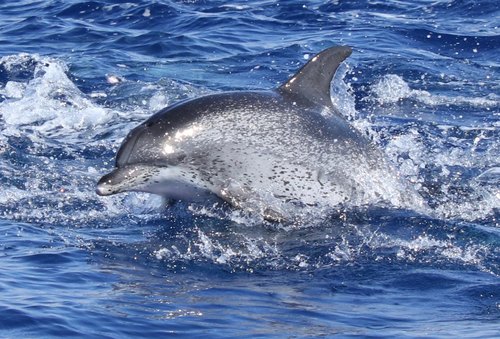
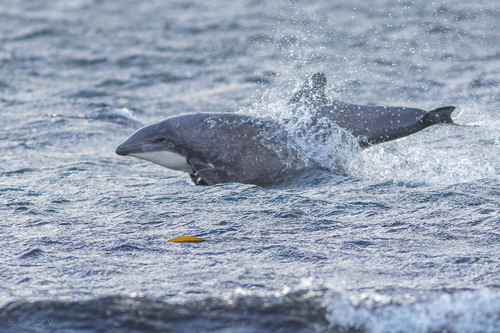
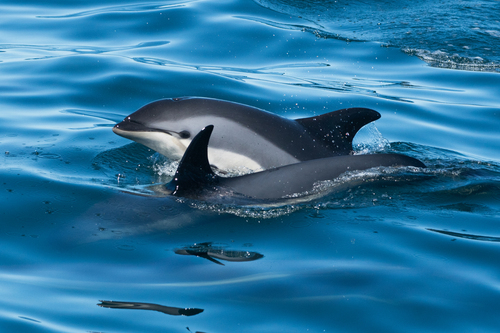
Its key distinguishing feature is its coloration: a white to pale-yellow patch is located behind the dorsal fin on both sides of the body.
Coloration Uniqueness
Its unique color variations stand out among the standard white, grey, black, and blue hues seen on other pelagic cetaceans.
Body Coloration Boundaries
Its body coloration has clear boundaries: the chin, throat, and belly are white; the flippers, dorsal fin, and back are dark-grey to black, excluding the yellow patch.
Additional Color Markings
An additional white patch sits below the dorsal fin, positioned above a lighter grayish stripe that runs from the beak, above the eye, down to the tail stock.
Pod Size Variation
Pod sizes for this species vary by location.
Regional Pod Size Observations
Close to the Newfoundland coastline, groups have been observed with an average size of 60 individuals, while groups found east of Iceland are somewhat smaller.
Diet Composition
Analysis of stomach contents from stranded individuals shows that herring, mackerel, and other fish, plus squid, are the main prey of this species.
Behavior and Interactions
The Atlantic white-sided dolphin is fairly acrobatic and eager to interact with boats, but it is not as extremely gregarious as white-beaked dolphins, bottlenose dolphins, or common dolphins.
Species Endemic Range
This species is endemic to the northern Atlantic Ocean.
Distribution Boundaries
Its distribution is bounded by the Norwegian Sea to the northeast, the Davis Strait to the northwest, coastal North Carolina to the southwest, and the Celtic Sea to the southeast, with a possible range extension south to the Azores.
High Density Population Areas
Areas with particularly high population density include the shores of Newfoundland and Cape Cod, the triangular sea area between the United Kingdom, Iceland, and Greenland, and the northern North Sea.
2008 South Carolina Sightings
In 2008, sightings of Atlantic white-sided dolphins (along with melon-headed whales) were documented off South Carolina, after several strandings occurred in the area that year.
North American East Coast Habitat Depth
Along the North American east coast, this species tends to live in continental shelf waters around 100 meters deep, and it appears to prefer areas with steep slopes and canyons.
Water Mass Association
It is associated with the colder, slightly less saline waters of the northern Atlantic, in contrast to common dolphins which occupy warmer, slightly more saline waters of the North Atlantic.
Habitat Preference Uncertainty
It remains unclear whether this difference comes from the species' habitat preferences, or if temperature and salinity affect prey availability instead.
Calving Season
Most calves are born around June and July.
Reproductive Seasonality
Reproduction is most likely seasonal, starting in February, as studies have found dormant testes in some males.
Calf Birth Interval
The birth interval for calves ranges between 1 and 3 years.