About Tursiops truncatus (Montagu, 1821)
Taxonomy and Appearance Overview
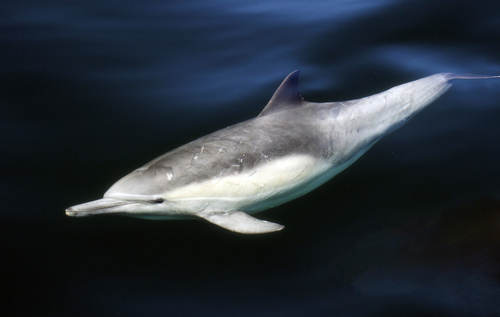
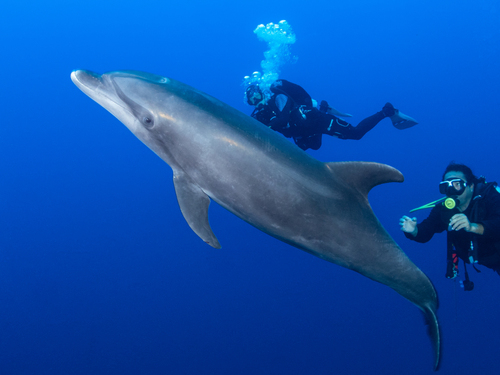
Common bottlenose dolphins (scientific name Tursiops truncatus (Montagu, 1821)) have grey coloration, a short beak, a single blowhole, and a hooked dorsal fin.
Size Range
Their total body length falls between 2 and 4 m (6.6 and 13.1 ft), and their weight ranges from 150 to 650 kg (330 and 1,430 lb). Males are generally larger and heavier than females.
Adult Size by Region
In most regions across the world, adult common bottlenose dolphins measure between 2.5 and 3.5 m (8.2 and 11.5 ft) long, and weigh between 200 and 500 kg (440 and 1,100 lb).
Common Name Etymology
They have a short, well-defined snout that resembles an old-fashioned gin bottle, which gives the species its common name.
Neck Flexibility
Five of their seven neck vertebrae are not fused together, unlike in other dolphin species, so common bottlenose dolphins have more flexible necks than other dolphins.
Global Distribution
While dolphins as a group inhabit every ocean on the planet, as well as some rivers and other ecosystems, the common bottlenose dolphin is found specifically in warmer oceanic regions: temperate, subtropical, and tropical oceans worldwide.
Global Population Estimate
The global population of the species is estimated at 600,000.
Population Types
Some common bottlenose dolphin populations live close to shore (called inshore populations), while others live further out to sea (called offshore populations).
Inshore vs Offshore Morphology
In general, offshore populations are larger, darker, and have proportionally shorter fins and beaks than inshore populations.
Migration Patterns
Offshore populations can migrate up to 4,200 km (2,600 mi) in a single season, while inshore populations tend to move much less. However, some inshore populations do make long migrations in response to El Niño events.
Range Extremes
Individuals of this species have been recorded as far north as 50° north in eastern Pacific waters, possibly as a result of warm water events.
Inshore Habitat Adaptations
Coastal (inshore) common bottlenose dolphins are adapted to warm, shallow waters, including harbors, bays, lagoons, and estuaries. They have smaller bodies and larger flippers, which support better maneuverability and more effective heat dispersal.
Offshore Habitat Adaptations
Offshore common bottlenose dolphins, by contrast, are adapted to cooler, deeper waters. Certain characteristics of their blood indicate they are better suited to deep diving. Their considerably larger body size protects them from predators and helps them retain body heat.
Social Structure Basics
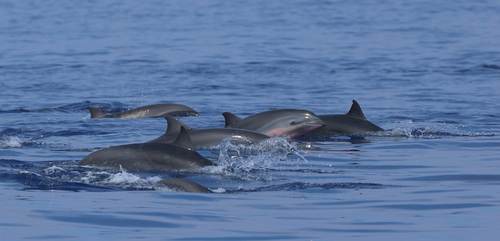
Common bottlenose dolphins are a highly social species. They live in social groups called pods, which typically contain around 15 individuals, though group size can range from pairs of dolphins to over 100, and occasionally even over 1,000 animals for short periods of time.
Group Composition Factors
Group structure is shaped by the sex and age of the dolphins in the group, and may change over time. The geographic range of a group influences many of its behaviors, including the density of dolphins while traveling.
Common Group Types
Common group types for this species are nursery groups, juvenile groups, and groups of adult males. Male dolphins often form pair bonds, which are the strongest type of social bonds seen in dolphins.
Female Social Bonds
Females stay with their calves for 3 to 8 years, after which they typically remain in social groups.
Social Interaction Timing
Common bottlenose dolphins are usually most social after feeding, during mid-day or evening. At these times, they are often observed engaging in group interactions such as play, vocalizations, and cooperative swimming.
Mating System
Common bottlenose dolphins have polygamous mating behavior. While they can breed at any time of year, breeding mostly occurs in spring.
Gestation and Breeding Overlap
Their gestation period lasts 12 months, so mating and birthing seasons overlap.
Male Mating Behavior
Males form alliances or pair bonds to seek out estrous females, and aim to breed as much as possible while keeping other males away from receptive females. To secure a chance to mate, males separate the female from her original home range.
Female Reproductive Frequency
Females give birth to one calf every three to six years. After a 12-month gestation, a single calf is born.
Newborn Calf Size
Newborn calves measure between 0.8 and 1.4 m (2 ft 7 in and 4 ft 7 in) long and weigh between 15 and 30 kg (33 and 66 lb).
Calf Development
Calves suckle for 18 to 20 months, and are weaned between three and eight years of age.
Adult Female Reproduction
After reaching sexual maturity, females typically reproduce every 3 to 6 years. Menopause has not been recorded in this species.
Sexual Maturity Age Range
The age of sexual maturity varies between populations, ranging from 5 to 14 years overall. For males, sexual maturity occurs between 8 and 13 years of age, while for females it occurs between 5 and 10 years of age.