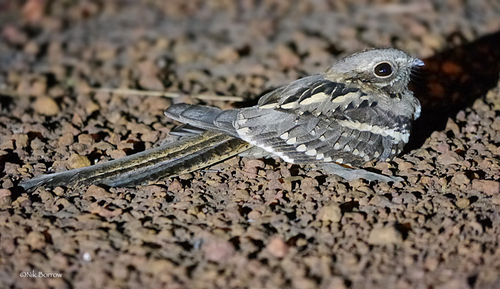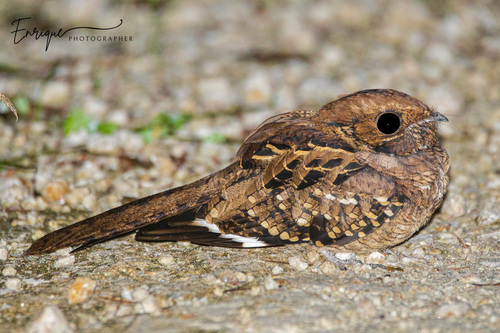
About Nyctidromus albicollis (J.F.Gmelin, 1789)
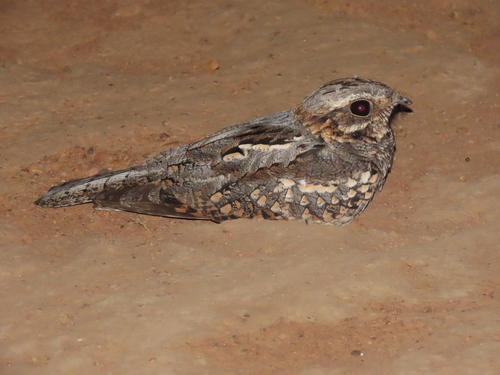
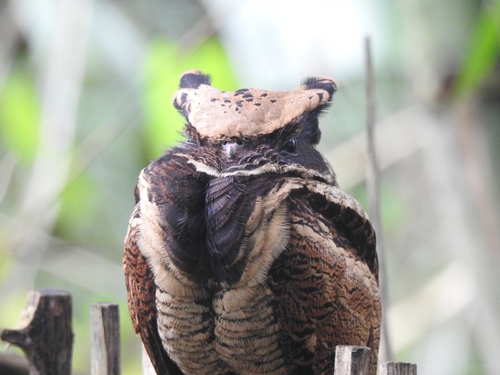
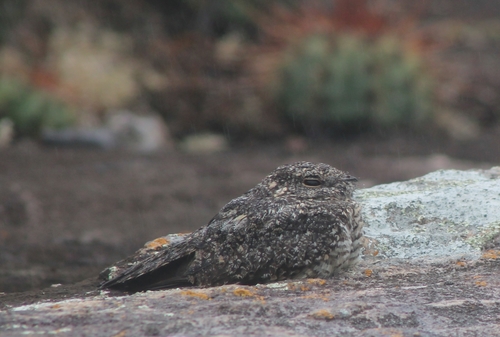
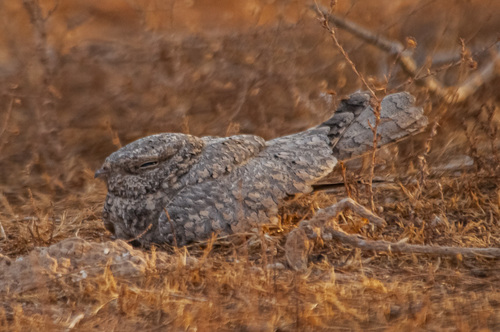
This is a medium-sized nightjar, Nyctidromus albicollis, commonly called the common pauraque.
Size and Morphs
It measures 8.7–11 inches (22–28 cm) in length, and has two colour morphs: variegated greyish-brown or variegated rufous-brown plumage. It has a long tail and broad rounded wings.
Facial Markings
A buff-coloured eye ring and facial stripe contrast with the reddish sides of its face.
Sexual Dimorphism
Adult males have a white band near the wing tips, and their outer tail feathers are mainly white. Females have a narrower wing band, and the white area on their outer tail feathers is more restricted.
Subspecies Variation
There are seven recognized subspecies, which differ from one another in size and the amount of grey in their plumage.
Male Vocalizations
The male's song is highly variable, and includes a whistled weeeow wheeooo (sounded like "who-r-you"), soft puk puk calls, and a whip call given during courtship flight while the male flutters around the female.
Female Vocalizations
The female's call is a rapid series of whip sounds.
The common pauraque's breeding range stretches from southern Texas in the United States to the lower Paraná River region in South America.
Migrant Populations
Most populations are permanent year-round residents, but the North American breeding subspecies N. a. merrilli typically winters in eastern Mexico.
Southern Subspecies Range
At the southern end of the species' range, the subspecies N. a. derbyanus is found from central and southern Brazil into adjacent parts of Bolivia, and extends through Paraguay into Argentina and Uruguay. Even the southernmost pauraque populations appear to be nonmigratory.
Edge of Range Distribution
At the edges of the species' range, it is only distributed in patchy, scattered groups. For example, there are no recorded breeding populations in Entre Ríos Province, Argentina, the species is scarce in Rio Grande do Sul, Brazil, and little is known about its presence in Uruguay except that a moderately sized population lives along the Yaguarón River in the Cuchilla de Mangrullo region.
Common pauraques inhabit open woodland and grassland habitats, and also occur in scrubland and agricultural crop fields.
Terrestrial Adaptations
Compared to other nightjars, this species has longer legs with bare tarsi, and is more terrestrial than most related species. If disturbed, it will sometimes run instead of flying away, and it often rests on roads and tracks.
Habitat Preferences
In general, it prefers mixed habitat that provides densely vegetated hiding spots—ideally forest—for daytime roosting, and open landscape such as rivers or wetlands for nocturnal hunting.
Feeding Behavior
Like other nightjars, the common pauraque is nocturnal and begins flying at dusk. It feeds on insects caught in flight: it typically uses a flycatching strategy from a low perch, but also forages for prey over open ground.
Reproduction
It does not build a nest. Instead, it lays its eggs directly on bare ground or leaf litter; usually two elongated, elliptical pinkish eggs are laid, but occasionally only one egg is produced.
The species is not globally threatened, and is classified as a Species of Least Concern by the IUCN.
Adaptability to Disturbance
It is an adaptable species that tolerates human habitat disturbance well, and has actually benefited from limited deforestation, as logging creates areas of low and secondary growth that allow the birds to hunt more efficiently. However, pauraques will abandon heavily built-up or completely clear-cut areas.
Predation Risk
In addition, the species is very vulnerable to predation by feral dogs and feral cats, and disappears from areas where these animals are abundant.