About Neotis denhami (Children & Vigors, 1826)
Genus Size Comparison
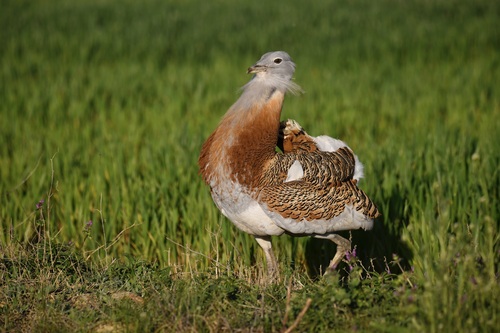
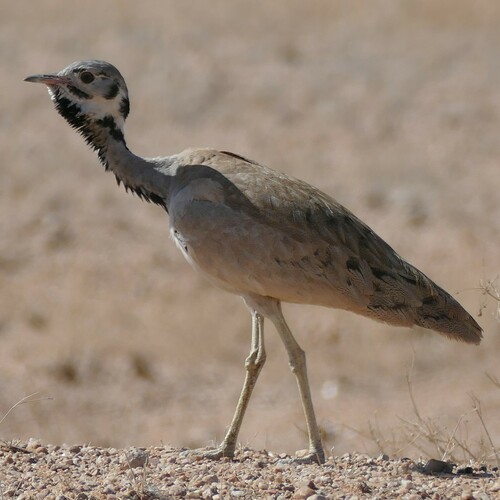
Denham's bustard (Neotis denhami) is the largest species in the genus Neotis, though it is smaller than bustards belonging to the genus Ardeotis, as well as the great bustard.
Size and Weight
Adult males weigh 9 to 10 kg (20 to 22 lb) and measure 100–116 cm (39–46 in) long, while females are much smaller, weighing 3 to 4 kg (6.6 to 8.8 lb) and measuring 80–87 cm (31–34 in) long.
Body and Underpart Coloration
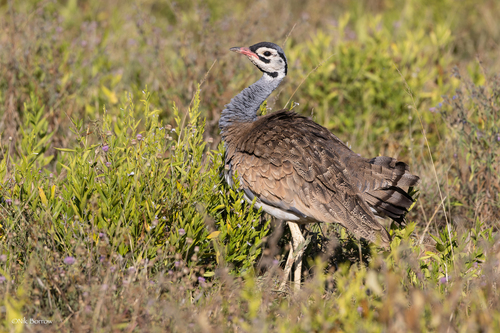
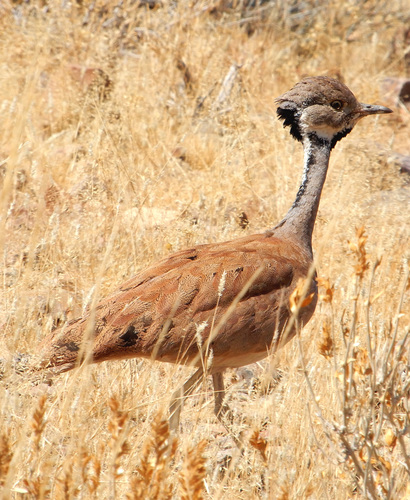
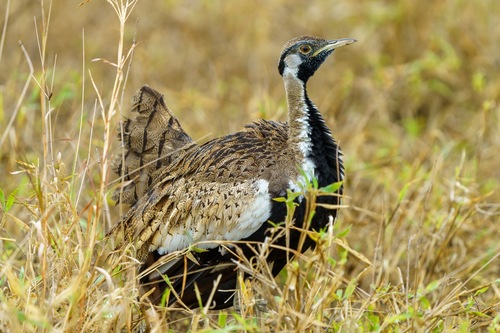
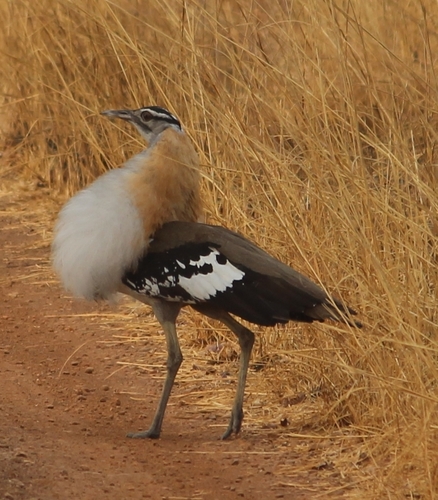
This species has a brown back, which is darker and plainer in males, and white underparts. Its neck is pale grey, with an orange nape.
Head Markings
The grey crown is bordered with black, a black line runs through the eye, and a white line above this forms an eyebrow.
Limb and Bill Coloration
The long legs are pale yellow to yellowish, and the bill is whitish horn-colored.
Wing Pattern
The wings have a striking pattern of brown, white, and black; males have more white in flight than females or young birds.
Male Display Behavior
During display, males inflate their throat to reveal a prominent balloon of white feathers.
Vocalization
This species is usually silent.
Subspecies Count
There are three geographically separated subspecies of Denham's bustard.
N. d. denhami Range
N. d. denhami is found from southwestern Mauritania, Senegal, and Gambia eastwards to Uganda and Ethiopia.
N. d. jacksoni Range
N. d. jacksoni occurs in Kenya and Tanzania, extending south to Zambia, Botswana and Zimbabwe, with additional populations in Angola and the Democratic Republic of Congo.
N. d. stanleyi Range
N. d. stanleyi is native to South Africa and Eswatini.
Primary Habitat and Elevation
Denham's bustard lives in grassland habitats, and is most commonly found in savanna, occurring at elevations up to 3,000 m (9,800 ft).
Secondary Habitats
It can also be found in a wide range of secondary habitats, including dense shrubland, light woodland, farmland, dried marsh, and arid plains.