About Lissotis melanogaster (Ruppell, 1835)
Scientific Name and Basic Morphometrics
The black-bellied bustard (scientific name Lissotis melanogaster (Ruppell, 1835)) measures 58–65 cm (23–26 in) in length, and has dull yellow bill and legs.
Male Upperpart and Underpart Coloration
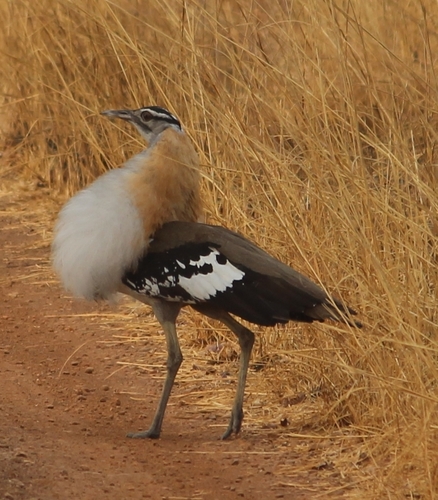
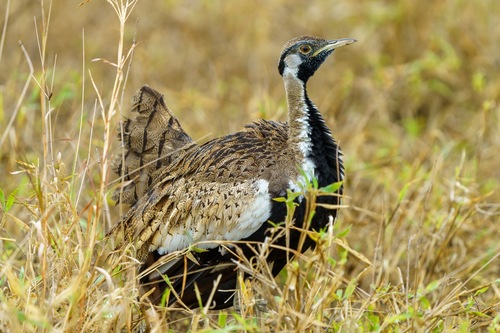
For male black-bellied bustards, the upperparts have black and brown markings on a tawny buff background, while the underparts are solid black. The head has bold patterning made up of black, white, and buff.
Male Neck Markings
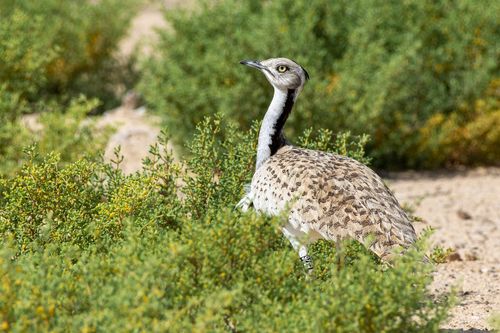
The long, thin neck (thin for a bustard) is buffy brown, with a thin black line running down the front that connects to the black breast.
Male Tail Pattern
The tail is brown and buff, marked with four or five narrow dark brown bands.
Male Wing Markings
The upper surface of the wings is white, with a brown triangle at the base; the flight feathers have black tips, with the exception of the outer secondary feathers. The white wing coloring is visible when the bird stands, creating a sharp contrast with the black underparts.
Female Plumage
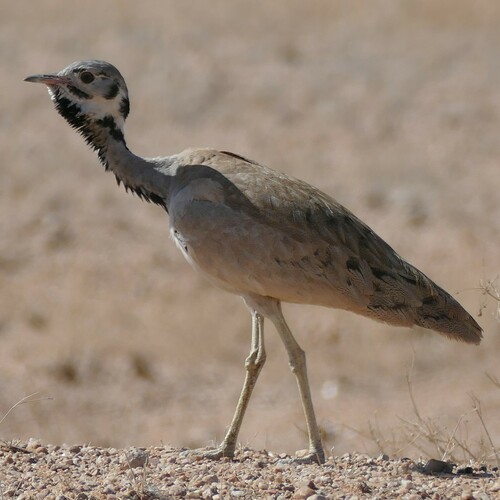
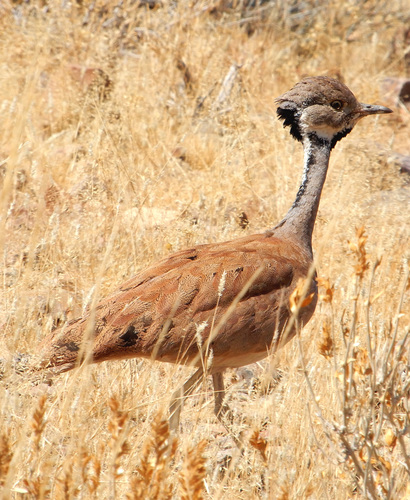
Female black-bellied bustards are plain buff, with cryptic patterning: darker brown mottling on the back, and narrow wavy band markings called vermiculation on the neck and breast.
Juvenile Plumage
Juvenile black-bellied bustards are duller and darker than adults, with a dark grey crown and buff spots on the wings.
Distinction from Hartlaub's Bustard
This species can be told apart from its close relative Hartlaub's bustard by several identifying features: the neck and rump patterns of both sexes, the male's white chin and lores, and the vermiculations on the female's body.
General Habitat and Distribution Range
The black-bellied bustard occurs in savanna, cultivated fields, and tall open grassland across sub-Saharan Africa. Specific regions it inhabits include South Africa, Zimbabwe, Botswana, and parts of Tanzania and Nigeria.
Rainfall Preference
Compared to Hartlaub's bustard, it prefers areas with higher rainfall, and in many regions it is only found after heavy rain.