About Eupodotis caerulescens (Vieillot, 1820)
Common Name and Taxonomy
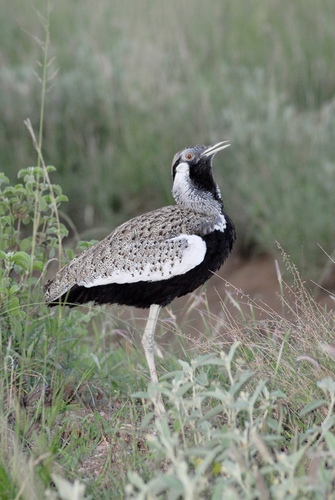
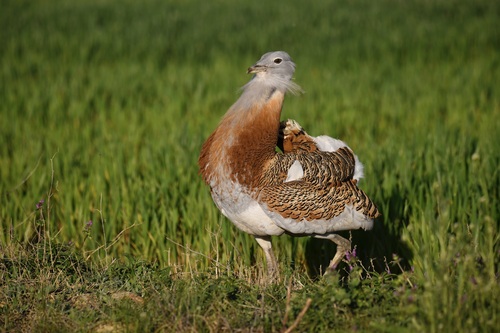
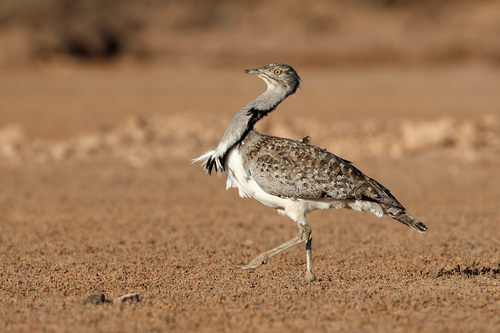
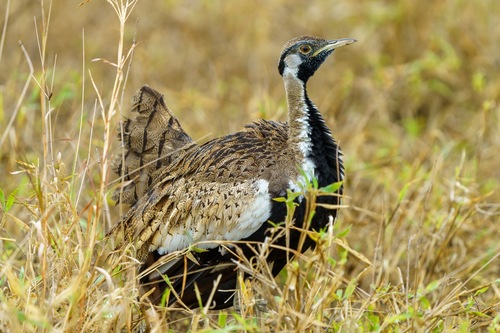
Eupodotis caerulescens, commonly known as the blue korhaan, is a species of ground-dwelling korhaan bird. All korhaans are ground-dwelling birds with sturdy bodies, large heads, long necks, long legs and short toes.
Size
The blue korhaan is a fairly large bird, reaching a total length of 50 to 58 cm (20 to 23 in).
Head Coloration
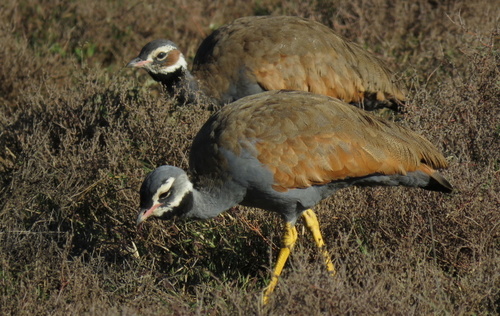
For this species, the forehead and crown are black, while the sides of the head are white.
Male Plumage
Males have brown backs, wings and tails, and bluish-grey necks, throats, breasts and bellies.
Female Plumage
Females have similar overall colouring, but their necks and underparts are a duller grey, and their ear coverts are buff.
Limb Coloration
The blue korhaan's legs and feet are yellow.
Vocalizations
Its call is a series of throaty "krok-kau" notes, most often heard around dawn, and regularly uttered while in flight.
Native Range
The blue korhaan is native to South Africa and the western fringes of Lesotho. Its range extends southward from Pretoria and Mbombela to Bhisho, covering an area of approximately 356,000 km² (137,000 mi²).
Altitudinal Range
It inhabits grassland at altitudes between 1,500 and 3,000 m (5,000 and 10,000 ft).
Preferred Habitat Features
It favours short grass habitats with scattered karoo-type dwarf shrubs, termite mounds and few trees, and it typically occurs within one kilometre of a water source. It can also be found in previously cultivated land, fallow areas, winter crop fields, and pasture.
Locomotion and Anti-predator Behavior
The blue korhaan is largely terrestrial. When disturbed, it crouches down, and when approached closer it tends to walk or run away with its head lowered. If strongly alarmed it will flush into the air and fly a considerable distance.
Social Structure and Diet
It usually occurs in pairs or small family groups, and forages for insects, lizards, scorpions, seeds, flowers and leaves.
Breeding Period
Breeding mainly occurs in October and November.
Nesting and Egg Laying
The nest is a shallow scoop dug into the ground, often placed in thick foliage, where one to three eggs are laid.
Incubation and Parental Care
Incubation lasts approximately 26 days, and family groups may stay together for up to two years.