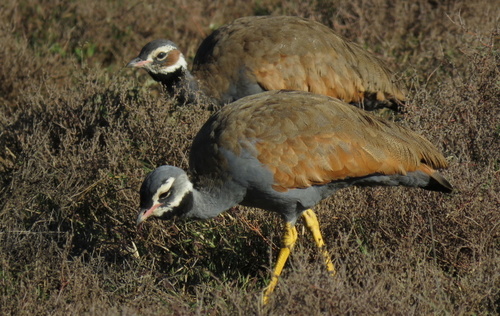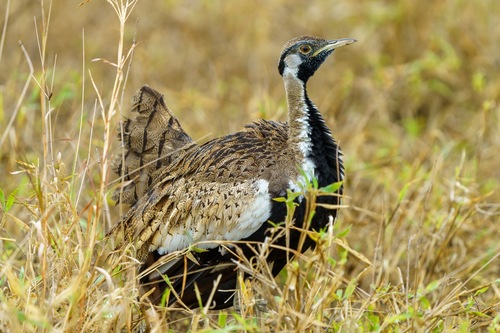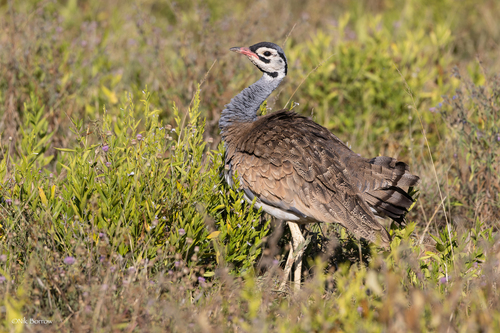
About Eupodotis senegalensis (Vieillot, 1820)
Size
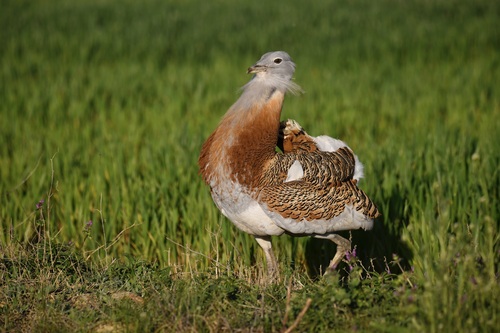
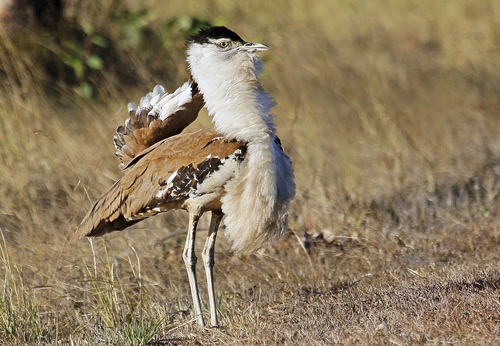
This species, the white-bellied bustard, is a small bustard with a total length of 48 to 61 centimeters (19 to 24 inches).
Adult Plumage Basics
All adults have tawny brown plumage on their upperparts and breast, white belly plumage, and cream-colored legs.
Head and Neck Plumage by Age
Juveniles have light brown necks and heads, while adults have blue-grey necks.
Sexual Dimorphism
This species shows clear sexual dimorphism, with males being larger than females.
Female Head Markings
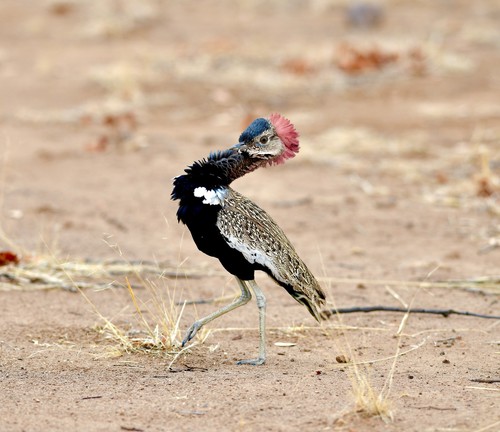
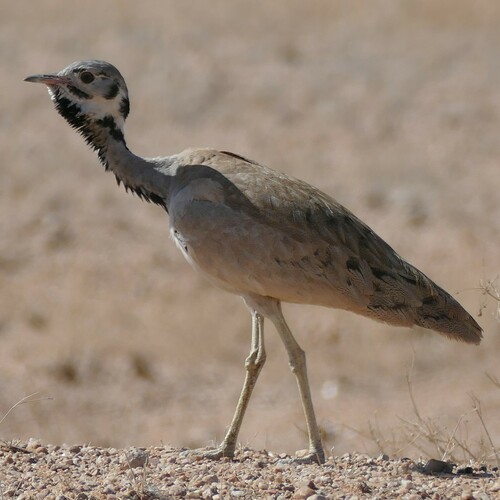
Adult females have a grey crown, a brown and buff stripe running below the eye, and black speckling on the throat.
Male Head Markings
Adult males have a black crown, black markings on their white cheeks, a solid black throat patch, and a pinkish-red bill.
Vocalization
The species' call, which is most often given in early morning and late evening, is described as "a very loud, guttural k'whuka WHUKa, k'wuka WHUKa..., or k'warrak, k'warrak...".
Social Structure
White-bellied bustards are most commonly observed in pairs or small family groups, because juveniles of this species stay with their parents for much longer than juveniles of other regional bustard species.
Continental Distribution
White-bellied bustards are found only on the African continent.
Subspecies Ranges
Outside of small isolated groups, their broad overall range is divided into four geographically distinct population zones, each holding one or more recognized subspecies: the subspecies E. s. barrowii ranges from southeastern Botswana to eastern South Africa and Eswatini; the subspecies E. s. mackenziei ranges from southeastern Gabon south to Angola and west to western Zambia; the subspecies E. s. canicollis and E. s. erlangeri are found across northern Ethiopia and Somalia, northeastern Uganda, and western Kenya through Tanzania; the nominate subspecies E. s. senegalensis ranges across West Africa from Senegal and Gambia south to Côte d'Ivoire, and east to central and southern Sudan.
Primary Habitat
The species mostly inhabits tall grasslands and savannah. It prefers open areas or bushland with dwarf trees.
West African Habitat Adaptations
The West African population is adapted to more arid conditions, and will sometimes enter desert areas during the rainy season.
Non-West African Habitat
Other non-West African populations remain in greener areas of dense tall grass, and can also be found in river plains or cultivated areas.
Elevation Range
In parts of eastern Africa, individuals have been recorded at elevations as high as 2,000 meters (6,600 ft) above sea level, though most sightings occur at 1,500 meters (4,900 ft) elevation or lower, with elevation ranges varying based on regional weather patterns.
Home Range Size
The estimated home range size for breeding pairs or groups of white-bellied bustards is around 40 hectares.
Territory Spacing
In some regions, groups have been observed staying 100 hectares apart from one another, which may indicate larger territory sizes in these areas.