About Neophema chrysogaster (Latham, 1790)
Taxonomy and Size
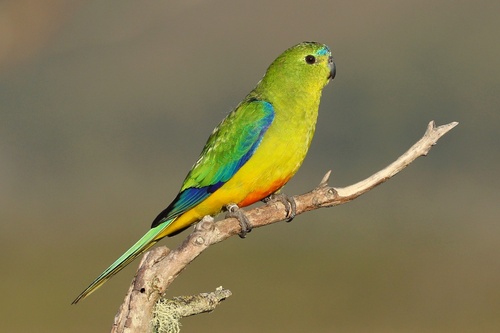
The orange-bellied parrot, scientific name Neophema chrysogaster (Latham, 1790), is a small parrot around 20 cm (8 in) long.
Adult Male Plumage: Head and Upper Body
Adult males have bright green on the head, neck and upperparts, with yellow-green on the breast, abdomen and flanks. The feathers of the cheeks, neck and underparts are yellow-green with lime green tips and fringes, so they appear brighter green right after moulting and more yellowish as plumage wears. Crown feathers are bright green with darker green tips.
Adult Male Plumage: Frontal Band
It has a prominent two-toned blue frontal band: a horizontal dark blue band with a lighter blue border both above and below it. There is an oval orange patch around 2 cm in diameter on the belly.
Adult Male Plumage: Tail and Wings
Undertail coverts are yellow to pale yellow. The uppertail is green-blue with yellow sides. Under wing-coverts and flight feathers are dark blue, with paler blue median wing-coverts.
Adult Male Bill and Facial Features
The upper mandible of the bill is blackish grey with a greyish, orange-brown or salmon-coloured base and cutting edge, while the lower mandible is brownish orange with a grey-black tip. The cere is blackish grey with a pale brown tinge around the nostrils; the orbital eye-ring is light grey and the iris is dark brown.
Adult Male Legs and Feet
The legs and feet are dark grey with a red tinge between scales.
Adult Female Plumage
Adult females have slightly duller green plumage overall, with a paler blue frontal band. Their orange belly patch is around 30% smaller and less distinct.
Moulting Period
Moulting occurs in late winter and early spring.
Juvenile Plumage
Juveniles are duller green to yellow-olive overall, with a much less prominent blue frontal band above the eyes. They have a dull yellowish or orange bill that darkens to brown by the time the bird is three months old.
Contact Call
The orange-bellied parrot most commonly makes a single-note buzzing contact call that is repeated every one to three seconds. This call is generally produced while flying, and is also made by birds that see other individuals flying.
Alarm Call
The alarm call is a quickly repeated tzeet that has a buzzing quality, made by individuals when they are flushed from cover.
Sentry Call
A gurgle-buzz call is produced by birds acting as sentries at feeding areas; it is a mixture of the alarm call interspersed with chattering and hissing.
Feeding Call
When feeding, orange-bellied parrots may make soft low-pitched chitting sounds.
Similar Parrot Species
Blue-winged parrots and elegant parrots can be mistaken for the orange-bellied parrot. They can be distinguished by their tinkling alarm calls and lighter olive-green upperparts.
Similar Species Identification Markers
Their blue frontal bands only have a light blue border on one side. Blue-winged parrots and female elegant parrots have yellow plumage behind and above the eye.
Migratory Status
The orange-bellied parrot is one of only three migratory parrot species.
Breeding Range and Habitat
It breeds solely in South West Tasmania, where it nests in eucalypts that border button grass moors, generally within 30 km of the coast.
Winter Migration Route
The entire population migrates across Bass Strait to spend the winter on the coast of south-eastern Australia. On the way, the parrots may stop over, and occasionally overwinter, on King Island, particularly at Lake Flannigan.
Mainland Wintering Habitat
The few mainland wintering sites are estuaries and lagoons that hold the species' favoured salt marsh habitat, and are generally within 3 km of the coast.
Victorian Wintering Sites
These sites include locations in or near Port Phillip such as Werribee Sewage Farm, the Spit Nature Conservation Reserve, the shores of Swan Bay, Swan Island, Lake Connewarre State Wildlife Reserve, Lake Victoria and Mud Islands, as well as French Island in Western Port.
South Australia Sighting Records
In late 2017, there was a possible sighting at Canunda National Park in South Australia; the most recent confirmed sighting in the state had been five years earlier at Port MacDonnell.
Northwestern Tasmania Sighting Records
In July 2021, two individuals were recorded at Arthur River in northwestern Tasmania; it is unclear whether they returned early from the mainland or did not migrate across Bass Strait at all.