About Poicephalus senegalus (Linnaeus, 1766)
Size
Senegal parrots (Poicephalus senegalus) measure around 23 centimetres (9.1 inches) in length, and weigh between 120 and 170 grams (4.2 to 6.0 ounces).
Body Structure
For their overall body size, they have a relatively large head and beak, and their feathers form a short, broad tail.
Adult Plumage
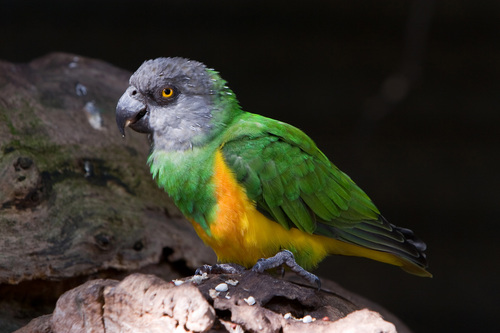
Adult Senegal parrots have a charcoal grey head, grey beak, bright yellow irises, green back and throat, and yellow underparts and rump.
The yellow and green areas on the front of their body form a V-shape that looks like a yellow vest over a green base.
Juvenile Iris Coloration
Juvenile Senegal parrots have dark grey, almost black, irises that lighten to light grey as they mature.
Sexual Dimorphism Status
Senegal parrots are not sexually dimorphic, but there are unconfirmed hypotheses that can sometimes help identify the sex of adult birds.
Vest Marking Sex Differences
The V-shaped 'vest' marking is usually longer in females: in females, the green area extends down over the chest to the space between the legs, while in males the tip of the green area ends halfway down the chest.
Head and Beak Sex Differences
Females generally have slightly smaller and narrower beaks and heads than males.
Undertail Covert Sex Differences
The undertail covert feathers, short feathers located under the base of the main tail feathers, are typically mostly yellow in males and mostly mostly green in females.
Size Sex Differences
Males are generally, though not always, larger and heavier than females.
Sex Testing
DNA testing is a reliable alternative method to determine a Senegal parrot's sex.
Habitat Type
Senegal parrots inhabit open woodland and savanna.
Geographic Range
They are most commonly found flocking in countries across West Africa.
Social Behavior and Vocalizations
This is a gregarious species that chatters continuously, producing a range of whistling and squawking calls.
Lifespan
In the wild, Senegal parrots have an average lifespan of approximately 25 to 30 years, and individuals have been recorded living up to 50 years in captivity.
Diet Composition Overview
A study conducted by Texas State University in southeastern Senegal found that the diet of wild Senegal parrots is around 77% fruit.
Common Fruit Prey
The most commonly eaten fruits are figs (Ficus sp.), African grapes (Lannea microcarpa), and shea fruits (Vitellaria paradoxa).
Remaining Diet Components
Seeds make up around 22% of their diet, and the remaining 1% is composed of flowers.