About Ara chloropterus G.R.Gray, 1859
Common Names
This species is commonly known as the green-winged macaw, also called the red-and-green macaw.
Distinction from Scarlet Macaw
It can be easily distinguished from the scarlet macaw by several key features.
Upper-Wing Covert Feather Comparison
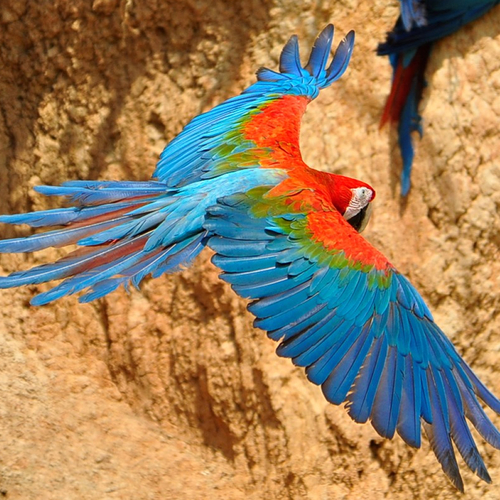
While both species have bright red breasts, the upper-wing covert feathers of the green-winged macaw are mostly green; in comparison, the scarlet macaw's upper-wing covert feathers are mostly yellow or a strong mix of yellow and green.
Eye Feather Markings
Additionally, the green-winged macaw has characteristic red lines around its eyes, formed by rows of tiny feathers on an otherwise bare white skin patch.
Noticeable Identification Feature
This feature is one of the most noticeable differences to casual observers comparing green-winged macaws to scarlet macaws.
Tail Feather Coloration
The species has iridescent teal tail feathers that are surrounded by red.
Size Comparison to Scarlet Macaw
When viewed alongside each other, the green-winged macaw is clearly larger than the scarlet macaw.
Size Ranking Among Macaws
Among all macaw species, the green-winged macaw is the second largest, exceeded only in length by the hyacinth macaw, which is the largest macaw species.
Body Length
Adult green-winged macaws reach a total body length of 90 to 95 cm (35 to 37 in).
Weight Measurements
A sample of twelve adults had an average weight of 1,214 g (2.676 lb), and a total weight range of 1,050 to 1,708 g (2.315 to 3.765 lb) has been reported for the species.
Weight Comparison to Other Macaws
Although the green-winged macaw's weight range is broadly similar to that of the hyacinth macaw, its average weight is slightly lower than the average weights of both the hyacinth macaw and the great green macaw.
Weight Comparison to Other Parrots
Among all living parrots, the kākāpō also has a higher average weight than the green-winged macaw.