About Cacatua pastinator (Gould, 1841)
Taxonomy and Common Name
Cacatua pastinator, commonly known as the western corella, is a species of cockatoo.
General Body Structure
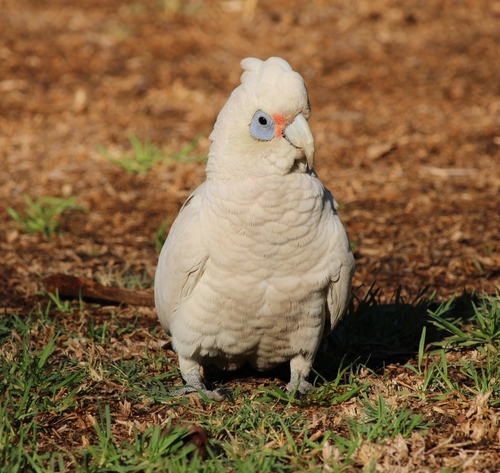
This medium-sized stocky cockatoo has broad rounded wings, a short tail, and a crest that is usually flattened, though it can be held erect.
Plumage Coloration (Main)
It is primarily white: the upper wing is entirely white, and the under surface of the wing is pale yellow.
Head and Facial Features
It has an erect white crest, blue-grey bare eye skin, crimson pink colouring between the eyes and beak, a small pink patch on the throat, and a long, pointed dull greyish-white bill.
Bill and Leg Features
The upper mandible has an especially long tip, and legs are dark grey.
Underpart Plumage Condition
The underparts are often stained or dirty from feeding on the ground and digging.
Sexual Dimorphism
The species lacks sexual dimorphism, so the sexes are difficult to distinguish.
Sex Identification Traits
Sex cannot be determined by eye colour or plumage, but observations of pairs confirm that males are larger than females and have a deeper alarm call.
Recognized Subspecies
There are two recognized subspecies: the nominate Muir's Corella (Cacatua pastinator pastinator) and the smaller northern subspecies Butler's Corella (Cacatua pastinator butleri).
Muir's Corella Size and Weight
Adult Muir's Corella measure 43–48 centimetres (17–19 in) in length and weigh 560–815 grams (19.8–28.7 oz).
Butler's Corella Size and Weight
Adult Butler's Corella measure 40–48 centimetres (16–19 in) in length and weigh up to 700 grams (25 oz).
Culinary Use
The flesh of the western corella is described as plump and tender, and suitable for stewing.
Overall Subspecies Distribution Range
Both subspecies have isolated, separate populations restricted to south-west Western Australia.
Butler's Corella Distribution and Population
Butler's Corella is found in the northern and central wheatbelt of south-western Australia, with a population of 5000–10000 birds.
Muir's Corella Distribution and Population
Muir's Corella is found in the far south-west of Western Australia, with an approximate population of 1000 birds.
Historical Population Status (19th Century)
At the time of European colonisation of Western Australia, the species was common, and large flocks were still recorded throughout the nineteenth century.
Historical Distribution Inference
The lack of specific records from early collector John Gilbert has been interpreted to suggest the corella was once abundant and widespread across the region.
General Habitat Characteristics
Its habitat consists of low-relief undulating land (less than 100 m elevation) where over 90% of native vegetation has been cleared for wheat and sheep farming.
Remaining Native Vegetation Status
Remaining woodland and shrub vegetation is restricted to small isolated patches and road reserves.
Critical Habitat Elements
Habitat critical to the species includes large eucalypts and other trees (both living and dead), found in forested areas, as isolated paddock trees, or along roadside vegetation.
Preferred Tree Species
Preferred tree species are marri (Corymbia calophylla), jarrah (Eucalyptus marginata), moitch (Eucalyptus rudis), yate (Eucalyptus cornuta), and the paperbark moonah (Melaleuca preissiana).
Movement Pattern Context
Within the central wheatbelt of Western Australia, Cacatua pastinator displays three movement phases that depend on the age of the bird.
Breeding Season Timing
Breeding occurs in spring.
Post-Fledging Movement
After nestlings fledge, family groups join flocks of immature birds and move to summer feeding locations.
Parental Post-Weaning Movement
The young are weaned within the following month, after which parents return to their breeding grounds between January and March.
Juvenile Return Timing
Juveniles do not return to breeding grounds until May or June.
Natal Site Fidelity
While some individuals disperse to other breeding areas, most show attachment to their natal area, and some birds have been recorded returning to their natal area after being absent for up to five years.