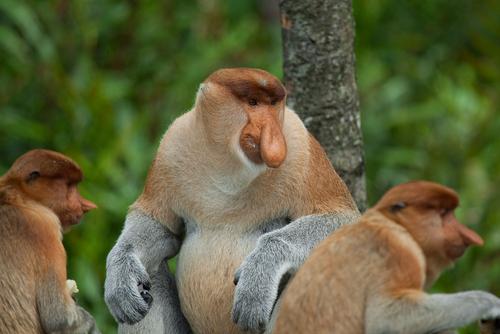
About Nasalis larvatus (van Wurmb, 1787)
Species Size
The proboscis monkey (scientific name: Nasalis larvatus (van Wurmb, 1787)) is a large species, one of the largest monkey species native to Asia. Only the Tibetan macaque and a few gray langur species can match its size.
Sexual Dimorphism
This species has pronounced sexual dimorphism.
Male Body Measurements
Males have a head-body length of 66 to 76.2 cm (26.0 to 30.0 in), typically weigh 16 to 22.5 kg (35 to 50 lb), and reach a maximum known weight of 30 kg (66 lb).
Female Body Measurements
Females have a head-and-body length of 53.3 to 62 cm (21.0 to 24.4 in), weigh 7 to 12 kg (15 to 26 lb), and have a maximum known mass of 15 kg (33 lb).
Male Genital Coloration
Males have a red penis and a black scrotum.
Adult Coat Coloration
Proboscis monkeys have long coats; fur on the back is bright orange, reddish brown, yellowish brown, or brick-red. Underfur ranges from light-grey, yellowish, and greyish to light-orange.
Infant Facial Color Development
Infant proboscis monkeys are born with a blue face that darkens to grey by 2.5 months of age, and turns the cream color of adult faces by 8.5 months of age.
Shared Physical Traits
Both sexes have bulging stomachs that create a pot-bellied shape, and many of the species' toes are webbed.
Species Distribution
Proboscis monkeys are endemic to the island of Borneo, found across all three nations that share the island: Brunei, Indonesia, and Malaysia.
Habitat Range Restrictions
The species is most common in coastal areas and along rivers, and is restricted to lowland habitats that may experience tides.
Occupied Habitat Types
It favors dipterocarp, mangrove, and riverine forests, but can also be found in swamp forests, stunted swamp forests, rubber forests, rubber plantations, limestone hill forests, nypa swamps, nibong swamps, tall swamp forests, tropical heath forests, and on steep cliffs.
Water Source Proximity
This species usually stays within at least one kilometer of a water source.
Swimming Capabilities
It is likely the most aquatic primate, and is a fairly strong swimmer capable of swimming up to 20 m (66 ft) underwater, and is known to swim across rivers.
Arboreal Movement
Aside from its aquatic activity, the proboscis monkey is largely arboreal, moving quadrupedally and by leaping. It is known to jump from branches down into water.
Female Sexual Maturity
For reproduction, female proboscis monkeys reach sexual maturity at five years of age. They experience sexual swelling, where their genitals turn pink or red.
Mating and Birth Seasons
At one monitored site, most matings occur between February and November, and most births take place between March and May.
Copulation Duration and Position
Copulation typically lasts around 30 seconds. Males grab females by the ankles or torso and mount them from behind.
Mating Initiation
Both sexes will initiate mating attempts, but attempts are not always successful.
Mating Solicitation Behaviors
When soliciting mating, both sexes make pouted faces. Males may also vocalize, while females present their backsides and shake their head from side to side.
Mating Harassment
Mating pairs are sometimes harassed by subadults.
Non-Reproductive Mounting
Proboscis monkeys also engage in non-reproductive mounting, including playful mounting and same-sex mounting, and females may attempt to initiate copulation even after they have conceived.
Gestation Period
Gestation usually lasts 166 to 200 days, or slightly longer.
Birth Behaviors
Females typically give birth at night or in the early morning. After birth, mothers eat the placenta and lick their infants clean.
Infant Development Milestones
Young proboscis monkeys start eating solid foods at six weeks old and are weaned at seven months old. A young male's nose grows slowly until he reaches adulthood.
Alloparenting Behavior
Mothers allow other members of their social group to hold their infants.
Infanticide Risk
When the resident male of a one-male social group is replaced, resident infants are at risk of infanticide.