About Piliocolobus kirkii (Gray, 1868)
Common Name and Classification
Piliocolobus kirkii, commonly called the Zanzibar red colobus, is an Old World monkey species.
Coat Coloration
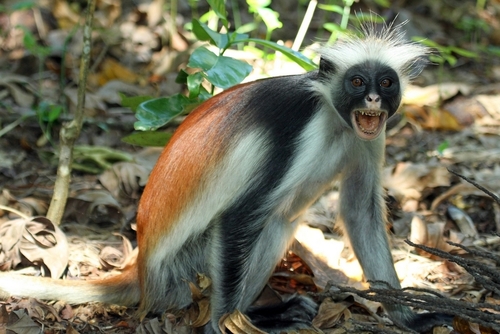
Its coat ranges in color from dark red to black, with a black stripe running along the shoulders and arms and a pale underside. It has a black face topped with long white hair, and a distinct pink marking on its lips and nose.
Tail Characteristics
This species has a long tail that is only used for balancing, and it is not prehensile.
Sexual Dimorphism
Sexual dimorphism is reduced in this species, meaning females show very little difference in body size and coloration from males. In social groups of this monkey, females usually outnumber males.
Cranium, Body Shape, and Weight
The species has a characteristically small cranium and a round body shape: adult males can reach over 12 kg (26 lb), while adult females typically reach around 10 kg (22 lb).
Facial Recognition Function
Adult Zanzibar red colobuses have highly distinct facial features that help them recognize one another within their group.
Etymology of "Colobus"
The name "colobus" comes from the Greek word ekolobóse, meaning "he cut short", a reference to the species' greatly reduced or completely absent opposable thumb compared to other primates.
Grasping Adaptation
To compensate for the lack of a fully developed thumb, these monkeys have four long digits that align to form a strong hook, which lets them easily grasp branches and climb.
Local Swahili Name
Local people on Zanzibar call this species kima punju, which translates to "poison monkey" in Swahili, because it has a strong smell that differs from other monkeys.
Local Cultural Perceptions
This local name reflects widespread negative views of the monkey, including the belief that it negatively influences the trees it feeds on and ultimately kills them.
Geographic Range
The Zanzibar red colobus is only found in three forests of the Zanzibar archipelago.
Arboreal Habitat Preference
While it has a wide tolerance of different habitats, it is primarily an arboreal species and prefers drier areas over wet ones.
Habitat Types
Its known habitats include coastal thickets, coral rag scrub, agricultural areas, and mangrove swamps; mangrove swamps provide the species with a year-round source of food.
Agricultural Area Behavior
When living in agricultural areas, these monkeys are more accustomed to humans and spend more time closer to the ground.
Total Population Size
Currently, only 1,600 to 3,000 individuals of this species remain, and 50% of the island's population lives outside of protected areas.
Protected Habitat
The largest and most important protected habitat for the species is Jozani National Park on Zanzibar's main island, which provides a 25 km2 (9.7 sq mi) reserve. Populations within this park have been the subject of extensive research into the species' ecology and behavior.
Adjacent Farmland Populations
Even so, many social groups are found in shambas (Swahili for farmland) that lie adjacent to the park. Higher population densities and more cohesive social groups have been recorded in these adjacent farmlands than inside the park reserve.
Unprotected Population Risk
The fact that some groups live permanently outside of the protected park reserve increases the risk of endangerment for these groups.
Sexual Maturity Age
Male Zanzibar red colobuses usually reach sexual maturity at 3 to 3.5 years old, while females reach sexual maturity at around two years old.
Estrus Signaling
Females entering estrus are easily identified by the swelling and bright red coloration of their genital area, which signals to males that they are ready to mate.
Mating Preparation Behavior
Just before mating occurs, males use their fingers to probe the female's birth canal, then sniff the area to detect estrogen and progesterone to confirm the female is ready to breed.
Gestation Period
The gestation period for this species is about six months.
Reproductive Output
A single female typically produces one or two newborns every two years.
Parental Care
Parental care is intensive, and it is often shared by multiple females within the social group.
Birth Seasonality
Around 76% of all offspring are born between September and December.
Infanticide Occurrence
Infanticide has occasionally been observed when a new male joins a social group that already has infants.
Charcoal Consumption and Birth Rates
Research suggests that dietary expansion, made partially possible by the consumption of charcoal, supports higher birth rates and higher population densities by increasing available resources.
Habitat Birth Rate Variation
Birth rates are higher for Zanzibar red colobuses living in mangroves than for those living in coral rag forests.
Geographical Birthing Peaks
Birthing peaks occur between October and December for populations on Uzi Island, and between January and February for populations in Kiwengwa, on the eastern side of Zanzibar's main island.
Infant Mortality Rate
Infant mortality is very high: half of all infants do not survive past six months of age.
Mainland Colobus Comparison
Compared to mainland colobus monkeys, birth rates are lower for the Zanzibar red colobus, and interbirth intervals are longer. Research suggests this difference is a result of the disturbed habitats the Zanzibar species occupies, a condition mainland colobus populations do not face.