About Melanerpes cactorum (d'Orbigny, 1840)
Size
The adult white-fronted woodpecker (Melanerpes cactorum) measures approximately 17 cm (7 inches) long.
Sexual Dimorphism
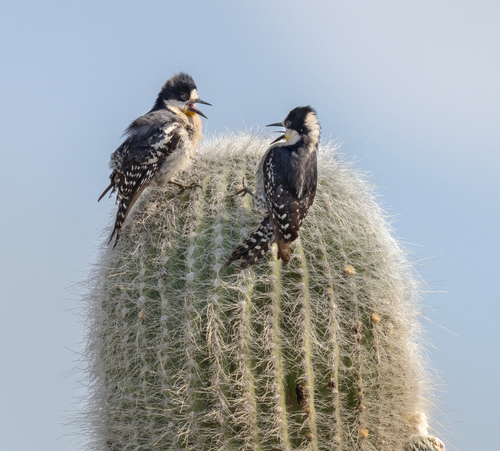
Males and females look similar, with one key difference: only males have a small, not always visible red patch on the crown.
Head and Upper Body Plumage
This species has glossy black plumage on the crown, nape, and upper body, with a thin white line running from a white nape patch down the center of the back. A black mask surrounds the eye and stretches out to the mantle.
Wing Features
The upper surface of the wings is bluish-black with bold white barring, while the underside of the wings is browner.
Tail Features
The upper side of the tail is black with white markings, and the underside is also browner.
Face and Underpart Plumage
The fore-crown and cheeks are white, and the chin and throat may be white, yellow, or buff. The breast and belly are some shade of grey, with indistinct barring across the flanks and lower belly.
Bare Part Characteristics
The iris is reddish-brown, the beak is greyish-black, and the legs are grey.
Juvenile Traits
Juveniles resemble adults but generally have duller black plumage, more heavily barred underparts, and both sexes show faint red or orange coloring on the mid-crown.
Geographic Range
White-fronted woodpeckers are native to central South America, with a range covering southeastern Peru, Bolivia, Uruguay, northern Argentina, Paraguay, and southeastern Brazil.
Habitat Types
Their typical habitats include chaco, savannah, and semi-desert areas with scattered trees, shrubs, and cacti. They can also be found in palm groves, gallery forests, and agricultural land with scattered trees.
Altitude and Movement
They live at altitudes up to 2,500 m (8,000 ft), and are a non-migratory, sedentary species.