About Chrysophlegma miniaceum (Pennant, 1769)
Scientific Name and Upperparts
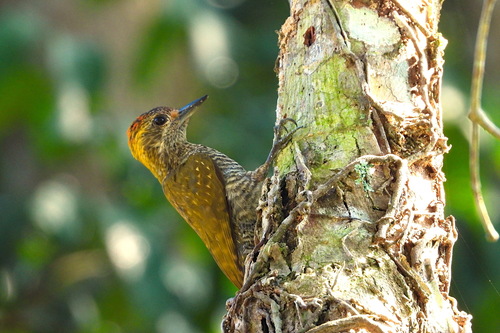
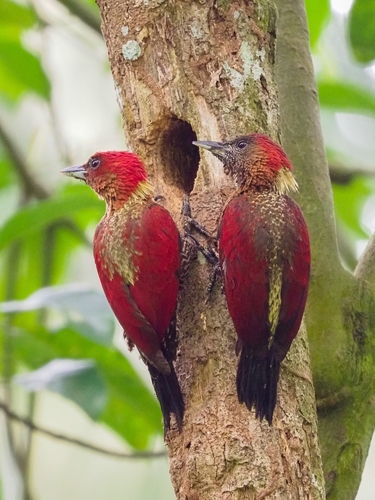
Banded woodpecker, with the scientific name Chrysophlegma miniaceum (Pennant, 1769), has predominantly rufous-brown upper parts. Its mantle is dull olive with buff scaling, and its rump is yellow.
Tail and Head Plumage
The tail is chocolate-brown. Most of its head is rufous-brown, with a shaggy yellowish nape.
Underparts Plumage
Its chin, neck and throat are reddish-brown, its breast is reddish with olive barring, and its whitish belly is heavily barred with brownish-black.
Sexual Dimorphism in Plumage
The two sexes differ slightly: the male has a redder face and throat, while the female has browner face and throat flecked with white. Both sexes share a dark beak, a chestnut eye with a bluish orbital ring, and greenish legs.
Adult Size
Adult banded woodpeckers are around 26 cm (10 in) long.
Native Range
This species is native to tropical southeastern Asia. Its range stretches from southern Myanmar, through the Malay Peninsula, Sumatra and Borneo, to Java.
Migratory Status and Elevation Range
It is a sedentary, non-migratory species that occurs mainly in the lowlands.
Habitat Types
Its primary habitat is primary rainforest containing vines, epiphytes, tangled shrubs and fallen trees, but it also lives in secondary forest, plantations, coastal scrub, mangroves, parks, wooded suburbs and overgrown gardens.
Foraging Behavior
Banded woodpeckers feed alone or in pairs, foraging unobtrusively in vines, dense cover and higher up in the canopy, probing into crevices, moss and epiphytes.
Diet Composition
Their main diet consists of ants, their eggs and larvae, plus other small invertebrates.
Breeding Period Variation
Breeding occurs at different times of year across the species' range.
Malay Peninsula Nesting Timeline
In the Malay Peninsula, nesting activity has been observed in January, with nestlings present between February and August.