About Picus canus J.F.Gmelin, 1788
Size and Morphometrics
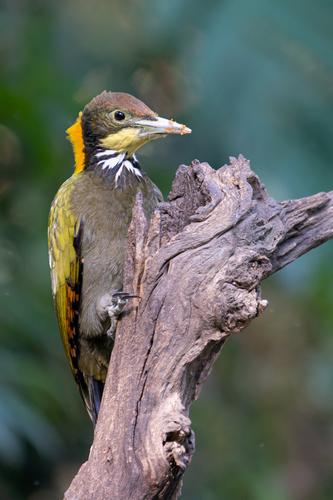
The grey-headed woodpecker, Picus canus J.F.Gmelin, 1788, measures 25–26 cm (9.8–10.2 in) in length, has a wingspan of 38–40 cm (15–16 in), and weighs around 125 g (4.4 oz).
Nominate Male Plumage
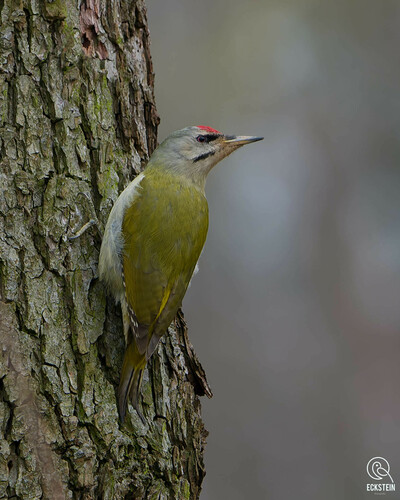
For the nominate subspecies, the male has a grey head with a red forecrown, a black line across the lores, and a narrow black moustache stripe. Its back, scapulars, and wing coverts are green; its breast and underbody are pale grey; its folded primaries have brown-black barring on a grey-white base.
Nominate Female Plumage
The female lacks the male’s red forecrown, but has fine black streaks on the crown.
Size Comparison to Related Species
This species is on average somewhat smaller and lighter than the European green woodpecker. This size difference is difficult to distinguish in the field, and the grey-headed woodpecker is roughly the same size as a Eurasian collared dove.
Morphological Differences from Green Woodpecker
Compared to the European green woodpecker, it also has a shorter neck, slimmer bill, and slightly rounder head.
General Plumage Features
Overall, grey-headed woodpeckers have uniformly olive green upperparts that transition to light grey across the neck, with the head being light grey. Typical woodpecker markings are small and not especially conspicuous.
Subspecies Overview
Multiple subspecies of Picus canus have been described with distinct physical traits.
Picus canus jessoensis Traits
The widely distributed Picus canus jessoensis is very similar to the nominate subspecies, but is slightly greyer and less green. Specimens of P. c. jessoensis, the more widespread of the two Eastern subspecies, are usually a little larger and heavier than individuals from the nominate type locality.
Picus canus guerini Traits
The Chinese subspecies Picus canus guerini has a black nape patch and a greenish underbody.
Picus canus hessei Traits
Picus canus hessei is similar to P. c. guerini, but is more golden green on its upperparts and a deeper green on its underparts.
Picus canus dedemi Traits
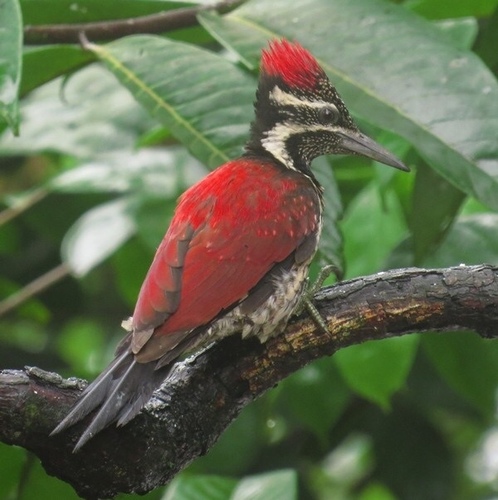
The subspecies Picus canus dedemi is very distinctive in appearance: males have brownish red upperparts, a bright red rump, and a black tail.
Global Distribution Range
The grey-headed woodpecker occurs across large parts of central, northern, and eastern Europe, and across a wide belt south of boreal coniferous forests spanning Asia all the way to the Pacific coast, Sakhalin, and Hokkaidō.
Range Limits
Its northern range limit lies at the border between closed coniferous and mixed forest; its southern range limit is where tree steppe transitions to treeless shrubby steppe.
East Asian Distribution
The species shows the most genetic and physical differentiation in East Asia; south of Manchuria, its range covers the Korean Peninsula, large parts of eastern China, the Himalaya, and the mountain forests of the Malay Peninsula.
European Nominate Subspecies Range
In Europe, the nominate subspecies breeds across a wide belt from western France to the Urals. It occurs in the middle latitudes of Scandinavia, as well as in central, eastern, and southern Europe.
Southern European Distribution
In Italy, it is restricted only to the northernmost areas.
Turkish Distribution Status
There is conflicting information about whether the species occurs in Turkey; it is most likely that several hundred pairs breed in the Mittelgebirge habitats of the Pontic Mountains.
Absent Regions
The species is not present on the North German Plain, British Isles, Iberian Peninsula, or Mediterranean islands.
Foraging Specialization
Compared to the European green woodpecker, the grey-headed woodpecker is a less specialized hunter of ants. Its foraging strategy is intermediate between that of many Dendrocopos woodpecker species, and that of the often ant-specialized members of the genus Picus.
Coexistence with Green Woodpecker
This lower degree of ant specialization allows it to live in the same geographic range as European green woodpeckers, and even to breed around 100 meters away from them.
Primary Diet Components
Even so, ants and their immature forms make up the majority of the grey-headed woodpecker’s diet, especially in spring and summer. Wood ants of the genus Formica, alongside members of Lasius and Myrmicinae such as Myrmica species, are the main prey items; combined with termites, these groups can make up 90% of the species’ diet.
Other Animal Prey
Other prey items include caterpillars, crickets, bark and wood beetle larvae, flies, spiders, and lice.
Vegetable Diet
In late autumn and early winter, grey-headed woodpeckers regularly add significant amounts of vegetable matter such as berries and other fruit to their diet.