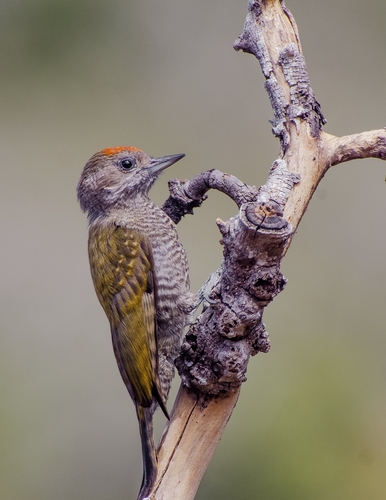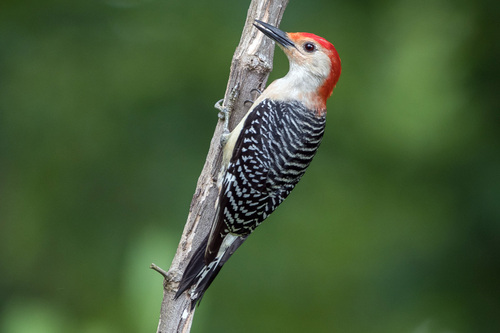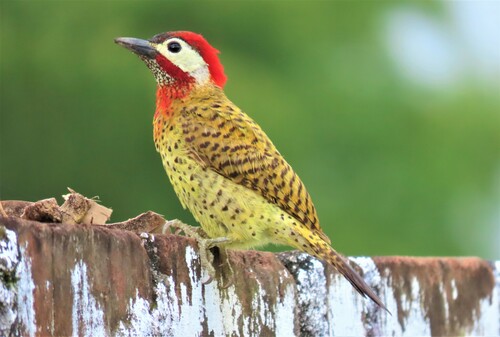
About Colaptes punctigula (Boddaert, 1783)
Size and Weight
The spot-breasted woodpecker (Colaptes punctigula) is 18 to 21 cm (7.1 to 8.3 in) long and weighs 50 to 79 g (1.8 to 2.8 oz).
Sexual Dimorphism Overview
Males and females have identical plumage everywhere except on their heads.
Nominate Subspecies Adult Male Head Plumage
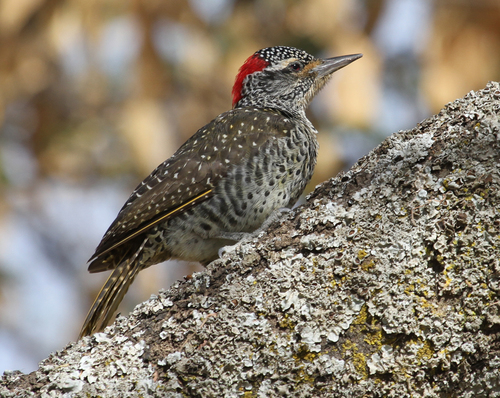
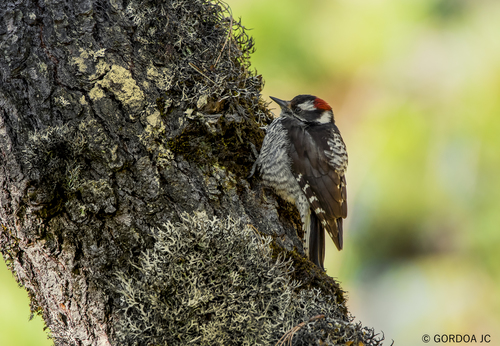
For the nominate subspecies C. p. punctigula, adult males have a black forehead and forecrown, and a red hindcrown and nape. A white stripe extends from the lores around the eye to the nape, with a red malar stripe below this stripe. Their chin and throat are black with white spots.
Nominate Subspecies Adult Female Head Plumage
Adult females only have red on the very back of the crown.
Nominate Subspecies Upperparts Plumage
Both sexes of the nominate subspecies have bronze-green upperparts marked with brownish black bars; the rump and uppertail coverts are paler with less heavy barring. Their flight feathers are brown with pale barring and yellow shafts.
Nominate Subspecies Tail Plumage
The upperside of their tail is brown: the central tail feathers have weak bars, and the outer tail feathers have green to yellow bars. The underside of the tail is yellow-brown with brown bars.
Nominate Subspecies Underparts Plumage
Their underparts are dull olive-yellow with a reddish tinge on the upper breast, and small black spots across the upper breast, lower breast, and flanks. Their undertail coverts are yellowish with black spots.
Nominate Subspecies Bare Parts
They have a short blackish bill, a rufous brown iris, and greenish gray legs that sometimes have a yellowish tinge.
Juvenile Plumage
Juveniles are generally duller than adults, have greener upperparts, and larger spots on their underparts.
Subspecies C. p. striatigularis Characteristics
Subspecies C. p. striatigularis has an almost all-white throat with a few black streaks, a reddish tinge on the rump and breast, and fairly heavy spotting on the underparts.
Subspecies C. p. ujhelyii Characteristics
Subspecies C. p. ujhelyii also has an almost all-white throat with very few streaks, has a large amount of red to orange on the breast, and has much less barring on the upperparts than the nominate subspecies; males of this subspecies often have an entirely red crown.
Subspecies C. p. zuliae Characteristics
Subspecies C. p. zuliae is slightly larger than the nominate, rather dull-colored on its upperparts, has very little black on the throat, and has sparser spotting on the breast.
Subspecies C. p. punctipectus Characteristics
Subspecies C. p. punctipectus has greener upperparts than the nominate without the nominate's bronzy tone, has a black throat with large white spots, and is dull-colored on its underparts with fewer and smaller spots.
Subspecies C. p. guttatus Characteristics
Subspecies C. p. guttatus has large white spots on the throat, is very olive on the breast, and has heavier spotting on its lower underparts than the nominate.
Subspecies Distribution
The different subspecies of spot-breasted woodpecker have separate ranges: C. p. ujhelyii is found from eastern Panama to northern Colombia; C. p. striatigularis is found in west-central Colombia; C. p. punctipectus is found in eastern Colombia and most of Venezuela except northwestern Venezuela; C. p. zuliae is found in northwestern Venezuela; C. p. punctigula is found in the Guianas and Amapá in northern Brazil; C. p. guttatus is found in the Amazon Basin of eastern Ecuador, eastern Peru, northeastern Bolivia, and western to northeastern Brazil.
Habitat Preferences
The spot-breasted woodpecker lives in a wide variety of humid lowland landscapes that include both open and wooded areas, though it prefers sparse woodlands over dense woodlands. It can be found in rainforest, deciduous forest, gallery forest, várzea, mangroves, llanos, palm savanna, and treed plantations including palm plantations and shade coffee plantations.
Elevation Range
In terms of elevation range, it mostly occurs up to 600 m (2,000 ft) in Venezuela, up to 1,500 m (4,900 ft) in Colombia, up to 1,200 m (3,900 ft) in Ecuador (and locally up to 1,600 m / 5,200 ft), and up to 900 m (3,000 ft) in Peru.