About Dryocopus lineatus (Linnaeus, 1766)
Size and Relative Species
The lineated woodpecker (Dryocopus lineatus) measures 31.5 to 36 cm (12.4 to 14.2 in) in length, and resembles its close relative the pileated woodpecker (Dryocopus pileatus) native to the United States and Canada.
Adult Plumage Upperparts
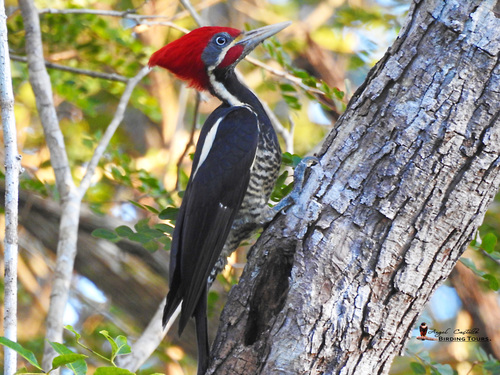
Adult lineated woodpeckers are mostly black on their upper bodies, with a red crest and whitish lines that run from the base of the bill down the neck and shoulders; individuals from the southeastern portion of the species' range often lack the shoulder line.
Underpart and Flight Plumage
Their underparts are whitish and marked with heavy black barring, and they display white wing plumage when in flight.
Sexual Dimorphism Head Plumage
Adult males have a red malar stripe running from the bill to the throat, along with a red forehead; in adult females, both of these plumage traits are black.
Bill Coloration
The bill is usually black for both sexes, though pale-billed individuals are regularly observed.
Vocalization and Drumming
This widespread but wary bird produces a loud, ringing wic-wic-wic call, and both sexes drum on wood.
Similar Species Overview
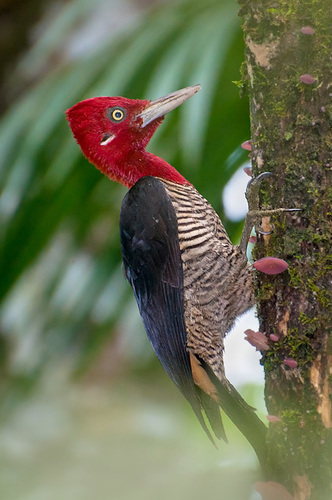
Across most of the lineated woodpecker's range, it is most easily confused with the crimson-crested woodpecker (Campephilus melanoleucos), which is similar in both plumage and size.
Female Crimson-crested Woodpecker Traits
Female crimson-crested woodpeckers have a much broader light facial line, and their white shoulder lines meet on the lower back to form a V shape.
Male Crimson-crested Woodpecker Traits
Male crimson-crested woodpeckers are quite distinct, with an almost entirely red head.
Habitat Preference
This species inhabits forest borders and other types of open woodland.
Elevation Range
It is not typically found in mountain habitats, though it has occasionally been recorded in upland areas, for example in the Serranía de las Quinchas of Colombia.
Foraging Behavior
Lineated woodpeckers chip out often quite large holes in trees while searching for insect prey.
Diet Composition
Their diet consists mainly of insects, particularly ants and their larvae, beetles and their larvae, termites, orthopterans, and caterpillars, supplemented with some seeds (including those from Heliconia and Clusia rosea), along with fruits, berries, and nuts.
Breeding Timing by Region
Breeding occurs from March to April in Panama, April to May in Belize, and February to April in Trinidad and Suriname.
Nest Cavity Placement
Nest cavities are excavated in dead trees at heights ranging from 2 to 27 m (6.6–88.6 ft) above the ground.
Nest Excavation Participation
Both sexes participate in excavation.
Nest Dimensions
Completed nests are around 45 cm (18 in) deep, 13 cm × 18 cm (5.1 in × 7.1 in) wide, with an entrance approximately 9 cm (3.5 in) in diameter.
Clutch Size
Clutch size ranges from 2 to 4 eggs, with clutches of 2 to 3 eggs being typical in Trinidad.
Incubation Duties
Typically three white eggs are laid in the nest hole, and incubation is performed by both parents.
Incubation Shift Patterns
Males and females take 2- to 3-hour incubation shifts during the day, while only males incubate at night.
Hatchling Feeding Method
Hatchlings are fed via regurgitation.
Chick Provisioning Behavior
Chicks are fed roughly once an hour by both parents through regurgitation; the female does most of the feeding while the male guards the nest.
Undocumented Life History Traits
Incubation and fledging periods for the species have not been documented.