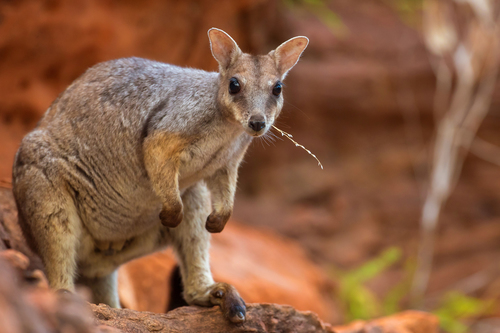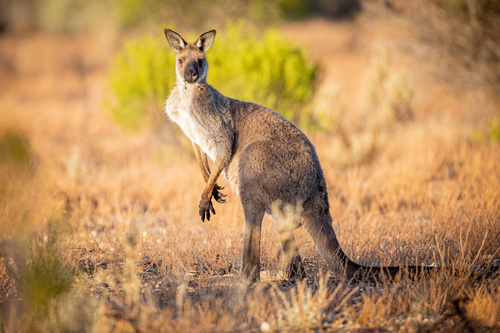
About Macropus fuliginosus (Desmarest, 1817)
Taxonomic Classification
The western grey kangaroo (Macropus fuliginosus) is one of the largest macropod species native to Australia.
Size Measurements
Adults weigh between 28 and 54 kg (62 to 120 lb), with a body length of 0.84 to 1.1 m (2 ft 9 in to 3 ft 7 in) and a tail that measures 0.80 to 1.0 m (2 ft 7 in to 3 ft 3 in) long; standing height is approximately 1.3 m (4 ft 3 in).
Sexual Dimorphism
This species shows clear sexual dimorphism, with males growing up to twice the size of females.
Fur Coloration
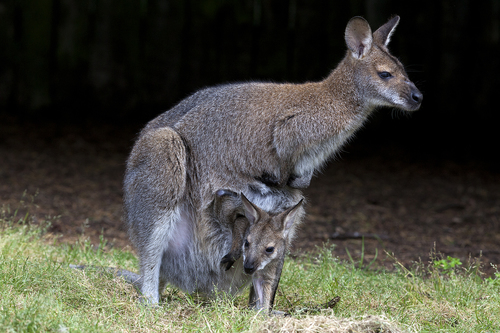
It has thick, coarse fur that ranges in color from pale grey to brown, with paler coloring on the throat, chest, and belly.
Species Distinction
The western grey kangaroo is hard to tell apart from its close relative, the eastern grey kangaroo (Macropus giganteus), but can be identified by its darker grey-brown overall fur, darker coloration around the head, and an occasional blackish patch near the elbow.
Group Structure
Western grey kangaroos live in groups of up to 15 individuals.
Breeding Contests
During the breeding season, males compete for access to females in so-called "boxing" contests, where they lock arms and attempt to push each other over.
Mating Dynamics
Typically, only the dominant male in the group gets to mate.
Reproductive Cycle
Gestation lasts 30 to 31 days, after which an incompletely developed fetus (called a joey) attaches to a teat inside the mother’s pouch, where it stays for 130 to 150 days.
Sexual Maturity
Females reach sexual maturity at 17 months old, while males reach maturity around 20 months old.
Distribution Overlap
The western grey kangaroo is closely related to the eastern grey kangaroo (M. giganteus), and their natural distributions overlap extensively, most notably in the Murray–Darling basin.
Wild Hybridisation
Even with this overlap, the two species only rarely interbreed in the wild.
While hybridisation can occur in both directions within the overlapping wild range, this pattern does not hold for captive animals.
Captive Hybridisation
In captivity, interbreeding does occasionally happen between the two species, but viable offspring are only produced when the mating pair is a female eastern grey kangaroo and a male western grey kangaroo.
Hybridisation Pattern
This pattern is an example of unidirectional hybridisation.