About Macropus antilopinus (Gould, 1841)
Taxonomy and Genus Classification
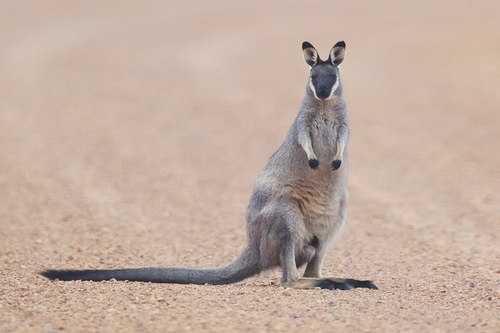
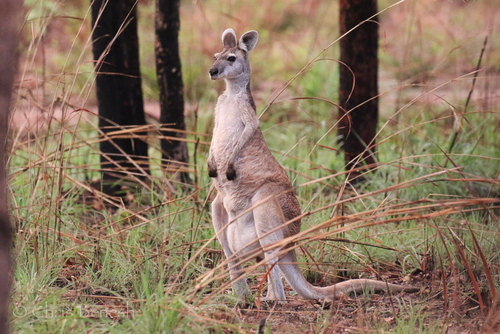
The antilopine kangaroo (Macropus antilopinus, also referenced as Osphranter antilopinus) is a relatively large species classified within the kangaroo and wallaby genus Osphranter.
Limb Morphology
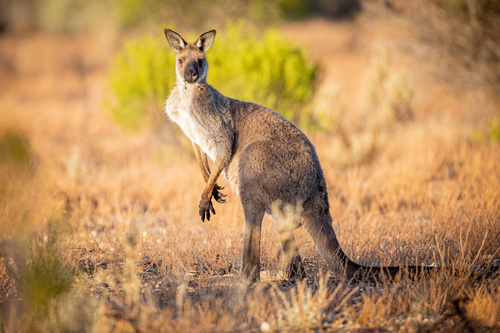
It shares many traits with other members of the genus, but has longer, more slender limbs that resemble those of the larger species in the group.
General Fur Coloration
Its fur is short, pale on the ventral (under) side, and transitions to reddish tan across the upper parts of its coat.
Female Base Coloration
Females have similar base coloration that is lighter overall, with greyish fur on the head and shoulders.
Head and Ear Fur Markings
A paler patch or stripe of fur occurs on the lower portion of the head, and lighter fur on the inner ear and ear edge sharply contrasts with the darker fur on the outer ear.
Paw Fur Coloration
The paws of both the front and hind legs are very dark, contrasting with the lighter fur on the lower limbs.
Tail Characteristics
The tail is thickly furred, maintains a uniform width along its entire length, and is a paler version of the upper body color.
Rhinarium Trait
The bare skin of the rhinarium (nose pad) is black.
Male Body Measurements
Combined head and body length reaches up to 1.2 metres (3.9 ft) for males, with a tail up to 900 mm (35 in) long.
Female Body Measurements
For females, combined head and body length is no longer than 840 mm (33 in), and tails reach up to 700 mm (28 in).
Standing Height
Standing height from the crown of the head to the ground is approximately 1.1 metres (3.6 ft).
Weight Range
Females may weigh up to 20 kilograms (44 lb), while males can weigh over twice that at 49 kg.
Male Head Shape
Like the red kangaroo (Osphranter rufus), the male antilopine kangaroo has a head shape that resembles that of a mule.
Sexual Dimorphism in Color
The antilopine kangaroo is one of the few macropod species that shows pronounced sexual dimorphism in coloration: males are mostly reddish on their upper bodies, while females are considerably greyer.
Relative Size Among Macropods
It is one of the largest macropods, only slightly smaller than the red kangaroo and the eastern grey kangaroo (Macropus giganteus).
Geographic Distribution Range
The distribution of the antilopine kangaroo extends inland from the northern coast of Australia, starting from the Kimberley region in Western Australia, crossing the Top End, and extending narrowly to a wider range in the tropical regions east of Cape York.
Population Clade Structure
The Queensland population is geographically isolated from other populations by an environmental barrier below the Gulf of Carpentaria, while weakly distinct second and third clades are found in the Northern Territory and Kimberley.
Habitat Preference
This species prefers tropical habitat with perennial grasses for forage, located on lower hills and plains.
Habitat Vegetation Types
The grasslands of its habitat occur alongside monsoonal eucalypts as open or regenerating woodlands, or as the dominant vegetation on unwooded plains.
Altitudinal Range
It is only found at altitudes below 500 metres.
Population Distribution Pattern
The species is locally common in parts of its large range, but its populations occur in patchy distributions across this area.