About Macaca assamensis (McClelland, 1840)
Pelage and Facial Features
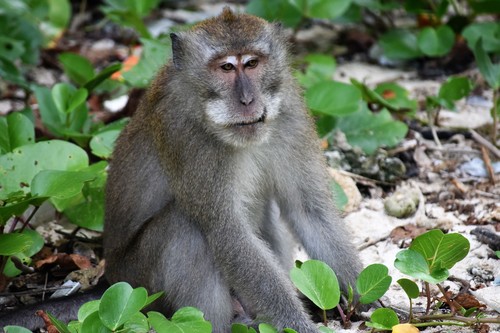
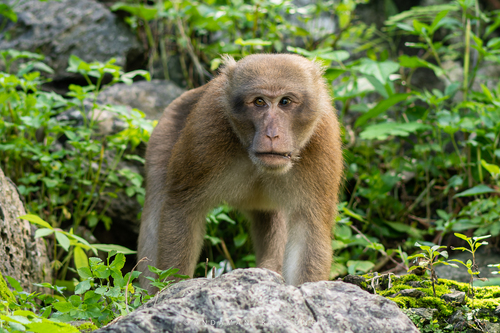
The Assam macaque (Macaca assamensis) has pelage ranging from yellowish-grey to dark brown. Its facial skin is dark brownish to purplish. A dark fringe of hair along its cheeks grows backwards toward the ears, and the hair on the top of its head is parted in the middle.
Body Coloration
The shoulders, head, and arms are typically paler than its greyish hindquarters. It has a short tail covered in thick hair.
Size and Weight
Head-to-body length ranges from 51 to 73.5 cm (20.1 to 28.9 in), the tail measures 15 to 30 cm (5.9 to 11.8 in) long, and adult individuals weigh 5 to 10 kg (11 to 22 lb).
Nepal Distribution
In distribution, the Assam macaque is found east of the Kali Gandaki River in Nepal, at elevations between 200 and 1,800 m (660–5,910 ft).
India Distribution
In northeastern India, it lives in tropical and subtropical semievergreen forests, dry deciduous forests, and montane forests up to 4,000 m (13,000 ft) in elevation.
Indochina Distribution
In Laos and Vietnam, it prefers elevations above 500 m (1,600 ft).
Habitat Preferences
It generally inhabits hilly areas above 1,000 m (3,300 ft), but also occurs in lowlands below this elevation in the wetter eastern part of its range, and at lower elevations in limestone karst forests.
Activity Pattern
Assam macaques are diurnal, and are both arboreal and terrestrial at times.
Diet
They are omnivorous, feeding on fruits, leaves, invertebrates, and cereals.
Namdapha National Park Population
In 2002, 15 groups totaling 209 individual Assam macaques were recorded in Namdapha National Park, Arunachal Pradesh. In this area, the population had a group density of 1.11 individuals per 1 km² (0.39 sq mi), with an average group size of 13.93 individuals.
Langtang National Park Survey
During a 2007 survey in Nepal's Langtang National Park, a total of 213 Assam macaques were encountered across 9 groups in a 113 km² (44 sq mi) study area. Troop sizes ranged from 13 to 35 individuals, with a mean troop size of 23.66 individuals.
Population Demographics
The population breakdown was 31% adult females, 16% adult males, with the remaining individuals being young of various ages.
Crop Foraging
In this surveyed population, Assam macaques preferred maize kernels, followed by potato tubers, and also raided cultivated fields of wheat, buckwheat, and millet.