About Clinotarsus curtipes (Jerdon, 1853)
Common and Scientific Name
This species is Clinotarsus curtipes, commonly known as the bicolored frog.
Vomerine Teeth Structure
Its vomerine teeth are scarcely developed, sometimes indistinct, arranged in two slightly oblique series that are level with the hind edge of the choanae.
Head and Facial Features
The frog has a large head and a short, rounded snout, with a well-marked canthus rostralis and a concave loreal region; the nostril is closer to the tip of the snout than to the eye, the interorbital space is broader than the upper eyelid, and the tympanum is distinct and nearly as large as the eye.
Limb and Digit Structure
Its fingers are moderate in size, with the first finger extending beyond the second; the toes are short and nearly entirely webbed, the tips of both fingers and toes are swollen or dilated into very small disks, the subarticular tubercles are well developed, the inner metatarsal tubercle is small, oval, and blunt, and there is a rather large, flat tubercle at the base of the fourth toe, with no tarsal fold.
Tibio-tarsal Articulation Position
The tibio-tarsal articulation reaches the eye.
Dorsal Skin Texture
The dorsal skin is finely granular, with a moderately prominent, rather narrow glandular lateral fold, and another fold runs behind the tympanum down to the shoulder.
Coloration
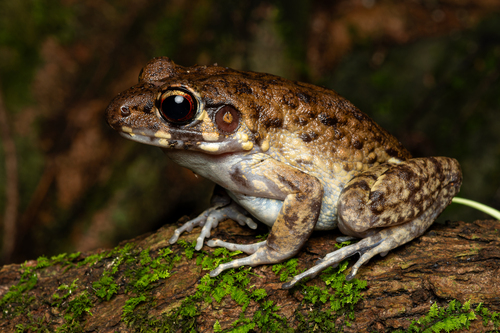
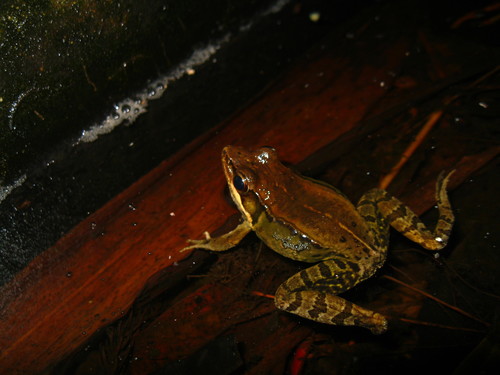
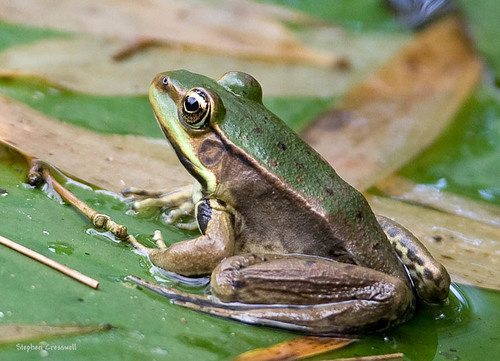
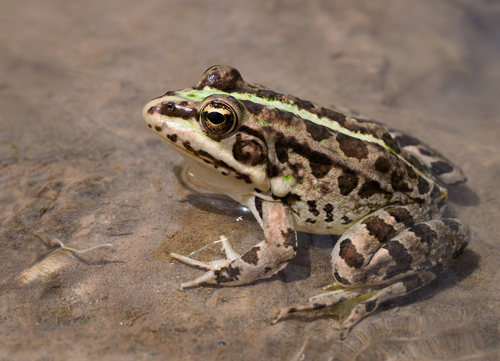
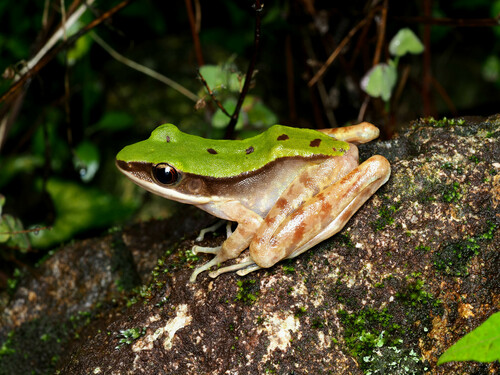
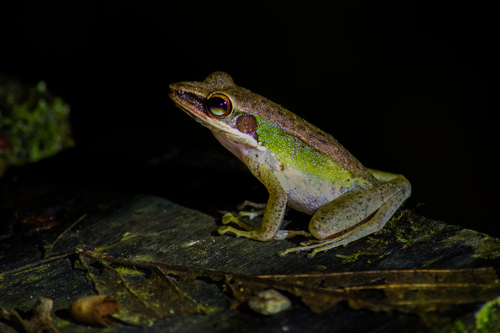
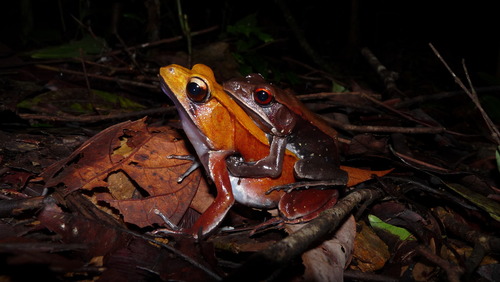
Dorsal coloration of Clinotarsus curtipes is greyish or brown, with or without blackish dots; the lateral fold is lighter and edged with black, there is a blackish oblique spot or band below the eye, the upper lip has a blackish margin, the limbs are dark purplish brown and lack cross bands, the underbelly is light brown, and the throat is sometimes dark brown.
Male Secondary Sexual Trait
Males have an internal subgular vocal sac.
Individual Identification Method
The distinctive spot patterns on the backs of individual frogs are often clear enough to be used for population estimation via capture-recapture techniques.
Population Density Estimate
A study using this method conducted in Bisale Reserve Forest, Kodagu, between January 1999 and July 2001 produced a population density estimate of 0.08–0.1 frogs per square metre.
Anti-predator Behavior
Adult bicolored frogs may occasionally feign death to escape predators.
Tadpole Traits and Behavior
The tadpoles of this species are large, reaching more than 9 cm (3.5 in) in total length, and form shoals in slow-moving streams.
Human Use of Tadpoles
These tadpoles are collected for local consumption.