About Lithobates sylvaticus (LeConte, 1825)
Size
Wood frogs (Lithobates sylvaticus) measure 51 to 70 mm (2.0 to 2.8 in) in length, with females growing larger than males.
Dorsal Coloration
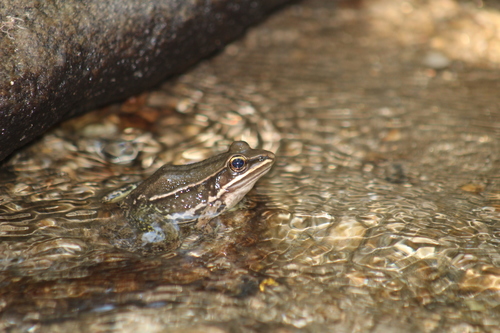
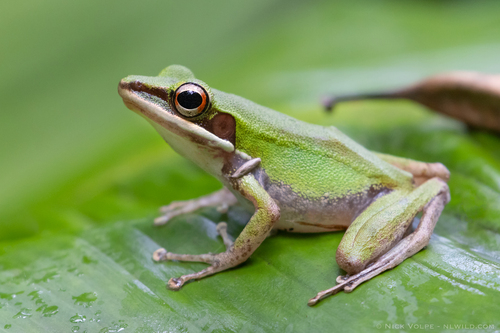
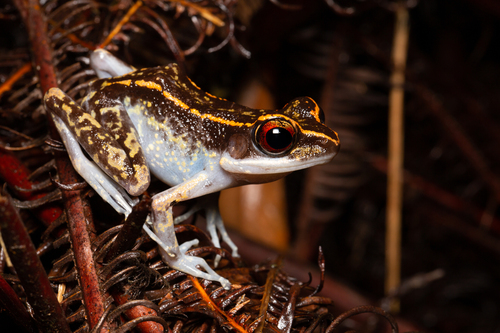
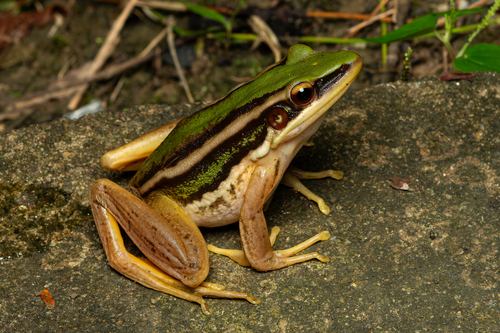
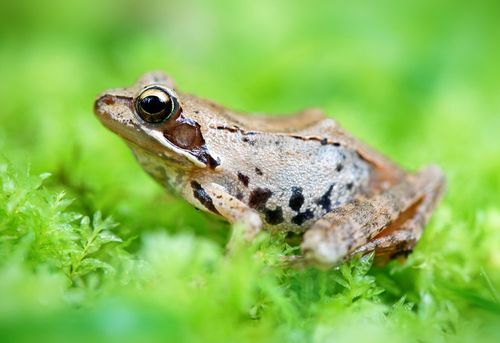
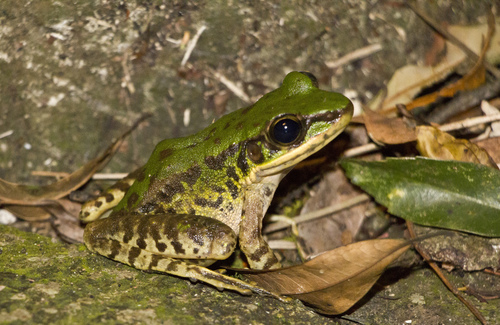
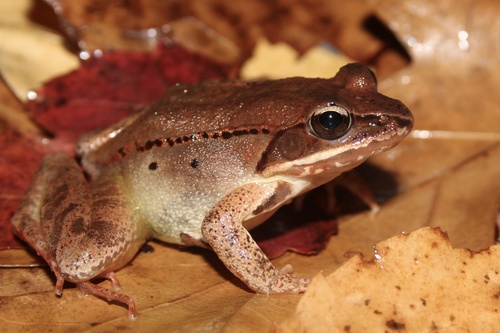
Adult individuals are usually brown, tan, or rust-colored, and most have a distinctive dark mask around the eyes. Individual wood frogs can change their body color; Conant (1958) documented one individual that appeared light brown and dark brown at different times.
Ventral Coloration
Their underparts are pale with a yellow or green tint, and bellies of northern populations may be faintly mottled. Body color can change seasonally, and exposure to sunlight causes the skin to darken.
Geographic Range
The wood frog's contiguous geographic range extends from northern Georgia and northeastern Canada in the east to Alaska and southern British Columbia in the west. They are found across all of Canada's boreal forests, and are the most widely distributed frog in Alaska. They also occur in the Medicine Bow National Forest.
General Habitat
Wood frogs are forest-dwelling, nonarboreal amphibians that primarily breed in ephemeral freshwater wetlands known as woodland vernal pools. They spend most of their time on the forest floor.
Migration Behavior
Long-distance migration plays an important role in their life history; individual wood frogs travel hundreds of meters between their breeding pools and neighboring habitats including freshwater swamps, cool moist ravines, and/or upland areas. The genetic range of individual pool-breeding populations extends more than one kilometer from the breeding site, so conserving this species requires a landscape-level perspective that protects multiple habitats at appropriate spatial scales.
Camouflage
Their natural coloration allows them to camouflage with their surroundings.
Breeding Site Fidelity
A study of wood frog dispersal patterns across 5 ponds in the Appalachian Mountains found that adult wood frogs were 100% faithful to the pond where they first bred, while 18% of juveniles dispersed to breed at other ponds.
Summer Habitat
Adult wood frogs spend the summer in moist woodlands, forested swamps, ravines, or bogs.
Overwintering Habitat
In the fall, they leave their summer habitats and migrate to neighboring uplands to overwinter, though some individuals remain in moist areas to overwinter. Their hibernacula are typically located in the upper organic layers of soil, under leaf litter. Overwintering in uplands adjacent to breeding pools lets adults make a short migration to thawed pools in early spring.
Activity Pattern
Wood frogs are mostly diurnal and are rarely seen at night, except during breeding choruses. They are one of the first amphibians to emerge for breeding right after snow melts, alongside spring peepers.
Breeding Habitat Preference
Lithobates sylvaticus primarily breeds in ephemeral pools rather than permanent water bodies such as ponds or lakes. This is thought to protect adult frogs and their offspring (eggs and tadpoles) from predation by fish and other predators that live in permanent water bodies.
Breeding Migration Timing
Adult wood frogs typically hibernate within 65 meters of breeding pools. They emerge from hibernation in early spring and migrate to these nearby pools.
Male Breeding Call
Once at the pools, males produce choruses of duck-like quacking calls.
Breeding Period Length
Wood frogs are explosive breeders: many populations complete all mating within a single week.
Mate Search Behavior
Males actively search for mates by swimming around the pool while calling. In contrast, females stay under water and rarely surface, most likely to avoid sexual harassment.
Amplexus
A male approaches a female and clasps her from behind her forearms, then hooks his thumbs together in a grip called amplexus, which is maintained until the female deposits her eggs.
Egg Deposition
Females attach their deposited eggs to submerged substrates, most often vegetation or fallen branches. Most females place their eggs close to other existing egg masses, forming large aggregated rafts of egg masses.
Egg Raft Advantages
Pairs that breed earlier gain an advantage: clutches closer to the center of the raft absorb heat and develop faster than clutches on the raft's periphery, and also get more protection from predators.
Breeding Pool Drying Risk
If the breeding pool dries out before tadpoles metamorphose into froglets, all tadpoles die. This risk counteracts the anti-predator protection that ephemeral pools provide. However, breeding in early spring increases the chance that wood frog offspring complete metamorphosis before pools dry out.
Larval Development Stages
Larval development occurs in two stages: from fertilization to free-living tadpoles, then from free-living tadpoles to juvenile frogs. During the first stage, larvae are adapted for rapid development, and their growth depends on water temperature. Variable larval survival is a major driver of annual fluctuations in wood frog population size.
Tadpole Development Factors
The second developmental stage involves rapid development and growth, which depends on environmental factors including food availability, water temperature, and population density.
Road Salt Toxicity Risk
Some research indicates that road salts used for road de-icing may have toxic effects on wood frog larvae. One study exposed wood frog tadpoles to NaCl and found that tadpoles had reduced activity and weight, and even developed physical abnormalities. Survivorship was also significantly lower, and time to metamorphosis decreased as salt concentration increased. This means de-icing agents may be a serious conservation concern for wood frog larvae.
Salt Tolerance Research
Another study found that wood frogs can develop increased salt tolerance when exposed to higher salt concentrations, but the study authors caution against over-extrapolating results from short-term, high-concentration studies to longer-term, lower-concentration conditions, as this can produce contradictory outcomes.
Juvenile Dispersal
After metamorphosis, less than 20% of juveniles disperse and permanently leave the area around their natal pools. The majority of offspring are philopatric, meaning they return to their natal pool to breed.
Breeding Frequency
Most wood frogs breed only once during their lifetime, though some breed two or three times, generally with differences in breeding frequency linked to age.
Population Genetic Drivers
The survival success of larvae and tadpoles shapes wood frog populations, as it affects gene flow and genetic variation in subsequent generations.
Adult Predators
Adult wood frogs are preyed on by larger frogs, garter snakes, ribbon snakes, northern water snakes, herons, raccoons, skunks, and American mink.
Tadpole Predators
Tadpoles are preyed on by diving beetles, water bugs, and salamander larvae.
Egg Predators
Leeches, eastern newts, and aquatic insects may eat wood frog eggs.