About Limnodynastes dorsalis (Gray, 1841)
Taxonomy and Nomenclature
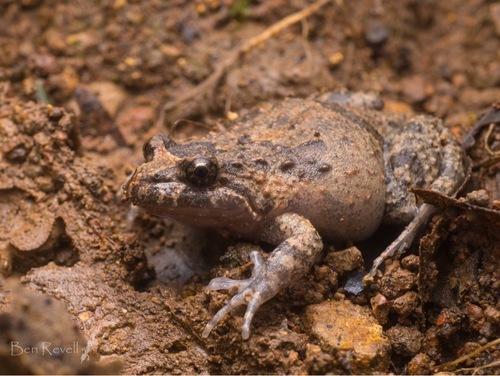
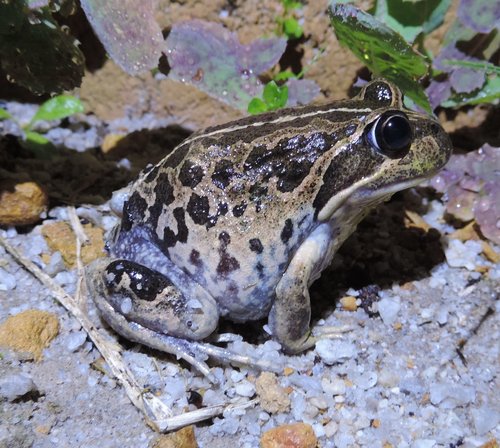
The western banjo frog, with the scientific name Limnodynastes dorsalis, is a frog species belonging to the family Limnodynastidae. Its informal common names are pobblebonk, sand frog, and bullfrog. It is an endemic amphibian of Western Australia.
Body Structure
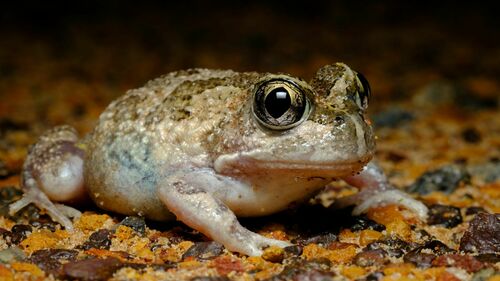
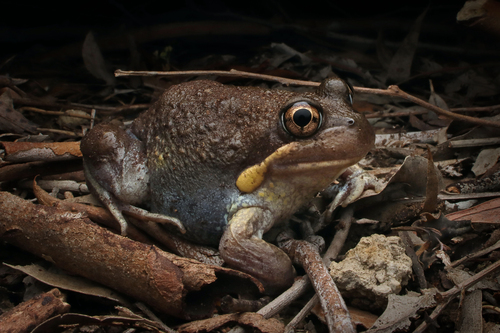
A large member of the family Myobatrachidae, it has sturdy limbs and a triangular head. Females can reach up to 87 mm in length, while males grow no larger than 75 mm.
Dorsal Coloration
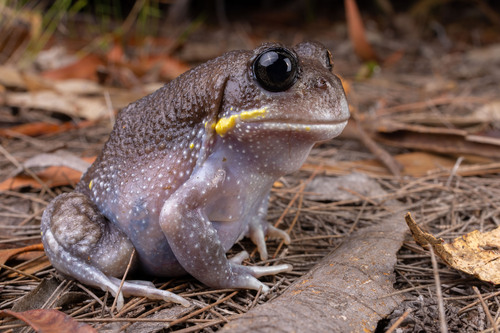
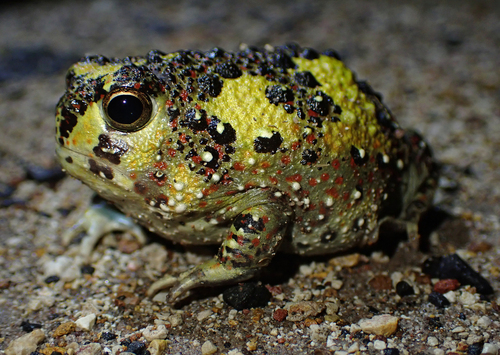
Its base coloration is grey or brownish-olive, marked with irregular very dark or black blotches and marbling. Markings are large on the upper surface of the body, and smaller on the legs and face. A wide dark stripe runs across the eye and extends to the fore limb.
Ventral and Dorsal Skin
The underside is pale, ranging from white to yellowish, and has a smooth texture. The upper surface is also smooth, or may be slightly warty.
Defensive Glands
The species has poisonous glands on its calves, including a large oval tibial gland located on the upper calf of the hind leg.
Toe Morphology
Its toes are only very slightly webbed, and the second toe is typically slightly longer than the first.
Distinguishing Species Trait
The groin area is colored reddish to bright red, a trait that distinguishes this western species from the similar eastern banjo frog (Limnodynastes dumerilii).
Male Calling Position
Males produce their call when almost fully submerged, or when hiding in dense vegetation.
Call Characteristics
The call is a loud 'plonk' or 'bonk' sound, similar to a plucked banjo string — this similarity is the origin of the species' common names. The loud 'explosive' sound of many western banjo frogs calling in unison is well known within the species' range.
Spawning Behavior
After mating, the species lays spawn in still or slow-moving water, where it forms a large mass that floats on the surface around grasses or other anchored vegetation.
Diet
Its diet primarily consists of insects and worms, but it will eat any prey it is able to capture.
Taxonomic History
Limnodynastes dorsalis was first described in 1841.
Genus Distribution Context
Of the twelve Limnodynastes species found across Australia, Limnodynastes dorsalis is the only one that occurs in Southwest Australia.
Isolation Origin
It is endemic to this southwestern region, which is surrounded by arid areas; the species became isolated here due to climate changes across the Australian continent.
Regional Habitat
The species is distributed throughout Southwest Australia, a biodiverse region with a Mediterranean climate, and occupies habitats near permanent water.
Geographic Range
Its range extends from east of Kalbarri in the north, east to the Bight, and inland into adjacent arid areas.
Population Security
While the Limnodynastes dorsalis population has been negatively affected by land use change, the species as a whole remains secure from major threatening factors.
Artificial Habitat Use
The construction of rural dams and suburban water features has created new habitat that the species readily occupies.
Population Abundance
It is common across the southwest of Western Australia, and occurs in large numbers around creeks and rivers.
Microhabitat and Dry Season Behavior
It is most often found in dense vegetation at these water-side sites, but sometimes occupies burrows during the dry season.