About Limnodynastes peronii (Duméril & Bibron, 1841)
Size
Females of this species may reach 75 millimetres (3.0 in) in length, while males reach 70 millimetres (2.8 in).
Dorsal Coloration
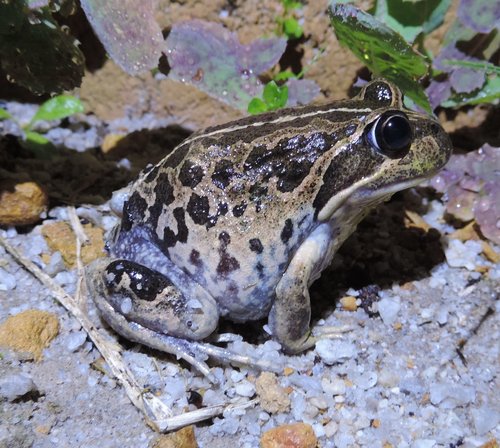
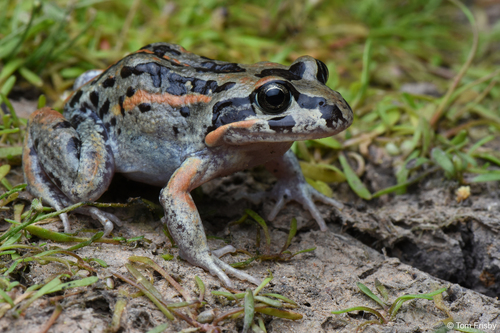
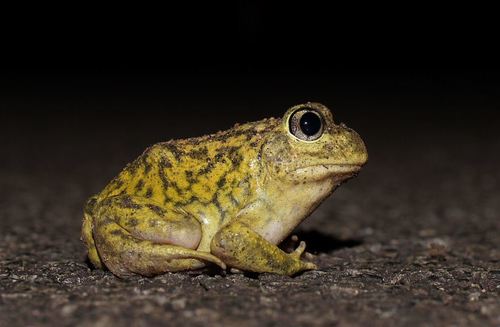
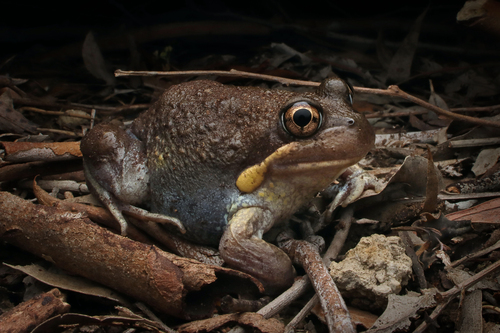
Their dorsal (back) surface is some shade of brown, which can be light, dark, or red-brown. Distinct darker stripes run down the frog's back, which gives this species its common name, and a paler mid-dorsal stripe usually runs down the center of the back.
Facial Markings
A black "mask" extends from the nostril, through the eye, and down to the shoulder; a thick light golden line runs under this mask and ends at the corner of the mouth.
Breeding Male Traits
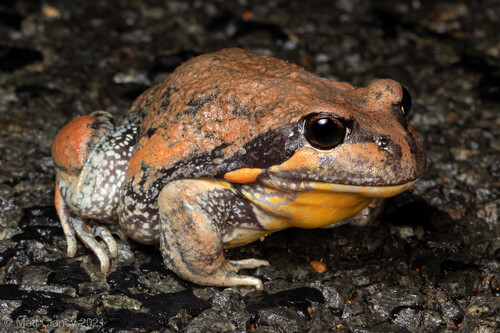
Breeding males develop thick arms, which they use in wrestling matches with other males of the species, and breeding males have a yellow throat.
Ventral Coloration
The belly is white.
Geographic Range
This species is distributed from southern Cape York Peninsula in North Queensland, through all of coastal New South Wales, across southern Victoria to southeastern South Australia, and into northern Tasmania.
Population Status
It is very common in coastal New South Wales, but uncommon in Tasmania, where it is listed as rare. This is the most frequently encountered frog species on Australia's east coast.
Human Proximity
It is usually the first frog species to colonize garden frog ponds, and individuals are often found trapped in backyard swimming pools.
Habitat
It inhabits ponds, roadside ditches, creeks, dams, flooded areas, and any other available body of water, and it is tolerant of polluted water.
Diet
Its natural prey includes the local frog species Bibron's Toadlet.
Male Calling Behavior
Males call while floating in water from hidden spots among vegetation.
Call Characteristics
Their call is a distinct "knock" that sounds like hitting timber with a hammer, and they call year-round, most often from spring to autumn. This call is familiar to anyone with a garden pond in Sydney.
Research Use
Multiple studies have used striped marsh frogs to investigate why worldwide amphibian declines are more severe in montane regions.
Stressor Interaction Study Results
Researchers found that the negative effects of low temperatures and high ultraviolet-B (UVB) radiation on tadpole survival are greater when the two stressors are combined. UVB radiation reduces the survival of striped marsh frog tadpoles, and mortality increases even more when low temperatures are also present.
UVB Damage Mechanism
UVB radiation causes DNA damage; as temperature falls, the rate of DNA repair slows, so the damage persists for longer.
Breeding Season
The species' breeding season runs from late winter to early spring.
Egg and Development
Eggs are laid in a foamy nest, and tadpoles take 8 to 12 months to fully develop.
Tadpole Traits
Tadpoles are pale brown, and can grow up to 6.5 cm long.