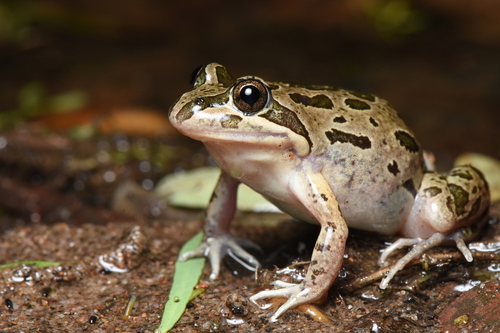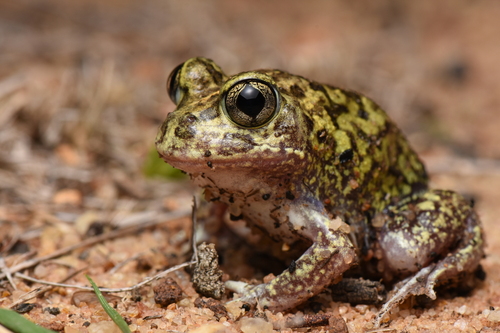
About Heleioporus australiacus (Shaw & Nodder, 1795)
Common Name and Size
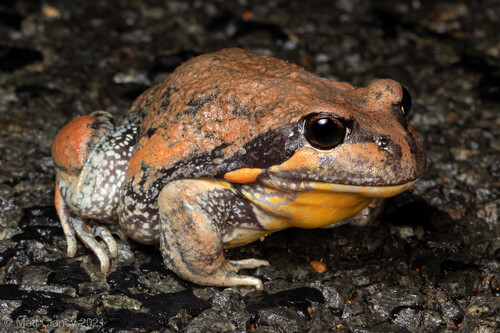
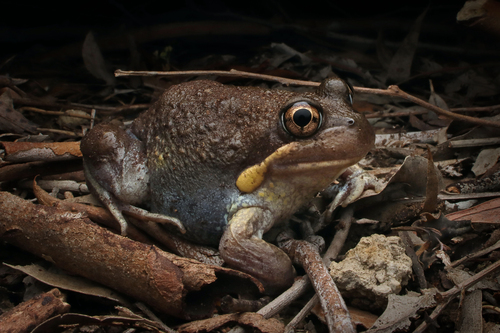
Heleioporus australiacus, commonly called the giant burrowing frog, is a large frog species that reaches up to 10 centimetres (3.9 in) in length, and it is the largest frog found in Victoria.
Dorsal and Ventral Coloration
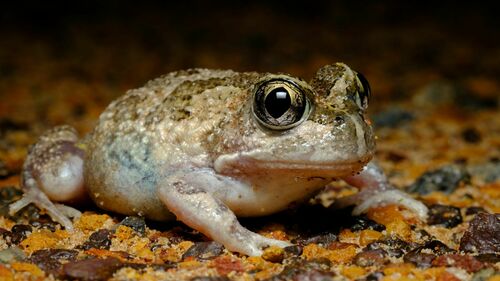
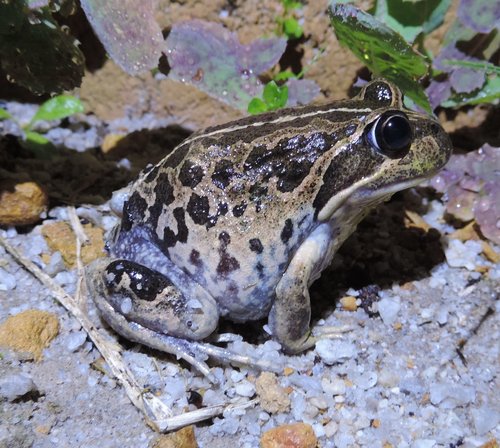
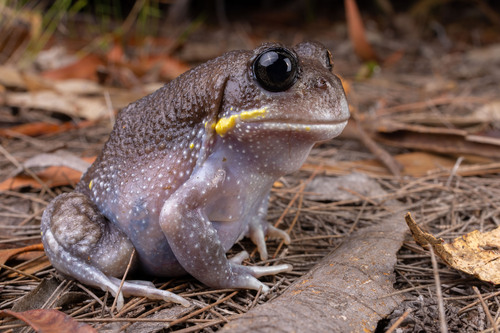
Its back is typically grey, dark brown, or black, while its belly is white.
Lateral and Facial Markings
It has yellow spots along its sides and a yellow stripe running along the upper lip, extending from the back of the eye to the back of the tympanum; this stripe is pink-orange in newly metamorphosed frogs.
Skin Texture
The species has rough, bumpy skin.
Breeding Season Male Trait
During the breeding season, males often have black spines on their fingers.
Eye Features
It has a silver iris and a vertical pupil.
Similar Species Distinction
Because of its large size and bumpy skin, it is often mistaken for the cane toad, but cane toads lack vertical pupils, and their current range does not overlap with the giant burrowing frog's habitat.
Habitat and Distribution
This species inhabits sandstone heathland, dry sclerophyll forest, and wet sclerophyll forest, ranging from north of Sydney to eastern Victoria.
Burrowing Behavior
As their common name suggests, these frogs have burrowing ability.
Breeding Call Context
During autumn and spring, usually after heavy rainfall, males call from burrows on the edges of creeks.
Call Characteristics
Their call is a very low-pitched "ou-ou-ou-ou-ou" that resembles an owl's call (which inspired the common name), and each call only lasts one or two seconds.
Male Spine Function
The spines on males' fingers may be used for fighting.
Egg Laying Details
Females lay between 750 and 1250 unpigmented eggs, which are deposited either in inundated burrows or under heavy vegetation in dams, ditches, and slow-flowing streams.
Tadpole Development Trigger
Tadpoles develop within the stream and leave when it floods.
Tadpole Coloration
The tadpoles are grey, with grey fins that have light flecks.
Tadpole Size and Movement
They grow up to 80 millimetres (3.1 in), making them very large, and they are very slow-moving.
Tadpole Development Duration
Their development takes 3 to 11 months.
Tadpole Habitat Conditions
They have been observed in clear water with a pH between 4.3 and 6.5, and a temperature range of 8.5 to 26.5 °C.
Observation Tips
Giant burrowing frogs are difficult to locate, and they are best seen at night after thunderstorm activity in summer, or after substantial rainfall.