About Notaden bennettii Günther, 1873
Common Name and Distinctiveness
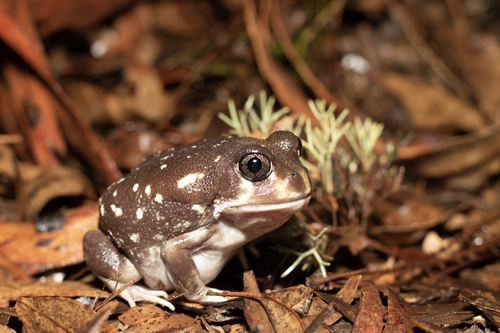
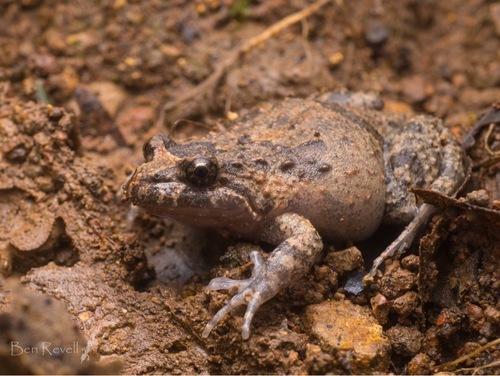
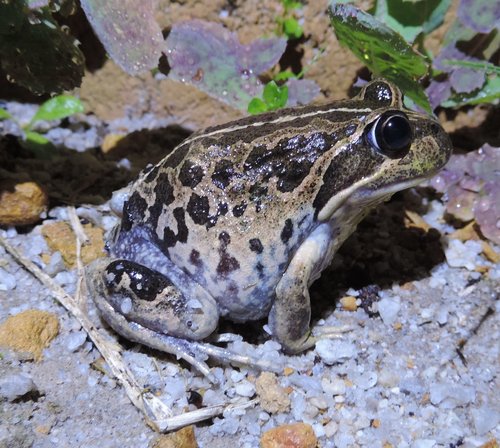
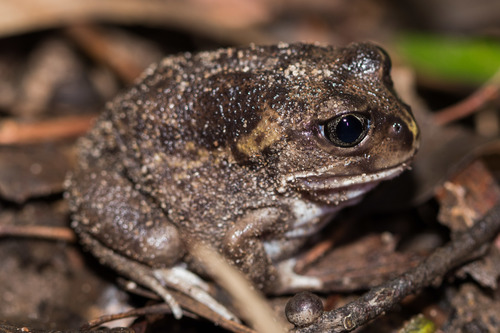
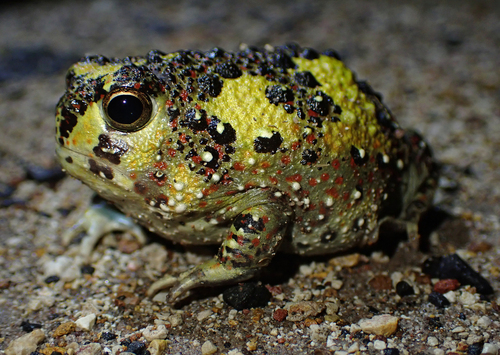
Notaden bennettii, commonly known as the crucifix toad, is the most visually distinctive species in the genus Notaden. Most other Notaden frogs are dark brown, but the crucifix toad displays many bright colors.
Dorsal Coloration and Markings
Its dorsal surface is bright yellow, marked with a multi-colored cross centered on its back. The cross is outlined with large black dots, and its interior is filled with white, black, and red dots.
Ventral and Flank Coloration
The crucifix toad has a white ventral surface and blue flanks.
Body Shape and Appendages
It is a small, very round frog with a blunt nose and small legs and feet.
Tympanum Characteristics
As a fossorial (burrowing) species, its tympanum (eardrum) is hidden.
Size Range by Sex
Males grow to a maximum length of 6.3 centimeters (2 15⁄32 inches), while females reach 6.8 centimeters (2 11⁄16 inches).
Burrowing Adaptations on Feet
The species has small spade-like structures on its feet to help it burrow deeply.
Habitat Range
This ground-dwelling frog lives in arid regions of western New South Wales and Queensland.
Dry Period Survival Strategy
It survives dry periods by burrowing underground and reducing its activity.
Breeding Trigger
After very heavy rain, individuals emerge from the ground to breed in temporary ponds.
Male Mating Call
Males call from within the pond to attract females, producing a call described as a "woop".
Tadpole Development Speed
Tadpole development is very rapid, allowing the species to take advantage of temporary wet conditions and reduce the risk of tadpoles dying when ponds dry up; the entire development cycle can complete in as little as six weeks.
Frog Glue Secretion Trigger
When provoked, the crucifix toad exudes a tacky, elastic substance called "frog glue" onto its dorsal skin.
Hypothesized Glue Functions
The purpose of this glue is not confirmed: it may confuse and deter predators like snakes, or trap biting insects that the frog later eats when it sheds and consumes its skin.
Glue Use in Mating
Males have been observed using this glue to attach themselves to larger females during mating.
Research Interest in Frog Glue
This frog glue has been found to be stronger than currently available non-toxic medical adhesives, so it is the subject of ongoing research.
Glue Composition and Properties
It is a protein-based pressure-sensitive adhesive that works effectively even in wet conditions.
Diet
The crucifix toad's diet is made up primarily of ants and termites.