About Leucocarbo verrucosus (Cabanis, 1875)
Common Name and Classification
Leucocarbo verrucosus, commonly known as the Kerguelen shag, is the smallest species of blue-eyed shag.
Adult Size
Adults measure 65 cm (25.5 in) in length with a 110 cm (43.5 in) wingspan.
Adult Plumage and Markings
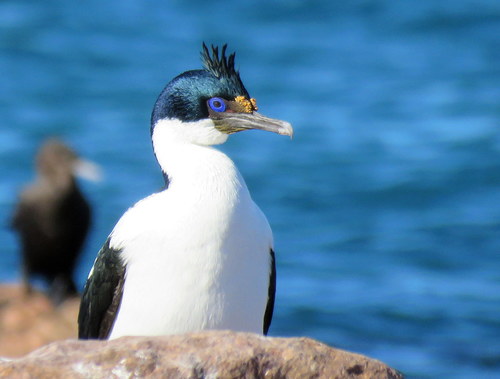
The adult's upperparts, tail, and thighs are metallic greenish black; the underbody extending up to the throat is white; and the wing linings are brown. Some individual Kerguelen shags have white patches on their back and wings.
Head and Neck Coloration
The head and back of the neck are deep blue or purple, with a black cap that extends below the eye to the chin and ear coverts. The face and throat pouch are dark brown, decorated with yellow-orange tubercles.
Bill, Eye, and Limb Coloration
The bill is either horn-colored or brown, and the eyes are hazel. Legs and feet range from dark brown to bright pink with dark blotches.
Breeding Adult Features
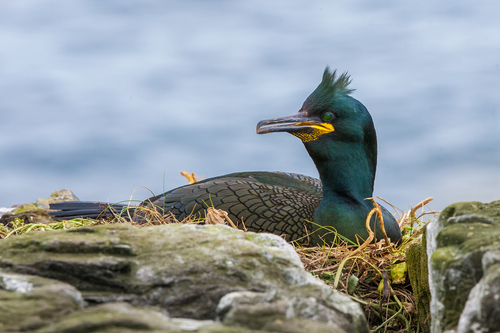
Breeding adults have a small erectile black crest on the forehead, yellow or orange caruncles (large warts) above the base of the bill, and a bright blue ring around the eye.
Post-breeding Adult Features
After the breeding season, plumage fades, the eye-ring changes to lead-blue, and the caruncles become smaller and duller in color.
Juvenile Appearance
Juveniles are dark brown with varying amounts of white on their undersides, and have brown irises, bills, and feet. They do not have caruncles, and their eye-rings are lead-blue.
Juvenile Plumage Development
They develop adult plumage gradually.
Perching Behavior
Unlike many cormorant species, the Kerguelen shag does not spread its wings while perched.
Nesting Distribution
This species nests along the coast of Grande Terre, the main island of the Kerguelen archipelago, as well as on offshore islands and islands within the Golfe du Morbihan.
Foraging Range
It forages at sea throughout the archipelago, usually staying within 6 km (3.7 mi) of shore and favoring bays and inlets, though immature individuals have rarely been sighted as far as 80 km (50 mi) from shore.
Extralimital Records
Reports of this species from Heard Island and western Australia are likely of birds that traveled there with assistance from ships.
Feeding Habitat
During the austral summer, it feeds among kelp, sometimes at the kelp bed bottom.
Breeding Colony Size
The Kerguelen shag breeds in colonies, which typically contain 3 to 30 pairs, but can occasionally hold up to 400 pairs.
Colony Co-location
Colonies may be located near colonies of southern rockhopper penguins.
Nest Building and Courtship Timing
A period of nest building and courtship displaying occurs in late March and early April, which is an unusual timing for a subantarctic cormorant.
Male Courtship Display
Advertising males display by throwing their head backward until the nape touches their tail.
Nest Structure and Materials
Nests are cone-shaped structures built from seaweed, twigs, and grass bound together with mud and guano.
Nest Dimensions
They can grow up to 1 meter tall and 33 cm across, with an interior cup that averages 20 cm across and 8 cm deep.
Nest Reuse
Surviving nests may be reused, though not necessarily by the same breeding pair.
Egg Laying Timing
Breeding activity can begin as early as September, but egg laying usually starts between late October and late November and continues until mid-January, with timing varying considerably between different colonies.
Clutch Characteristics
A clutch holds two to four eggs, which measure about 6.2 cm long and 3.9 cm wide. The second egg is laid 2 to 3 days after the first.
Incubation Period
Both parents incubate the eggs for an average of 29 days.
Chick Predation and Parental Defense
Both parents also protect chicks from predators including skuas, gulls, and sheathbills, though these predators still catch some chicks.
Chick Appearance
Newly hatched chicks are black with a pink throat, and later develop blackish-brown down with greyish-white tufts.
Unstudied Reproductive Details
Other details of the species' reproductive behavior and breeding success have not been documented.
Population Estimate
Between 1984 and 1987, the total population was estimated at 6,000 to 7,000 breeding pairs.
Threat Assessment
Interactions with humans and introduced mammals do not appear to be harming the species' population.