About Leucocarbo carunculatus (Gmelin, 1789)
Common Name & Basic Size
Leucocarbo carunculatus (Gmelin, 1789), commonly called the New Zealand king shag, is a large cormorant that measures 76 cm long and weighs 2.5 kg.
Plumage & Limb Coloration
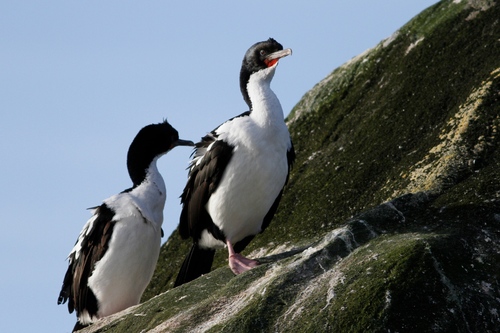
It has black and white plumage, pink feet, and white patches on its wings that look like bars when the wings are folded.
Facial Caruncles
Yellow-orange swellings called caruncles are located above the base of its bill.
Breeding Season Facial Features
Its grey gular pouch turns reddish during the breeding season, and a blue eye-ring shows its relationship to other blue-eyed shags.
Sexual Dimorphism
This species displays sexual dimorphism: males are larger than females, and this size difference is already noticeable 17 days after hatching.
Prehistoric Distribution
Prehistorically, New Zealand king shags lived in coastal colonies on both the North Island and South Island of New Zealand.
Current Observational Location
Today, they are visible from Cook Strait ferries in Queen Charlotte Sound, opposite the start of the Tory Channel.
Movement Pattern
They live and breed year-round in the coastal waters of the Marlborough Sounds across nine occupied colonies, and are non-migratory, only moving between these different colonies.
Full Colony List
The nine colonies are located at Stewart Island, Trio Island, The Twins, Duffers Reef, Blumine Island, Tawhitinui, Hunia Rock, Rahuinui, and White Rocks.
Frequently Observed Breeding Colonies
The most frequently observed breeding colonies are Duffers Reef, North Trio Island (Kuru Pongi), White Rocks, and Tawhitinui.
Breeding Pair Survey Data
Annual surveys record fluctuating numbers of breeding pair nests across these colonies.
Largest Colony Sizes
North Trios (Kuru Pongi) and Duffer's Reef are the largest colonies, each holding over 100 nests.
2022 Population Estimate
As of 2022, the total estimated population of this species is 792 individuals.