About Phalacrocorax carbo (Linnaeus, 1758)
Scientific Name and Size Variation
The great cormorant, scientifically named Phalacrocorax carbo (Linnaeus, 1758), is a large bird with wide size variation across its large geographic range. Its body weight ranges from 1.5 kg (3 lb 5 oz) to 5.3 kg (11 lb 11 oz), and males are typically larger and heavier than females.
Subspecies Size Difference
The nominate subspecies P. c. carbo averages about 10% larger in linear measurements than the smaller subspecies P. c. sinensis. The lowest recorded average weights are for P. c. sinensis in Germany, where 36 males averaged 2.28 kg (5 lb 1⁄2 oz) and 17 females averaged 1.94 kg (4 lb 4+1⁄2 oz).
Highest Recorded Weights
The highest recorded average weights are for P. c. carbo on Prince Edward Island in Canada, where 11 males averaged 3.68 kg (8 lb 2 oz) and 11 females averaged 2.94 kg (6 lb 7+1⁄2 oz). Total body length ranges from 70 to 102 cm (27+1⁄2 to 40 in), and wingspan ranges from 121 to 160 cm (47+1⁄2 to 63 in).
Size Ranking Among Cormorants
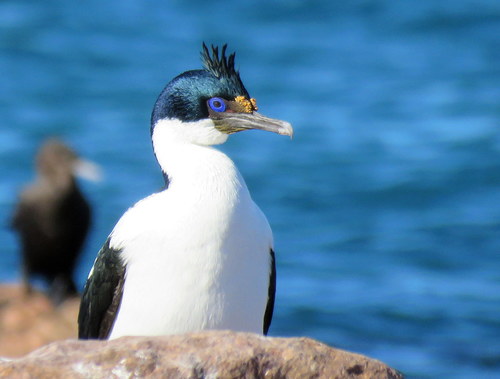
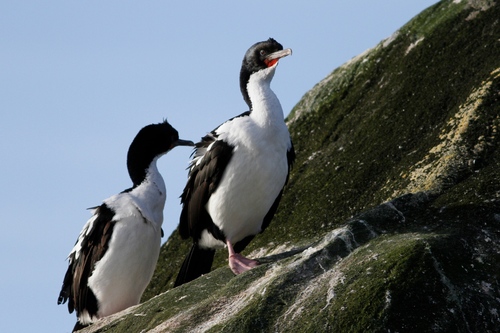
It is tied as the second largest extant cormorant species, after the flightless cormorant; the Japanese cormorant averages a similar size. By bulk, if not by linear dimensions, the blue-eyed shag species complex of the Southern Oceans is only marginally smaller on average.
Plumage Coloration
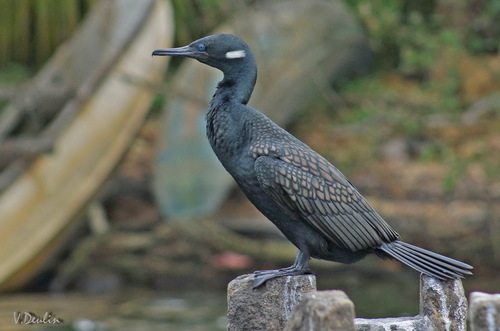
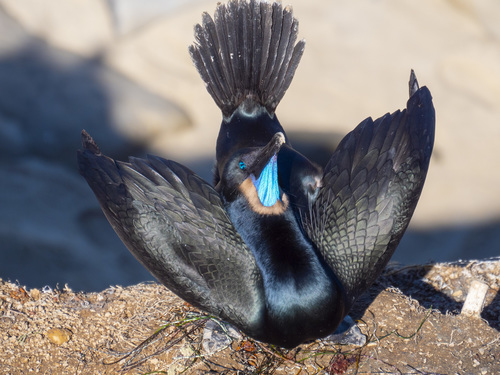
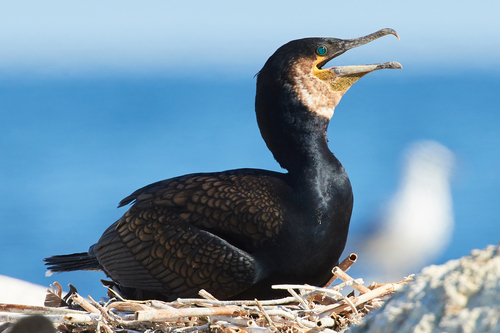
The great cormorant's plumage is mostly black, with bronze to greenish iridescence on the wings and tail, and purple iridescence on the body. Adult great cormorants have striking deep sea-green eyes, while juvenile birds have duller dark grey eyes.
Tail Characteristics
The tail is fairly long and has 14 feathers.
Bill and Throat Features
The bill is stout, strongly hooked at the tip, dark grey at the tip and fades to a paler shade at the base. There is also a yellow, or sometimes red, patch of bare gular skin on the throat at the base of the bill.
Leg and Foot Traits
The legs are short but stout, and dark grey; the feet are large, and fully webbed between all four toes, a trait called totipalmate.
Breeding Season Plumage
During the breeding season, adults grow white filoplume patches on the thighs, head, and upper neck. The two African subspecies P. c. maroccanus and P. c. lucidus also have more extensive white plumage on the foreneck and breast.
Non-breeding Plumage
In winter, the plumage becomes more uniformly black, slightly duller and less glossy, and the white filoplumes are shed.
Juvenile Plumage Development
Juvenile and immature great cormorants have pale to whitish underparts; their plumage becomes browner in their second year, and they reach full adult plumage at 3–4 years old.
Vocalization
Great cormorants are mostly silent, but they produce various guttural calls when at their breeding colonies.
European Similar Species Distinction
In European waters, great cormorants can be told apart from European shags by their larger size, heavier build, thicker bill, lack of a crest, and body plumage with a purple rather than green tinge.
North American Similar Species Distinction
In eastern North America, great cormorants are larger and bulkier than double-crested cormorants; double-crested cormorants also have more yellow on the throat and bill, and lack the white thigh patches seen on breeding adult great cormorants.
Tail Feather Count Distinction
Both European shags and double-crested cormorants also have 12 tail feathers, unlike the great cormorant's 14.
Subspecies Identification Challenge
Identifying great cormorant subspecies is difficult, and this challenge is made more complex by hybridisation between subspecies.
Gular Patch Identification
The most useful distinguishing feature is the shape of the gular skin patch: it forms an acute angle in the nominate P. c. carbo, and an obtuse angle in P. c. sinensis. Similar shape variation is used to distinguish P. c. hanedae and P. capillatus in eastern Asia.
African Subspecies Identification
Differentiating the two white-breasted African subspecies remains complex and uncertain.
General Distribution and Habitat
The great cormorant is a very common and widespread bird species. It feeds in inshore marine waters, estuaries, freshwater lakes, and rivers.
Movement Patterns
Northern populations migrate south to escape water that freezes in winter, moving to any unfrozen coast or freshwater area with a good supply of fish; in warmer regions, great cormorants disperse only locally. They only rarely cross large bodies of water such as the North Sea.
Nominate Subspecies Range
The type subspecies P. c. carbo lives mainly in Atlantic waters and nearby inland areas, along northwestern European coasts, the Faroe Islands, Iceland, Greenland, and the northeastern seaboard of North America.
Continental Subspecies Range
The widespread continental subspecies P. c. sinensis occurs across most of mainland Europe, and eastward through the Palearctic to Siberia and southeastern Asia.
Australasian Subspecies Range
The subspecies P. c. novaehollandiae is found in Australian and New Zealand waters.
Feeding Method Overview
The great cormorant feeds on fish caught by diving.
Chausey Islands Diet
Birds living at the Chausey Islands feed primarily on wrasses, but also eat sand smelt, flathead, and common soles.
Temperature Effect on Prey Size
The average weight of fish eaten by great cormorants increases as air and water temperature decrease. In summer, great cormorants consume all fish of suitable size that they can catch; in winter, they noticeably select larger, mostly torpedo-shaped fish.
Winter Foraging Efficiency
Researchers have found that greater foraging efficiency in winter comes from capturing larger fish, not from catching more fish.
Freshwater Prey Consumption Rate
In some freshwater systems, the total mass of fish taken by overwintering great cormorants has been estimated at up to 80 kg per hectare per year, for example in the Vltava River, Czech Republic.
Diving Behavior
Great cormorants forage by propelling dives with their feet, and capture prey with their beak. Dive duration ranges from 1 to 3 minutes, and the birds can dive to a maximum depth of 9.5 metres (31 ft).
Dive Zone Distribution
About 60% of dives reach the benthic zone, about 10% reach the pelagic zone, and the remaining dives go to zones between these two.
Hearing Adaptations
Studies suggest that the great cormorant's hearing has evolved for underwater use, which may help them detect fish. These underwater hearing adaptations come at a cost: their hearing sensitivity in air is reduced.