About Larus belcheri Vigors, 1829
Taxonomy and Size
Belcher's gull (scientific name Larus belcheri Vigors, 1829) grows to a length of about 49 centimetres (19 in). The sexes have similar appearance.
Breeding Adult Plumage
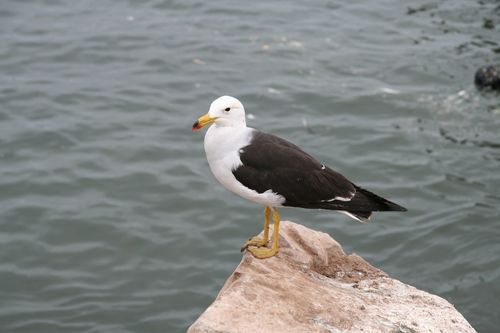
In breeding season, adult individuals have a white head, and very pale grey neck and underparts. The mantle and back are greyish-black; the tail is white, with a broad black subterminal band and a white trailing edge. The wing coverts and primaries are black, while the secondaries are dark grey with white tips.
Adult Soft Parts
The eye is black, the bill is yellow with a distinctive red and black tip, and the legs and feet are yellow.
Non-breeding Adult Plumage
Outside the breeding season, the head is dark brown with a white ring surrounding the eye.
Juvenile Plumage
Juvenile Belcher's gulls are mottled brown and white, and attain full adult plumage during their third year.
Similar Species Distinction
Belcher's gull can be confused with the slightly larger kelp gull (Larus dominicanus), but the kelp gull has a small white tip on its otherwise black wing and lacks the black tail band that Belcher's gull has.
Geographical Range
Belcher's gull is found on the Pacific coast of South America. Its range extends from northern Peru to northern Chile, in the area influenced by the Humboldt Current.
Habitat
Its habitat includes rocky shores, bays, and offshore islands.
Foraging Range and Movement
It ventures several kilometres offshore to forage, and also feeds on rocky shores when the tide is out. It is a non-migratory species.
Diet
Belcher's gull is an omnivore and scavenger. It feeds on fish, crabs, molluscs, and carrion, and seasonally consumes the eggs and nestlings of seabirds.
Kleptoparasitic Behavior
It often associates with Guanay cormorants, pestering them until they regurgitate their prey, which it then eats.
Breeding Colony Details
Breeding takes place from December onwards in small colonies of up to one hundred pairs. The nest is a shallow scrape in the sand or among rocks near the high tide line.
Egg Characteristics
Clutches usually contain three eggs that average 65 by 45 mm (2.6 by 1.8 in), pale with dark olive blotched markings.