About Larus glaucoides B.Meyer, 1822
Taxonomy and General Build
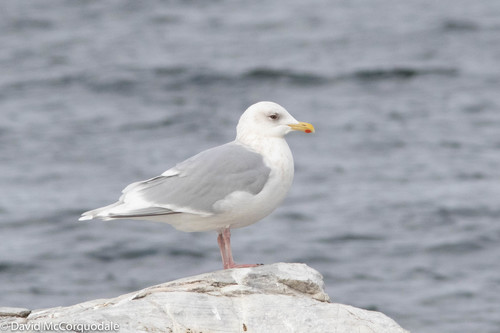
The Iceland gull, scientifically named Larus glaucoides B.Meyer, 1822, is a medium-sized gull with a relatively slender build and light body weight.
Standard Size Measurements
It measures 50 to 64 cm (20 to 25 in) in total length, has a wingspan of 115 to 150 cm (45 to 59 in), and weighs 480 to 1,100 g (1.06 to 2.43 lb). Standard body measurements for the species include a wing chord of 37.9 to 44.3 cm (14.9 to 17.4 in), a bill length of 3.6 to 5.4 cm (1.4 to 2.1 in), and a tarsus length of 4.9 to 6.7 cm (1.9 to 2.6 in).
Size Comparison to Other Gulls
Compared to the very large glaucous gull, the Iceland gull is smaller overall and has a thinner bill, and it is also usually smaller than the herring gull.
Maturation Timeline
It takes four years for the Iceland gull to reach sexual maturity.
Migratory Status
The Iceland gull is a migratory bird.
Winter Range
It spends the winter in the North Atlantic, ranging as far south as the British Isles and the northernmost eastern U.S. states, and also occurs in interior North America westward to the western Great Lakes. It is much rarer across Europe than the similar-looking glaucous gull.
Breeding Habitat
This gull species breeds either in colonies or as solitary pairs on coasts and cliffs.
Nesting Details
It builds its nest, lined with grass, moss, or seaweed, on the ground or a cliff ledge. Clutches typically contain two or three light brown eggs.
Breeding Distribution
The species breeds in Canada and Greenland, and does not breed in Iceland.
Diet Composition
Like most gulls in the genus Larus, Iceland gulls are omnivores; their diet consists of fish, molluscs, offal, food scraps, and eggs.
Foraging Behavior
They forage in flight, picking up food from or just below the water surface, and also feed while walking or swimming. Their scavenging behavior brings them to garbage dumps, sewage outlets, and areas where fish are cleaned regularly.