About Sternula albifrons (Pallas, 1764)
Size Measurements
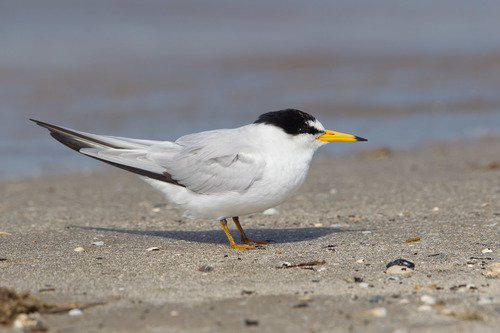
This small tern measures 21–25 cm in length with a 41–47 cm wingspan. Due to its size and the white forehead of its breeding plumage, it is rarely confused with other tern species, with the exception of the fairy tern and Saunders's tern.
Breeding Plumage Appendages
It has a thin, sharp yellow bill with a black tip, and its legs are also yellow.
Non-breeding Plumage Traits
In winter, the bird's forehead becomes more extensively white, its bill turns black, and its legs become duller in color.
Breeding Range
This species breeds along coasts and inland waterways in temperate and tropical regions of Europe, Asia, north and west Africa, and eastern Australia.
Migration and Winter Range
It is strongly migratory, and winters in subtropical and tropical oceans as far south as South Africa and Australia.
Breeding Habitat
Little terns breed in colonies on gravel or shingle coasts and islands.
Egg Laying
They lay two to four eggs directly on the ground.
Nest Defense Behavior
Like all white terns, little terns are defensive of their nests and young and will attack intruders.
Feeding Behavior
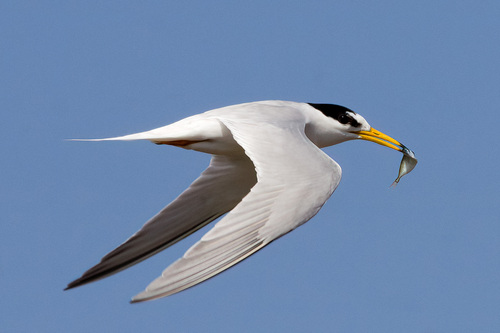
Like most other white terns, little terns feed by plunge-diving for fish, foraging either in coastal saline environments or inland along larger rivers.
Courtship Behavior
During courtship, the male little tern offers fish to the female as part of the display.
Vocalization
This species produces a loud, distinctive creaking call.