About Larus hyperboreus Gunnerus, 1767
Taxonomic Naming
This is the glaucous gull, scientifically named Larus hyperboreus Gunnerus, 1767.
General Appearance
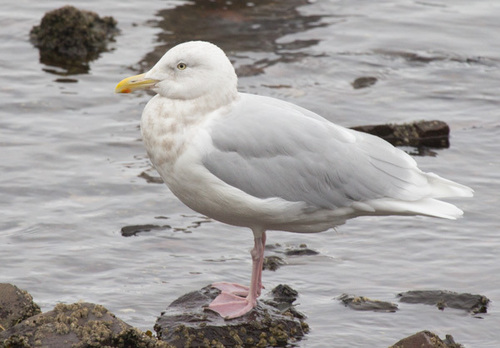
It is a large, powerful gull, the second-largest of all gull species, and is very pale in every plumage stage, with no black markings on either its wings or tail.
Adult Plumage
Adult glaucous gulls are pale grey on their upper bodies, with a thick yellow bill.
Juvenile Plumage
Juveniles are very pale grey, with a pink and black bill.
Size Comparison to Similar Gulls
This species is considerably larger, bulkier, and has a thicker bill than the similar-looking Iceland gull, and can sometimes reach the same size as the great black-backed gull, which is often named the largest gull species.
Weight Comparisons to Great Black-backed Gull
In some areas, glaucous gulls are about the same weight as great black-backed gulls, or even heavier, and the species has a greater maximum weight than the great black-backed gull.
Weight Range
Glaucous gulls weigh between 960 and 2,700 g (2.12 to 5.95 lb).
Historical Average Weights
Historically, average weights have been reported as 1.55 kg (3.4 lb) for males and 1.35 kg (3.0 lb) for females.
Coats Island Colony Weights
At a breeding colony on Coats Island, Canada, glaucous gulls are nearly 15% heavier than other recorded populations. This colony has a mean weight of 1.86 kg (4.1 lb) for five males and 1.49 kg (3.3 lb) for seven females.
Wrangel Island Weights
Another study reported even higher weights for glaucous gulls on Wrangel Island: 9 males reportedly averaged 2.32 kg (5.1 lb), and six females averaged 2.1 kg (4.6 lb).
Potential Size Ranking
If these measurements are accurate, the glaucous gull would be the heaviest gull and shorebird in the world, though it is not known to be the largest in average length.
Length and Wingspan
Glaucous gulls measure 55 to 77 cm (22 to 30 in) in total length, with a wingspan of 132 to 170 cm (52 to 67 in); some individual specimens may reach a wingspan of 182 cm (72 in).
Standard Body Measurements
Standard measurements for the species are: wing chord 40.8 to 50.1 cm (16.1 to 19.7 in), bill length 4.9 to 6.9 cm (1.9 to 2.7 in), and tarsus length 6 to 7.7 cm (2.4 to 3.0 in).
Maturity Period
Glaucous gulls take four years to reach full maturity.
Vocalization
Their call is a "laughing" cry similar to that of the herring gull, but deeper in pitch.
Breeding and Wintering Range
Glaucous gulls breed in Arctic regions of the Northern Hemisphere, and migrate south to winter on shores of the Holarctic.
Core Wintering Regions
They winter across the North Atlantic and North Pacific Oceans, reaching as far south as the British Isles and the northernmost states of the United States, and also winter on the Great Lakes.
Vagrant Range
A small number of individuals sometimes reach the southern United States and northern Mexico.
Nesting Habits
This seagull species breeds either in colonies or as single pairs on coasts and cliffs, building a lined nest on the ground or cliff face.
Egg Characteristics
Typically, females lay two to four light brown eggs marked with dark brown splotches.
Diet Type
Like most Larus gulls, glaucous gulls are omnivores.
Diet Composition
Their diet includes fish, insects, molluscs, starfish, offal, scraps, eggs, small birds, small mammals, carrion, as well as seeds, berries, and grains.