About Larus smithsonianus Coues, 1862
Larus smithsonianus Coues, 1862 is a heavily built large gull with a long powerful bill, full chest, and sloping forehead.
Male Size
Males measure 60–66 cm (24–26 in) in length and weigh 1,050–1,650 g (2.31–3.64 lb).
Female Size
Females are 53–62 cm (21–24 in) long and weigh 600–900 g (1.3–2.0 lb).
Wingspan
This species has a wingspan ranging from 120 to 155 cm (47 to 61 in).
Standard Measurements
Standard measurements are as follows: wing chord 41.2 to 46.8 cm (16.2 to 18.4 in), bill 4.4 to 6.2 cm (1.7 to 2.4 in), and tarsus 5.5 to 7.6 cm (2.2 to 3.0 in).
Breeding Adult Plumage
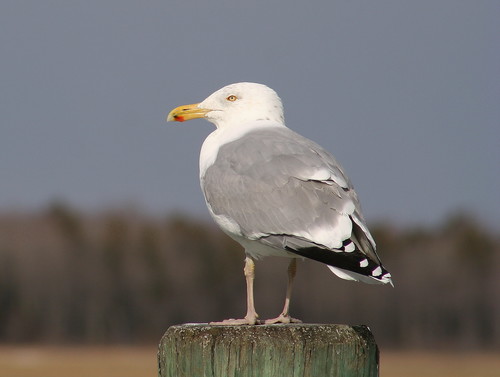
Breeding adults have white head, rump, tail, and underparts, with a pale gray back and upperwings.
Wing Markings
Wingtips are black with white spots called "mirrors", and the trailing edge of the wing is white. The underwing is grayish, with dark tips on the outer primary feathers.
Leg and Bill Features
Legs and feet are normally pink, but can have a bluish tinge, or occasionally be yellow. The bill is yellow with a red spot on the lower mandible.
Eye and Winter Plumage
The eye is bright, pale to medium yellow, surrounded by a bare yellow or orange ring. In winter, the head and neck are streaked with brown.
Immature Plumage Timeline
Young birds take four years to develop fully adult plumage, passing through several plumage stages during this time and often appearing quite variable.
First-Winter Plumage
First-winter birds are gray-brown with a dark tail, brown rump marked with dark bars, dark outer primaries and pale inner primaries, dark eyes, and a dark bill that usually develops a paler base over the winter. The head of first-winter birds is often paler than the body.
Second-Winter Plumage
Second-winter birds typically have pale eyes, a pale bill with a black tip, a pale head, and begin growing gray feathers on the back.
Third-Winter Plumage
Third-winter birds closely resemble adults, but still retain some black on the bill, brown on the body and wings, and have a black band on the tail.
Breeding Range
The breeding range of this gull stretches across northern North America, from central and southern Alaska to the Great Lakes and the northeast coast of the United States, extending south from Maine to North Carolina. It breeds across most of Canada, excluding the country's southwest and Arctic regions.
Year-Round and Winter Range
The species is present year-round in southern Alaska, the Great Lakes, and the northeast United States, but most individuals winter south of the breeding range as far as Mexico. Small numbers reach Hawaii, Central America, and the West Indies.
Vagrant Records
Vagrants have been recorded in Colombia and Venezuela, with additional single reports from Ecuador and Peru. The first European record came from a bird ringed in New Brunswick that was caught on a boat in Spanish waters in 1937, and a number of additional records from Western Europe have been documented since 1990. The first British record was documented in 1994 in Cheshire.
Nesting Habitats
Larus smithsonianus usually nests in colonies near water, on coasts, islands, and cliffs; it also nests on rooftops in some cities.
Feeding Habitats
It feeds at sea, and on beaches, mudflats, lakes, rivers, fields, and refuse dumps.
Roosting Habitats
It roosts in open areas located close to feeding sites.
Pair Formation
Pairs form in March or April.
Nest Construction
The nest is a ground scrape lined with vegetation, including grass, seaweed, and feathers.
Egg Characteristics
Most clutches contain three eggs, laid over a 4–6 day period. Eggs measure 72 mm (2.8 in) long, and vary in color, with brown markings on a pale blue, olive, or cinnamon background.
Incubation Period
Incubation lasts 30–32 days, starting when the second egg is laid.
Fledging Period
Young birds fledge after 6–7 weeks, and continue to be fed in the nest area for several more weeks. Parental care continues until the young are around 6 months old.
Parental Roles
Both parents participate in nest building, incubating eggs, and feeding the young.
Pair Bonding
Some pairs have been observed forming a close bond, staying within watchful proximity of each other year-round; other gulls are more independent, but may reuse the same mate each spring.